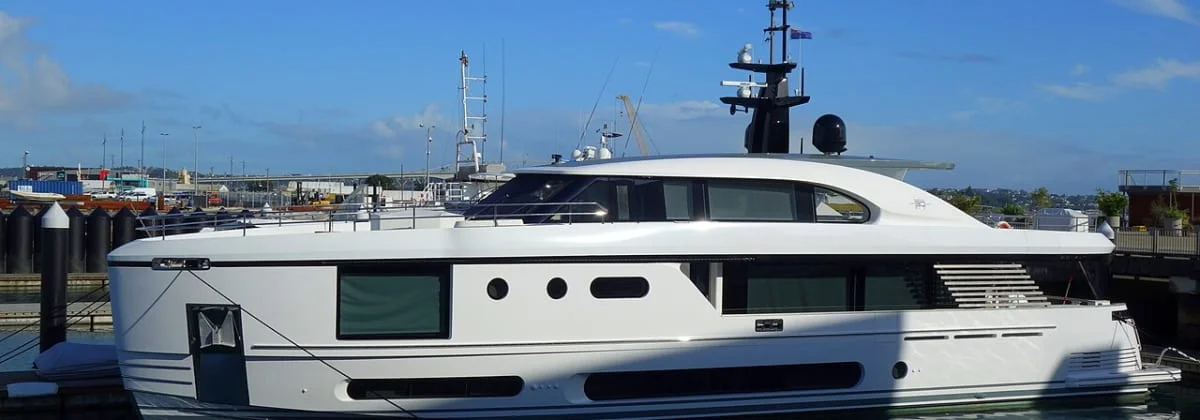
Quick answer: Azimut Yachts is the production and semi-custom motor yacht arm of the Azimut-Benetti Group, the world’s #1 private yacht builder by the BOAT International 2026 Global Order Book, with 163 active projects totalling 5,924 metres (Source: BOAT International 2026 GOB) across both Azimut and Benetti brands. For buyers seeking an Italian production motor yacht in the 10m-35m range, Azimut offers the widest model depth of any single European builder, a dense global dealer and service network, and one of the most liquid secondary markets in brokerage.
The Azimut-Benetti Group: Scale and What It Means for Buyers
The Azimut-Benetti Group, founded by Paolo Vitelli in 1969 and still privately held, holds the #1 position in the BOAT International 2026 Global Order Book with 163 active projects totalling 5,924 metres (Source: BOAT International 2026 GOB), ahead of every other private and listed competitor.
This scale has direct consequences for what you pay and what you get. The group’s purchasing power with engine and electronics suppliers (Volvo Penta, MAN, Garmin) translates to pricing that smaller builders cannot match at equivalent spec. The warranty and service network spans 130+ countries. And the group’s financial stability, rare among yacht builders, who have a long history of insolvency, means warranty commitments made at contract carry real weight.
Azimut itself (the production brand, as distinct from Benetti) targets the 10m-35m segment, producing roughly three to five times more hull units per year than Benetti. The majority of Azimut’s 163 combined GOB projects are in the 24m-35m Grande sub-range; the higher-volume sub-24m production runs outside the GOB tracking threshold but represents the largest unit count in the Azimut model portfolio.
The Azimut Range: From Entry Production to Grande
Azimut covers more of the market than any other Italian builder, from entry production flybridge models through the Magellano displacement line to the Grande semi-custom range above 25m. That breadth is why the brand appears in almost every used shortlist between 40ft and 100ft.
Azimut’s model architecture splits into three product lines, each with a distinct buyer logic.
Flybridge Series (34ft to 72ft), this is the core of the brand and the highest-volume line globally. Wide beams for salon volume, open galley-to-salon layouts, substantial aft cockpits, and well-equipped flybridge stations with sunpad aft. The range runs from the Azimut 34 (10.3m) through the Azimut 72 (21.9m). The 50-65ft bracket is where the money is, strongest unit sales and deepest resale liquidity on the secondary market.
S Series, the sport/express line sits lower, runs faster, and looks more aggressive than the Flybridge. The S6 (18.4m) and S7 (20.9m) are the headline models, both running IPS drives for higher cruise speeds and lower windage profiles. Brokers know the S series carries a narrower resale market than the Flybridge, fewer are built, fewer come up for sale, and the buyer pool is smaller. If you plan to sell within 5 years, factor that in.
Azimut’s Triple series (the aluminium-hulled predecessors to the current S range) changed the brand’s resale dynamics, the aluminium hulls hold up significantly better than the older GRP S-range in tropical waters, and buyers in the Caribbean and Southeast Asia actively seek them out over newer GRP models.
Grande Series (21M, 27M, 32M, 35M), the semi-custom line where Azimut overlaps with entry-level Benetti. Grande hulls use standardised naval architecture but each vessel is finished to individual owner specification: galley placement, master cabin configuration, tender garage design, and finish materials are all negotiable at contract stage. The Grande 35M is the ceiling of the Azimut range before the buyer transitions to Benetti’s 37m+ programme. Grande build contracts run 18-30 months with milestone payment structures.
| Model Series | Length Range | Approx. Price Range | Primary Market |
|---|---|---|---|
| Flybridge | 10.3m to 21.9m | €300K-€2.8M | Mediterranean, Atlantic |
| S Series | 18.4m to 20.9m | €2.0M-€3.2M | Med sport, performance |
| Grande | 21.2m to 35m | €2.5M-€8M+ | Semi-custom buyers |
Who Buys Azimut: Buyer Profile and Decision Framework
The typical first-time Azimut buyer is moving up from a 10-14m bowrider or cruiser, aged 40-55, using the boat primarily in the Mediterranean or Caribbean. They gravitate toward the Flybridge 50-65ft range because these boats are designed for living, not driving, generous space for family and guests, with the assumption that crew will handle the manoeuvring.
Second-yacht buyers upgrading from a 45-55ft vessel look at the Azimut 72 or entry Grande range. At this stage, specification becomes a real conversation: engine choice (Volvo IPS versus conventional shaft), generator sizing, tender arrangements, and satellite communications are all live decisions rather than standard-fit items.
Grande buyers are the most experienced segment, typically second or third yacht owners who know the survey and sea trial process cold. Most work with an independent buyer’s representative alongside the yard project manager and travel to Fano or Viareggio at least once during the build for specification reviews.
New-Build Process at Azimut
Buying a new Azimut production yacht follows a more standardised process than a full custom build, but the specifics vary by model tier.
For Flybridge and S series: Initial contact is typically via the authorised dealer network. Azimut does not sell directly to end buyers, the dealer takes the order, confirms production slot availability, and manages the customer relationship through delivery. Specification options are constrained to the options list defined for that model year; the buyer selects from pre-engineered packages rather than specifying from blank. Deposits are typically 20-30% at order confirmation, with the balance due at delivery. Lead times for in-production models range from 6-14 months; out-of-cycle orders for the following model year may run longer.
For Grande: The process moves closer to a custom build. The buyer engages Azimut’s Grande project team directly (often with dealer facilitation), negotiates a bespoke specification, and signs a staged-payment contract with milestones at contract, keel-lay, launch, and delivery. Change orders after steel cut are possible but carry cost and schedule penalties, the same discipline applies here as with Benetti or Sanlorenzo. An independent owner’s representative is advisable from contract negotiation onwards.
An in-production Azimut slot, or a specific second-hand hull?
We connect buyers with dealer allocation and brokerage inventory globally, and price the wait against what is already on the water.
The Azimut Resale Market: Liquidity and Value Retention
Azimut’s resale performance is a structural advantage that the brand’s marketing underuses. The scale of the Azimut fleet globally, tens of thousands of units built over 50+ years, creates a deep, well-understood secondary market where surveyors, brokers, and insurers have established valuation references across virtually every model. This liquidity is a genuine financial benefit to buyers.
Value retention for Azimut production models follows predictable patterns:
- Year 0-2: Depreciation is steepest, typically 15-25% off MSRP in the first two years as the yacht moves from new to pre-owned categorisation in the broker market.
- Years 3-7: The rate of depreciation slows significantly. A well-maintained Azimut Flybridge 55 at year 5, with low engine hours and documented service history, commonly retains 55-68% of its original price in Mediterranean brokerage.
- Years 8-15: Values stabilise at a lower plateau dependent on system condition, refit history, and model desirability. Azimut models from this era with documented refit work (new upholstery, updated electronics, engine service) can carry premiums of 8-15% over non-refitted comparable examples.
The Mediterranean market, Italy, France, Croatia, Spain, Greece, carries the largest concentration of Azimut resale inventory globally, with the Italian market typically offering the widest choice and most competitive pricing given the proximity to the production network and the density of buyers. The US market (Fort Lauderdale, Miami, Palm Beach) is the second most active Azimut resale hub, with strong appetite in the 45-65ft range from Florida-based buyers.
When buying a used Azimut, the pre-purchase survey is non-negotiable. Azimut’s GRP construction is generally robust, but areas requiring attention include: osmosis survey of the hull below the waterline (particularly on units from the 1990s-early 2000s), gel coat condition on deck surfaces (UV degradation is aggressive in Mediterranean and Caribbean service), pod drive or IPS drive condition if fitted, and generator service history. Budget €25-40 per foot for a thorough condition survey on a mid-size Azimut.
Running Costs and Ownership Realities
Annual running costs for an Azimut motor yacht vary significantly by size and use pattern, but the following ranges provide planning benchmarks:
Azimut Flybridge 50-60ft (private owner, 200-400 hours annually, Med-based):
- Berth/marina: €15,000-€40,000 per year depending on location and season
- Insurance: €8,000-€20,000 annually (varies with hull value, area of navigation, owner experience)
- Maintenance and service: €15,000-€35,000 annually including engine services, antifouling, and minor repairs
- Fuel: highly variable, budget €12,000-€30,000 for moderate coastal use
- Total indicative annual running cost: €50,000-€120,000, or approximately 8-14% of the vessel’s current market value
Azimut Grande 32M (privately owned, professional captain, Med-based):
- Crew (captain + 1-2 crew): €120,000-€200,000 annually
- Berth/marina at a premium Med port: €60,000-€120,000 per year
- Insurance: €50,000-€90,000 annually
- Maintenance: €80,000-€150,000 annually
- Total indicative annual running cost: €350,000-€650,000, approximately 10-16% of hull value
The charter offset option is available to Azimut owners in many markets: placing the yacht on a managed charter programme through accredited operators can offset 30-60% of annual running costs in exchange for a period of commercial availability. The economics depend heavily on the yacht’s condition, location, season, and management agreement terms.
Azimut vs the Competition: Honest Assessment
In the 45-72ft range, Azimut’s primary European competitors are Sunseeker (UK) and Princess (UK). In the larger Grande segment, Sanlorenzo, Ferretti, and entry Benetti are the relevant comparisons.
Against Sunseeker: Azimut typically offers slightly more interior volume per overall length due to fuller beam plans and lower freeboard profiles. Sunseeker counters with more aggressive sportfisher-influenced styling, strong UK build quality, and a slightly stronger position in the UK domestic market and British buyer segment globally. Resale liquidity is broadly comparable in European markets; Sunseeker has a slight edge in UK-specific brokerage.
Against Princess: Princess flybridge models, particularly the F-class, compete directly with Azimut’s core Flybridge line. Princess has the advantage of Plymouth build quality perception among British buyers and tends to hold values slightly better in UK auction and brokerage. Azimut counters with lower base pricing in most European markets and a denser dealer network in southern Mediterranean countries where the bulk of usage occurs.
Against Sanlorenzo: At the Grande/semi-custom level, Sanlorenzo’s SX range sits at a premium over Azimut Grande, higher price, more limited production, and a stronger resale story. The Sanlorenzo SX88 and Azimut Grande 27M compete directly, and the brokerage market verdict so far gives Sanlorenzo the edge on resale, their deliberate volume restraint keeps supply low, which props up prices. The counter-argument for Azimut Grande is tangible: wider global service network, faster parts availability, and a purchase price that’s typically 10-15% lower at equivalent spec.
Why choose Azimut over the competition? If your primary cruising ground is the Mediterranean and you want the widest dealer coverage, fastest parts availability, and deepest resale pool in Italian brokerage, Azimut is the default. The brand’s scale is the advantage: no other single European builder has this depth of after-sales support in the 10-35m range. Where Azimut loses ground is to buyers who want semi-custom exclusivity or performance styling, those buyers pay more at Sanlorenzo or Sunseeker, respectively, and get something more distinctive.
Source Note for Azimut Yachts
For Azimut Yachts, brand, order-book, resale, and running-cost references are buyer-intelligence benchmarks, not manufacturer representations or live inventory. Confirm current delivery slots, warranty terms, closed-sale comparables, and service support with the yard, central agents, and independent surveyors.
Related Guides
Red Flags and Buyer Checklist
Before the deposit, settle the questions that decide an Azimut’s resale rather than its first impression.
- Red flag specific to Azimut: a model-year listing where the interior and electronics package does not match the build sheet, which affects both resale and warranty.
- Ask which yard in the group built the hull and confirm the service file names the same one.
- Confirm the regional dealer still supports the model year, warranty and parts run through appointed dealers rather than the yard.
- On the S and Grande lines request a composite survey of the superstructure, not a visual walkthrough.
- Compare the same model listed in Italy before accepting a location premium elsewhere.
- Request drive service records alongside engine hours, pods and shafts age differently under the same use.
Brand-level resale sits inside a wider cycle: the used yacht market report 2026 covers current days-to-sell by segment.
Model-range context sits alongside the type guides: flybridge yachts covers the configuration most Azimut buyers end up in, and motor yachts the wider category. Running costs are in the yacht ownership cost guide.
Frequently Asked Questions
Both brands are owned by the same parent company, Azimut-Benetti Group, the world's #1 private yacht builder by the BOAT International 2026 Global Order Book with 163 active projects totalling 5,924 metres (Source: BOAT International 2026 GOB). Azimut is the production and semi-custom division, covering roughly 10m to 35m vessels built across standardised platforms with factory customisation options. Benetti is the custom and superyacht division, focused on vessels from 37m upward built to bespoke owner specifications. Buyers in the 10m-35m range work with Azimut; buyers above 37m move to Benetti.
Entry Azimut production models in the 34-40ft range start from approximately €300,000-€550,000 ex-yard. The popular flybridge series in the 45-65ft range typically falls between €750,000 and €2.5M depending on length, specification, and current production allocation. Azimut Grande models (21m-35m) range from approximately €2.5M to €8M+. All figures are before VAT, which applies to EU buyers using the vessel in EU waters, and before options, delivery, and commissioning costs.
Azimut has one of the strongest secondary markets among production motor yacht brands, driven by wide global distribution, standardised parts availability, and strong brand recognition. A well-maintained 5-year-old Azimut Flybridge in the 50-65ft range typically retains 55-70% of its original MSRP depending on specification, engine hours, and market condition. The Mediterranean brokerage market, particularly in Italy, France, Croatia, and Spain, carries the largest volume of Azimut resale inventory globally.
Azimut production is consolidated across two main Italian facilities: the Avigliana plant near Turin handles design, engineering, and composite fabrication for smaller hull moulds, while the Fano facility on the Adriatic coast near Pesaro handles final assembly, fit-out, and commissioning for the broader range. Some Grande-series hulls are outfitted at the Viareggio/Livorno corridor, where Benetti also operates. All Azimut production remains in Italy, the brand has not offshored fabrication.
In the 45-65ft flybridge segment, Azimut competes directly with Sunseeker and Princess. Azimut typically positions slightly lower on initial purchase price than equivalent Princess models but with comparable build quality for Mediterranean-use buyers. Sunseeker's styling tends toward the more aggressive and sporty end; Azimut favours softer Italian aesthetics with larger interior volume per foot. Resale liquidity is broadly similar across all three in the European market, with slight advantages for Azimut in southern Mediterranean broker networks.
Yes, the Azimut Grande series (21M, 27M, 32M, 35M) is positioned as semi-custom: the hull and structural platform are standardised for production efficiency, but interior layout, specification choices, colour, upholstery, and technical options are negotiated individually with the yard. Lead times for Grande models currently run approximately 18-30 months from contract signing, varying by production slot availability and specification complexity. A buyer's representative is advisable for Grande contracts given the change-order process.
Request a yacht buyer consultation
Share your budget, target LOA, and use case. We reply within one business day with matched brokers or surveyors.