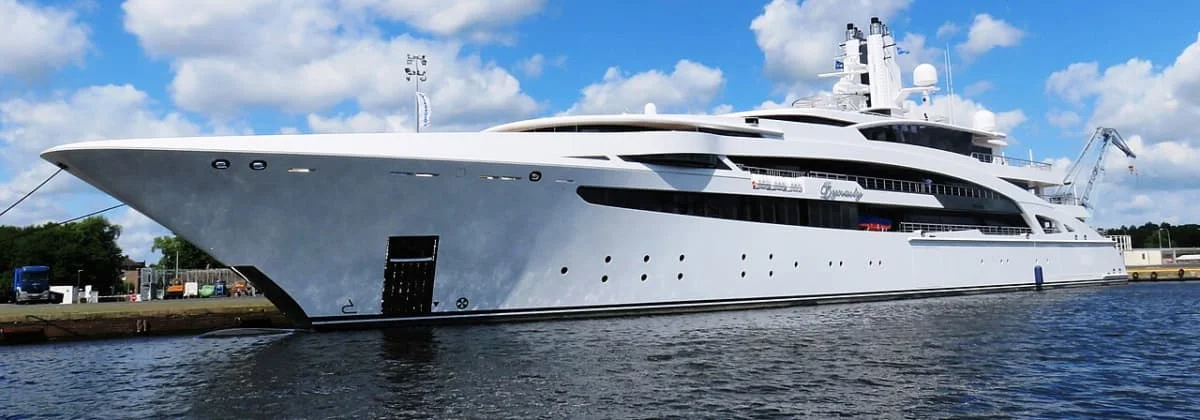
Quick answer: A yacht refit is a defined yard project that changes the vessel’s condition, systems, or layout, not routine servicing. Budget from $150K for a 50ft cosmetic refresh to seven figures for machinery and interior rebuilds. Allow 3-6 months for serious work and 20-30% contingency for discoveries. Control scope in writing before haul-out.
What Is a Yacht Refit?
Refit covers everything from a paint job to a rebuild, which is why quoted figures vary so widely. Defining which one you mean is the first step in budgeting it.
A refit is planned yard work that goes beyond scheduled maintenance: paint systems, teak renewal, interior redesign, machinery overhaul, electronics architecture, stabilizer retrofits, or layout changes. It restores market appeal, fixes deferred defects, or upgrades capability.
The global yacht refit and maintenance market was estimated at $2.9B-$6.8B in 2025 (Source: FMI / industry reports). Refit-only estimates near $2.7B in 2024 illustrate how scope definition changes the number, for owners, the relevant figure is the yard quote on your hull, not the macro market.
This guide covers refit planning for yachts roughly 40ft to 40m. For 40m+ megayacht programmes with class survey cycles and hundred-million-euro scopes, see the Megayacht Refit Guide. For annual service budgets between refits, see the Yacht Maintenance Cost Guide.
When Should an Owner Refit Instead of Replace?
Refit where the hull and machinery are sound and the fatigue is cosmetic or cosmetic-plus-interior; replace where the structure is in question. Engine hours under 60% of rated life, an obsolete interior on a strong hull, or cosmetic tiredness with sound mechanics all favour refit. Structural findings such as osmosis or wet core are case-by-case and more often point to replacement.
| Trigger | Refit often makes sense | Replace often makes sense |
|---|---|---|
| Cosmetic fatigue, sound mechanics | Yes | n/a |
| Obsolete interior, strong hull | Yes | n/a |
| Engine hours under 60% life | Yes | n/a |
| Structural issues (osmosis, core) | Case-by-case | Often yes |
| Repower + systems + interior combined | If discount on purchase | If refit exceeds 40% of replacement |
| Regulatory obsolescence | Rare | Usually yes |
Buyer scenario: A 52ft 2010 motor yacht at $1.1M needing $250K paint/teak/interior refresh may be rational. The same vessel needing repower ($180K), stabilizer retrofit ($120K), and generator replacement ($80K) plus cosmetics pushes $500K+, at that point a newer $1.6M alternative deserves comparison. Model this before offer using survey input from the yacht survey checklist.
What Are the Main Refit Scope Categories?
Refit scope divides into a handful of categories that behave very differently on cost and on schedule. Knowing which ones your project touches is what makes a contingency figure mean anything.
Cosmetic refit
- Awlgrip or polyurethane repaint
- Teak deck sand and recaulk
- Interior soft furnishings and joinery refresh
- Stainless and hardware polish/replace
Indicative range (50-65ft): $150K-$400K · Timeline: 6-14 weeks
Machinery refit
- Engine rebuild or repower
- Generator replacement
- Stabilizer install or overhaul
- Fuel tank treatment or replacement
Indicative range (50-65ft): $200K-$800K · Timeline: 8-20 weeks
Interior refit
- Galley and heads rebuild
- Layout changes (bulkhead moves, naval architect required)
- AV/IT backbone replacement
- Lighting and climate upgrades
Indicative range (55-75ft): $250K-$1.2M · Timeline: 12-30 weeks
Structural / class works
- Osmosis treatment
- Keel bolt inspection and renewal
- Classification society survey items
- Extension or major modification
Indicative range: Highly variable · Timeline: 3-18 months
Evaluating a yacht that needs yard work?
We help buyers separate cosmetic refit from machinery risk before the survey deposit is spent.
How Much Does a Yacht Refit Cost by Size?
Refit cost spans roughly a five-fold range at any given length depending on depth of scope. A 50-65ft yacht runs $150K-$350K for light cosmetic work, $350K-$750K for cosmetic plus a systems touch, and $750K-$1.5M for a deep refit. At 24-30m the deep-refit band starts at $2.5M, which is where refit-versus-replace becomes a genuine financial question.
| LOA band | Light cosmetic | Full cosmetic + systems touch | Deep refit |
|---|---|---|---|
| 40-50ft | $80K-$200K | $200K-$450K | $400K-$900K |
| 50-65ft | $150K-$350K | $350K-$750K | $750K-$1.5M |
| 65-80ft | $250K-$500K | $500K-$1.2M | $1.2M-$2.5M |
| 24-30m (80-100ft) | $400K-$900K | $900K-$2.5M | $2.5M-$6M+ |
All figures indicative, ex-yard, ex-owner’s rep, ex-class fees. Add 20-30% contingency.
Refit commonly reaches 10-25% of vessel value for serious work, similar framing to megayacht programmes but at different absolute numbers.
How Do You Select a Refit Yard?
Yard selection starts with physical fit and ends with communication, and getting the order wrong wastes a season. Confirm LOA, beam and draft against the travel lift or dry dock first, then scope capability, since a paint-only yard cannot take mechanical work. Class society authorisation is mandatory for classed yachts, and workforce language and time zone decide how the project is actually run.
| Criterion | Why it matters |
|---|---|
| LOA / beam / draft limits | Physical fit in travel lift or dry dock |
| Scope capability | Paint-only yards vs full mechanical |
| Class society authorization | Required for classed yachts |
| Workforce language and timezone | Communication during project |
| Parts logistics | Proximity to OEM distributors |
| Hurricane / weather risk | Florida summer vs Med winter |
Regional yard clusters (indicative, not exhaustive)
| Region | Known for | Typical LOA sweet spot |
|---|---|---|
| South Florida | Paint, mechanical, sportfish | 40-120ft |
| Turkey (Tuzla, Marmaris) | Value refit, steel/aluminium | 24-50m |
| Spain / Palma | Med owners, quality paint | 50-90ft |
| Italy (La Spezia, Viareggio) | Premium joinery | 60ft+ |
| Netherlands | Technical precision | 70ft+ |
Owners cruising the US East Coast often combine Florida yard periods with Marina Berth Cost planning for the downtime window.
What Should a Refit Contract Include?
Six clauses decide whether a refit stays on budget, and the discovery clause is the one owners most often omit. Fix the scope document with drawings and specification attachments, state the price basis explicitly, tie milestone payments to progress, require written approval before extra work, agree in advance how hull-opening findings are priced, and secure a workmanship warranty of typically 12 months.
- Fixed scope document with drawings and spec attachments
- Price basis: fixed, estimate + T&M cap, or day rate with ceiling
- Timeline with milestone payments tied to progress
- Change order procedure: written approval before extra work
- Discovery clause: how hull opening findings are priced
- Warranty on yard workmanship (typically 12 months)
- Insurance: yard liability and vessel cover during stay
- Dispute resolution: jurisdiction and expert surveyor mechanism
Red flag: Unlimited time-and-materials without a cap. Owners have lost control of seven-figure projects on T&M with weak change-order discipline.
How Should Owners Control Refit Timeline?
Yard slot booking, at 4-52 weeks of lead time, is the longest and least controllable phase of a refit. Pre-refit survey and scoping take two to four weeks and under-scoping there propagates through everything after; haul-in and strip take one to two weeks and is where discovery findings appear; production runs to scope and is then hostage to parts delays.
| Phase | Duration | Risk |
|---|---|---|
| Pre-refit survey and scope | 2-4 weeks | Under-scoping |
| Yard slot booking | 4-52 weeks lead time | Peak season queues |
| Haul-in and strip | 1-2 weeks | Discovery findings |
| Production | Per scope | Parts delays |
| Sea trial and snag | 1-2 weeks | Incomplete commissioning |
| Redelivery | 1 week | Documentation gaps |
Insider tip: Book the yard slot before finalising scope detail, prime yards in Palma and Fort Lauderdale fill 6-12 months ahead. Scope can refine while waiting; losing the slot cannot.
Refit vs Buying Used: The Discount Test
A refit only makes sense when the discount on the tired yacht exceeds the refit quote plus contingency plus the value of the season lost to the yard. Run that arithmetic explicitly before committing, because it fails more often than it passes.
Required discount ≥ (refit quote + contingency + lost season value)
| Item | Example (55ft yacht) |
|---|---|
| Yard quote | $320,000 |
| Contingency 25% | $80,000 |
| Lost season (charter or use) | $50,000-$150,000 |
| Minimum rational discount | $450K-$550K |
If asking price is only $200K below clean comparables, you are subsidising the seller’s deferred maintenance.
Used yacht buyers should integrate refit modelling into the used yacht buying guide workflow before deposit.
- Structural modifications
- Repower with different horsepower
- Commercial charter conversion
- Major electrical architecture changes
Flag states may require re-inspection after modifications affecting stability or safety equipment. Plan class and flag touchpoints in scope, not as afterthoughts at redelivery.
See Yacht Insurance Guide for how condition affects premiums post-refit.
Owner’s Representative: Role and Cost
On any refit above $300K an independent owner’s representative usually saves more than the fee. Day rates run $400-$1,200 depending on experience, and project fees run 8-15% of the yard invoice on larger refits. What the fee buys is change-order control, quality hold points and snag management, which is precisely where a refit budget is won or lost.
- Day rate: $400-$1,200 depending on experience
- Project fee: 8-15% of yard invoice on larger refits
- Value delivered: Change-order control, quality hold points, snag management
On any refit exceeding $300K, an independent owner’s rep often saves more than their fee in prevented scope creep.
Insurance and Class While the Yacht Is in the Yard
A yacht in a shed is a different risk from a yacht on a mooring, and most standing policies say so. Tell the underwriter before the boat is lifted rather than after.
Three things usually need attention. Cover during works is normally endorsed rather than assumed: hot work, paint and open tanks all change the fire position, and an underwriter who learns about them from a claim is entitled to ask why. The yard’s own liability covers the yard’s negligence and not much else, so read what its standard terms exclude before signing. Class continuity matters on any vessel that carries it: work that touches structure, machinery or fire systems may need class attendance while it is open, and a survey done after the panel is closed costs the panel again.
The same applies to flag. Structural changes and anything affecting tonnage may require a re-measure, and an unnoticed change here follows the yacht to its next sale.
Put all of it in the contract’s insurance clause rather than in an email.
Post-Refit: Documentation for Resale
A refit adds resale value only to the extent it can be evidenced, so build the pack as the work happens. Record what was replaced against what was refurbished, who performed engine work and whether it was OEM or yard, and whether paint and teak warranties are transferable. A next buyer’s surveyor prices documented work and discounts undocumented work.
- What was replaced vs refurbished?
- Who performed engine work, OEM or yard?
- Are paint and teak warranties transferable?
- Is there a post-refit survey report?
Archive invoices, photos, and survey sign-off in the vessel’s technical file. Poor documentation erases refit value at resale.
How Do Refit Discoveries Change the Budget?
Refit overruns come mostly from what the yard finds once the boat is opened up, not from owners adding scope. Knowing which discoveries are common on a hull of a given age is what turns a contingency figure into an informed one.
Yard discoveries are the primary driver of refit overruns, not owner scope creep alone.
| Discovery type | Frequency on 15+ year yachts | Typical cost impact |
|---|---|---|
| Corroded exhaust risers | Common | $8K-$25K |
| Wet deck core (GRP) | Moderate | $20K-$80K |
| Obsolete switchboards | Common | $15K-$45K |
| Tank contamination | Moderate | $5K-$30K |
| Stabilizer seal wear | LOA-dependent | $12K-$40K |
Contract discovery clauses should specify: yard pauses, owner approves supplemental quote within 48 hours, or work stops at agreed hold point. Without pause rights, the yard proceeds and invoices.
Survey before refit, not only before purchase, reduces discovery shock. A $4K pre-refit survey on a 60ft yacht can surface $80K of hidden scope before the yard contract is signed.
Refit Scope Levels and Cost Bands
Refit scope divides into three levels with sharply different cost and yard time. A cosmetic refresh covering exterior paint and soft interior is the most predictable; machinery-heavy work with paint and interior is where budgets and schedules both fail.
Level 1: Cosmetic refresh (exterior + soft interior)
| LOA | Indicative total | Typical inclusions |
|---|---|---|
| 40-45 ft | $80K-$180K | Wash, spot paint, teak refresh, soft goods |
| 50-60 ft | $150K-$350K | Full exterior paint, teak, upholstery select |
| 65-75 ft | $250K-$550K | Paint, teak, galley touch, AV refresh |
| 80-90 ft | $400K-$900K | Full cosmetic, tender garage paint |
Timeline: 6-14 weeks. Contingency: 20-25%.
Level 2: Systems and machinery (no full interior gut)
| LOA | Indicative total | Typical inclusions |
|---|---|---|
| 45-55 ft | $200K-$500K | Generator, AC, engines partial, electronics |
| 55-65 ft | $350K-$800K | Stabilizer retrofit, engine major, hydraulics |
| 65-80 ft | $500K-$1.2M | Multi-system overhaul, tank work |
Timeline: 3-6 months. Contingency: 30-35%.
Level 3: Deep refit (interior + machinery + paint)
| LOA | Indicative total | Notes |
|---|---|---|
| 50 ft | $500K-$1.1M | Layout changes add cost fast |
| 60 ft | $700K-$1.8M | Often approaches superyacht PM needs |
| 70 ft+ | $1M-$3M+ | See megayacht refit guide |
Timeline: 6-18 months. Contingency: 35-40%.
Paint Systems: What Owners Get Wrong
Paint is the refit line owners most consistently underestimate, because most of the invoice is not paint. Surface preparation, fairing and sanding account for 40-60% of the cost, and a colour change adds a premium beyond the material itself.
- Surface prep share, 40-60% of paint invoice is fairing and sanding, not colour coats
- Colour change premium, dark hulls absorb heat; may affect interior climate load
- Teak interface, recaulking should align with paint window to avoid water ingress at deck joints
- Warranty conditions, yard paint warranty often void if owner drags fenders or defers washdown
Request written paint specification: primer system, coat count, fairing standard, and warranty exclusions.
- Yard hull and paint team
- Independent joinery shop
- AV integrator
- Upholstery contractor
- Classification surveyor (if classed)
The owner’s rep must hold the critical path schedule, not assume the yard coordinates subcontractors it does not employ. Delay in AV cable pulls after joinery closure is a classic 3-week snag. Contract should name who schedules whom, and who pays standby if one trade waits on another. Without that clause, the owner pays every trade’s idle days while pointing at the yard.
Refit Planning Checklist
| Step | Action |
|---|---|
| 1 | Commission pre-refit condition survey |
| 2 | Define must-have vs nice-to-have scope |
| 3 | Request three yard quotes on identical scope |
| 4 | Check travel lift capacity and insurance |
| 5 | Appoint owner’s rep or confirm captain capacity |
| 6 | Negotiate contract with change-order caps |
| 7 | Fund 25% contingency reserve |
| 8 | Plan redelivery sea trial and snag list |
| 9 | Update insurance and registry if required |
| 10 | Archive documentation for future sale |
Refit or walk away?
Share the listing and survey summary, we help buyers run the discount test before closing.
Frequently Asked Questions
Scope decides it: roughly $150K to $400K for cosmetic work on a 50ft yacht, and $500K to $1.5M+ once machinery and interior are included. At 24 to 30m the deep-refit band starts around $2.5M, which is where refit against replace becomes a genuine financial question. Global refit market estimates range $2.7B to $6.8B depending on definition. Fix the specification before any yard quotes, and treat a provisional sum above 10 percent of the total as an unresolved question.
Maintenance is scheduled upkeep that keeps the yacht where it is; a refit materially changes its condition or capability. They run on different clocks and should be reserved for separately. An annual yard period costs 0.5 to 1.5 percent of value every year, while five-year survey works run 2 to 8 percent, an interior refresh 3 to 10 percent every 7 to 12 years, and a repower 15 to 25 percent at 15 to 25 years.
Cosmetic work runs 6 to 12 weeks, machinery and paint 3 to 5 months, and deep interior or structural work 6 to 12 months. The uncontrolled item is the yard slot itself, at 4 to 52 weeks of lead time depending on season. Add contingency for discovery findings once the structure is opened and for parts delays, which is where a fixed production schedule usually slips.
Only where the purchase discount exceeds the refit quote plus contingency plus the value of the season you lose. Contingency should scale with how much gets opened: 20 percent for cosmetic work, 30 percent once machinery is opened, and 35 to 40 percent for structural or tank work. Model all of it before the MOA, because a refit project bought at survey stage is far cheaper to walk away from than to unwind.
The owner needs an independent representative or a genuinely capable captain, not the yard, on any serious refit. Day rates run $400 to $1,200 and project fees 8 to 15 percent of the yard invoice on larger work. On anything above roughly $300K an independent rep usually saves more than the fee through change-order control, quality hold points and snag management. Add a surveyor for class items.
This guide covers roughly 40ft to 40m, where the owner is the project client and the decisions are scope, yard and contingency. Above 40m the work becomes a class-supervised programme with different contracting, oversight and cost structure, covered in the megayacht refit guide. The dividing line is practical rather than exact: once class attendance drives the schedule, the larger-yacht process applies.
Request a yacht buyer consultation
Share your budget, target LOA, and use case. We reply within one business day with matched brokers or surveyors.