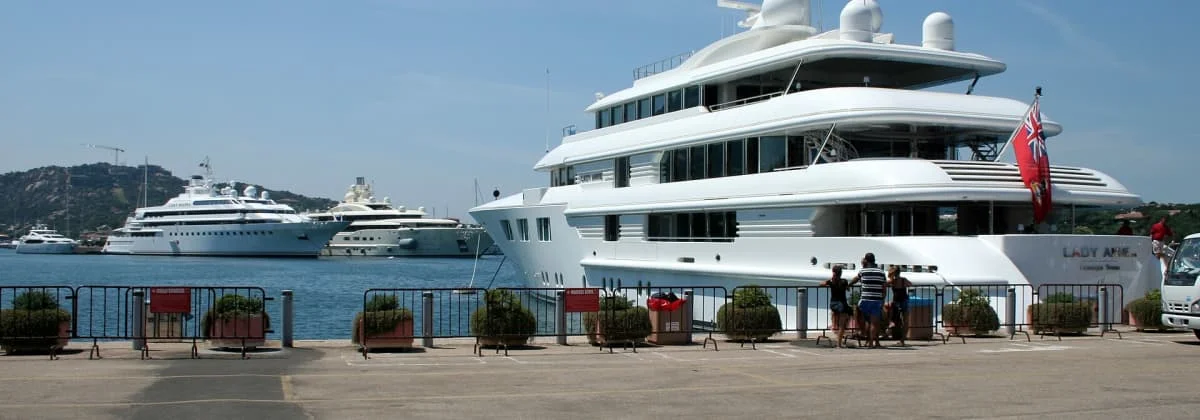
Quick answer: The Mediterranean is one cruising ground and half a dozen tax jurisdictions, and the second fact governs ownership more than the first. Berth capacity is concentrated in a few places, the peak season lasts about 14 weeks, and each country charges differently for the privilege of being in it.
Where Does the Capacity Actually Sit?
In three places, and thinly everywhere else. Port Vauban in Antibes holds more than 1,500 berths across a range from 4.5 to 165 metres. Palma combines Europe’s largest refit yard with the moorings around it. Croatia’s ACI chain runs 22 marinas, the largest single operator in the sea.
Set that against Greece, where the largest marina in the country and the Balkans holds about 1,100 berths with roughly 50 for yachts over 25 metres, and the imbalance becomes the planning problem of the region.
| Region | Capacity position |
|---|---|
| French Riviera | Antibes has the berths; Monaco allocates about 700 |
| Balearics | Yard capacity first, berths expensive in season |
| Adriatic | ACI’s 22 marinas, consistent and concentrated |
| Greece | Around 1,100 at the largest facility, nationwide scarcity |
| Turkey | Modern marinas at lower cost, outside the EU |
Which Tax Decides Your Year?
The one attached to where the boat sits and who uses it. Three regimes account for most of the surprises in this sea, and each is settled by facts created at purchase rather than by decisions made afterwards.
| Country | The rule that matters |
|---|---|
| Spain | 12% matriculation tax on vessels over 8 m, residents caught regardless of flag |
| Italy | Charter VAT relief requires proven navigation outside EU waters since November 2020 |
| Greece | TEPAI charged monthly by length on vessels over 7 m |
| Croatia | Vignette on first entry, plus a sojourn tax by length and stay |
| Turkey | Outside the EU customs territory, with the consequences in both directions |
Our Spain yacht market, Italy yacht market and Greece yacht market pages set out each in detail.
What Does the Fourteen-Week Season Really Cost?
A full year of ownership divided by a quarter of one. Peak demand concentrates from mid-June to mid-September, extended in the west by the Cannes and Monaco shows and in the east by a warmer autumn, and every berth, crew contract and insurance premium runs for twelve months regardless.
That arithmetic is what pushes owners toward the eastern and southern edges of the basin, where the same annual budget buys more weeks. It is also why the cost-per-day comparison matters more than the headline berthing rate.
- Model the season by days of actual use, not by annual cost.
- Count the shows if the boat is for sale, because they extend the useful period.
- Consider a longer eastern season against a shorter western one.
- Remember that crew and insurance do not stop in October.
Where Should a Yacht Winter?
Where the yards are, which is rarely where the summer was. The pattern most owners settle into is to cruise the eastern Mediterranean or the islands through the season and to winter in Palma, Italy or Turkey, where the capacity to do actual work exists.
| Wintering option | What it offers |
|---|---|
| Palma | Europe’s largest refit capacity, Spanish tax regime |
| Italy | Builder-adjacent service for Italian hulls |
| Turkey | Lowest labour cost, outside the EU customs territory |
| The Riviera | Convenient, expensive, and short of slack |
Our Mallorca yacht market and Turkey yacht market pages compare the two extremes of that choice.
How Do the Cruising Grounds Differ?
They differ far more than the map suggests they should. The western basin offers infrastructure and short hops between famous harbours; the Balearics give a compact archipelago with regulated anchoring; the Adriatic gives sheltered water and dense anchorages; the Aegean gives distance, wind and the best variety in the sea.
Choose the ground before the boat. A Cyclades season and an Adriatic season ask for different vessels, and the wind is the reason.
What Does a Cross-Border Season Require?
Planning that starts with paperwork rather than with itineraries. Every frontier in this sea has an arrival procedure, and the ones that catch people out are the ones that specify what must happen first: Croatia’s requirement to reach a port open to international traffic by the shortest route is the clearest example.
- Establish each country’s entry procedure before the passage plan is fixed.
- Confirm the vessel’s VAT and customs status for every jurisdiction on the route.
- Check crew visa positions, which differ by nationality and by border.
- Build clearance days into the itinerary as scheduled stops.
Which Region Suits Which Owner?
The match is usually obvious once the constraints are written down. An owner who needs service depth belongs in the west; an owner who wants cruising and value belongs in the east; an owner who needs a specific berth size belongs wherever that size exists, which is a shorter list than the coastline suggests.
| Priority | Region that fits |
|---|---|
| Refit and service capacity | Palma, or Italy for Italian hulls |
| Berthing certainty at size | Antibes |
| Cruising variety and value | Greece, with wintering elsewhere |
| Sheltered, forgiving water | Croatia and south-west Turkey |
| Address and market access | The Riviera, at a price |
What Are the Advantages and Disadvantages of the Basin?
Unmatched cruising against fragmentation and cost. The advantages are a sea with more worthwhile coastline than any single season can cover, deep service capacity in specific places, and the world’s most concentrated brokerage calendar every September. The disadvantages are six rulebooks, scarce berths and a season that carries twelve months of cost.
What Does the September Calendar Do to the Whole Basin?
It pulls the market west for three weeks. Cannes runs 8 to 13 September 2026 and Monaco 23 to 26 September, and between them the brokerage community, the buyers and a large part of the fleet concentrate on one stretch of coast. Nothing comparable happens anywhere else in the sea.
For an owner not selling, that is a reason to be elsewhere. Berths, services and attention on the Riviera are committed for the period, while the eastern Mediterranean in September offers warm water, an emptying coastline and the best cruising weeks of the year.
| If you are | September should be spent |
|---|---|
| Selling a yacht | On the Riviera, across both shows |
| Buying | The same, seeing the market in one place |
| Cruising | East, where the crowds have gone |
| Refitting | Booking the slot that opens in October |
The eastern option is the one most owners overlook. Water temperatures in the Aegean and the Adriatic hold into October, the harbours empty from the second week of September, and a season extended into that window costs nothing extra in berthing or crew, because both are already committed for the year.
What Does TEPAI Cost an Owner?
A monthly charge that does not depend on use. TEPAI applies to pleasure vessels over 7 metres in Greek waters, is calculated by length, and is paid through the tax authority’s electronic portal. A boat that stays on its lines for a month owes it exactly as a boat that cruises the Cyclades does.
For a budget that means treating it as an annual line rather than as a cruising cost. It is not large next to berthing, and it is one of several separate instruments that make a Greek season more expensive than a comparison of marina tariffs suggests.
- Register the vessel on the portal before the season, not during it.
- Budget TEPAI as twelve monthly charges unless the boat leaves Greek waters.
- Keep the payment records aboard with the ship’s papers.
- Check the length band the vessel falls into, since the charge steps by size.
Where Should a First-Time Mediterranean Owner Start?
With the wintering decision, working backwards. Where the boat will spend eight months determines the yard, the tax exposure and much of the annual cost, and the summer cruising plan can be built on top of it. Owners who choose the summer first tend to discover the rest in October.
That sequence sounds pessimistic and is simply practical: the summer is the part of the year with the most options, so it is the part that can be decided last. The country pages here set out each jurisdiction on its own terms, and our yacht ownership cost guide provides the framework for comparing them on the same basis rather than on the anecdotes that circulate about each of them. The differences between these countries are large, documented and stable, which makes them a good subject for arithmetic rather than for opinion.
Planning a Mediterranean season across borders?
Send the vessel, the flag, your residence and where you want to cruise. We will map the tax exposure, the berthing options and a wintering plan that works with all three.
Frequently Asked Questions
Concentrated in a few places and absent from most. Port Vauban in Antibes holds more than 1,500 berths from 4.5 to 165 metres, Palma has the yards and the moorings around them, and Croatia's ACI runs 22 marinas. Greece, by contrast, has around 1,100 berths at its largest facility for an entire country of islands.
Croatia and Turkey on running costs, Greece on cruising, and none of the western coasts on anything. The honest comparison is not a single ranking but a match between where the boat will actually be used and which cost line dominates your particular budget.
The one attached to the place the boat will sit. Spain's 12% matriculation tax on vessels over 8 metres reaches residents regardless of flag, Italy requires proven offshore navigation for charter VAT relief, and Greece charges TEPAI monthly on anything over 7 metres. Each is decided by facts you create at purchase.
About fourteen weeks of peak demand from mid-June to mid-September, extended in the west by the September shows and in the east by warmer autumn weather. That short window carries a full year of ownership cost, which is the arithmetic every Mediterranean owner is really solving.
Rarely, and most do not. The common pattern is to cruise where the water is best and winter where the yards and berths exist, which usually means summering in Greece, Croatia or the islands and wintering in Palma, Italy or Turkey.
Sources: berth capacity from Port Vauban, Alimos Marina, ACI Marinas and STP Shipyard Palma. Tax rules from Marosa VAT on the Spanish matriculation tax, Watson Farley & Williams on the Italian regime and IYC charter taxes.
Request a yacht buyer consultation
Share your budget, target LOA, and use case. We reply within one business day with matched brokers or surveyors.