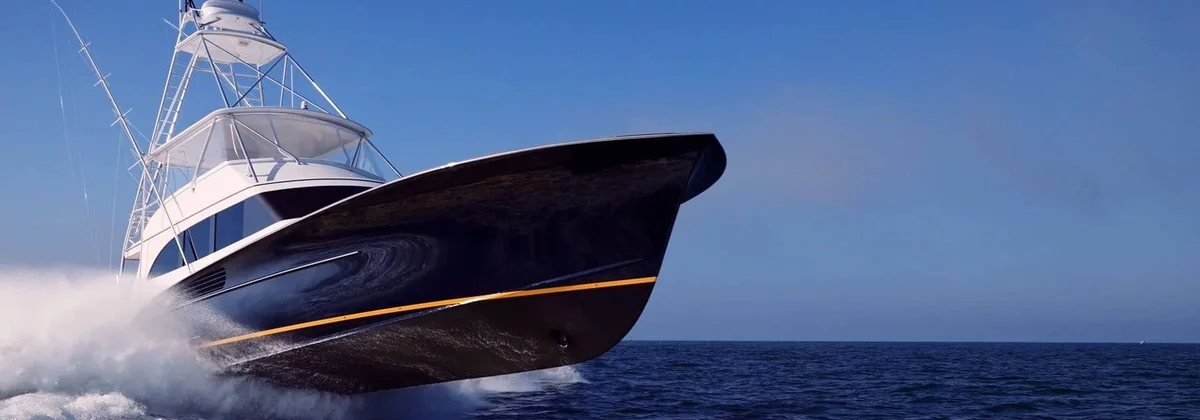
Quick answer: Sportfishing yachts are 45-90 ft offshore fishing platforms built for tournament competition and deep-sea sport fishing. Core features are a large open cockpit, full tower, twin diesel engines, and dedicated fish storage systems. Prices start at roughly $400,000 used for a 45-50 ft production vessel; custom-built tournament machines from premier builders can reach $6M or more.
What Is a Sportfishing Yacht?
A sportfishing yacht, often called a sportfisher or sportfish boat, is a purpose-engineered offshore vessel designed around the requirements of deep-sea sport fishing, particularly the pursuit of blue marlin, white marlin, sailfish, swordfish, tuna, and mahi-mahi. Unlike general-purpose motor yachts that can carry fishing gear, a true sportfishing yacht is engineered from the hull up around fishing performance.
The defining physical features are the large open cockpit aft (typically 14-20 ft long) with a fighting chair, transom door for releasing or gaffing fish, multiple outriggers for deploying trolling patterns, livewells, fish boxes integrated into the cockpit sole, and a rigged bait center or bait station. Above the main deck sits a raised bridge, or full tower, that provides the captain with elevation to spot fish in the water, oversee trolling lines, and command the vessel. The tower also houses a second set of controls for driving from height, which is operationally valuable when chasing or positioning on fish.
Sportfishing yachts are built for speed as well as stamina. Reaching productive offshore grounds, often 30-80 miles from port, quickly in the morning and returning in time to weigh in for a tournament requires reliable speeds of 28-38 knots. This performance mandate drives twin-diesel configurations with high-output engines and carefully designed hulls that balance speed with offshore seakeeping.
Sportfishing Yacht Sizes: From 45 Ft to 90 Ft and Beyond
The sportfishing market divides into a practical size hierarchy, each tier serving a different combination of use case, crew size, and budget:
| Size Range | Typical Use | Crew | Typical Price (New) |
|---|---|---|---|
| 45-55 ft | Day fishing; regional tournaments | 2-4 | $600K-$1.5M |
| 56-65 ft | Tournament circuit; overnights | 2-4 crew + captain | $1.2M-$3M |
| 66-80 ft | Major tournaments; extended range | Captain + 2-4 crew | $2.5M-$6M |
| Over 80 ft | Custom; prestige tournament | Captain + 3-6 crew | $5M-$15M+ |
The 55-65 ft range is the sweet spot of the production sportfishing market: large enough to handle serious offshore conditions and overnight passages, with practical operating costs and strong resale value. Vessels in the 45-55 ft category offer the entry point for tournament fishing with substantially lower acquisition and running costs.
Custom-built sportfishing yachts, from builders such as Jarrett Bay, Spencer Yachts, and Merritt Boat Works, typically run 62-90 ft and are built specifically to owner specification. These vessels are lighter, faster, and more purpose-optimised than production boats, at two to five times the cost per foot. They dominate the results at major billfish tournaments along the US East Coast, Bermuda, and the Caribbean.
The Florida yacht market guide covers the largest concentration of sportfishing yacht inventory in the US market.
How Much Do Sportfishing Yachts Cost New and Used?
Sportfishing yachts hold their value better than most recreational vessel categories because serious tournament fishing creates consistent demand at all size points and the best builders maintain strong brand reputations.
| Builder Tier | 45-55 ft (Used) | 55-65 ft (Used) | 65-80 ft (Used) |
|---|---|---|---|
| Production (Viking, Hatteras, Bertram) | $350K-$900K | $700K-$2M | $1.5M-$4M |
| Semi-custom (Davis, Cabo, Riviera) | $300K-$750K | $600K-$1.8M | $1.2M-$3.5M |
| Custom (Jarrett Bay, Spencer, Merritt) | Rarely available under 55 ft | $1.5M-$3.5M | $3M-$8M+ |
Annual running costs for a sportfishing yacht are driven by fuel consumption (sportfishers are among the thirstiest vessels for their size), insurance, crew, and tournament entry fees if competing:
| Expense Category | 55 ft Production | 65 ft Tournament |
|---|---|---|
| Fuel (600 annual hours, 35 kts avg) | $40,000-$80,000 | $70,000-$130,000 |
| Captain + one mate | $90,000-$150,000 | $130,000-$200,000 |
| Marina (South Florida rates) | $25,000-$60,000 | $40,000-$90,000 |
| Insurance (0.75-1.25% of hull) | $6,000-$25,000 | $15,000-$50,000 |
| Annual maintenance and haul-out | $20,000-$60,000 | $40,000-$120,000 |
For full ownership cost modelling at various vessel sizes, see the yacht ownership cost guide. For financing options on vessels in this range, the yacht financing guide covers marine loan structures, LTV parameters, and lender comparison.
Diesel vs Gas vs Outboards: The Engine Decision
Engine configuration affects everything, speed to the fishing grounds, range, fuel bill, and what your annual maintenance looks like. Get this wrong and you’ll feel it every fill-up.
Twin diesel inboard: The dominant configuration for vessels 60 ft and above. Modern marine diesel packages from CAT, MAN, MTU, and Volvo Penta provide the torque, fuel efficiency, and longevity that extended offshore operation demands. Diesel offers roughly 30-40% better fuel economy per nautical mile than comparable gasoline engines at tournament running speeds, and marine diesel engines are designed for high-hour commercial-grade duty cycles. Shaft-drive and IPS (integrated propulsion system) configurations are both available at this tier.
Quad or quint outboards: A significant and growing configuration in the 50-65 ft sportfishing market. Four or five large outboard engines (Yamaha F425, Mercury 600R, or Suzuki DF350) deliver exceptional speed, simplified maintenance (no internal shaft or outdrive), and easy replacement of individual units. The tradeoff versus diesel is higher fuel consumption per mile at cruising speed. Outboard-powered sportfishers have gained significant market share in the 48-62 ft segment over the past decade, particularly on production-grade vessels.
Twin gas inboard (V-gas or petrol): Common on older vessels in the 45-55 ft range. These engines are less fuel-efficient than diesel and have lower TBO (time between overhaul) ratings, but initial cost is lower. Buyers targeting the used market will encounter many well-maintained gas-powered sportfishers from the 1990s and 2000s that remain functional tournament boats at entry-level prices.
Cockpit Design: What Tournament Anglers Actually Require
The cockpit is the functional heart of a sportfishing yacht, and experienced anglers evaluate it with the same rigour that experienced brokers apply to a motor yacht’s engine room.
Fighting chair: A properly mounted fighting chair with a reinforced pedestal bolted to structural frames (not just the sole) is essential for targeting large billfish and tuna. The chair should rotate 360 degrees, have adjustable footrests, and accommodate a kidney harness for stand-up fishing on smaller fish. Outriggers should clear the fighting chair’s sweep without interference.
Outriggers: Standard outrigger configurations for a 60 ft sportfisher include a main port/starboard pair plus a pair of short riggers, allowing a five- or six-bait trolling spread. Carbon fiber outriggers have largely replaced aluminum on tournament-grade vessels for their lighter weight and superior vibration characteristics.
Fish boxes and livewells: A serious tournament cockpit will have at least 200-400 gallons of insulated fish box capacity built into the cockpit sole for large pelagics, and one or two livewells (20-80 gallon capacity) for bait. The bait center or bait station should include a saltwater wash-down, cutting board, rod holders, and tackle storage integrated into the transom.
Transom door: A flush transom door at or near the waterline allows the crew to work fish at the transom, bring aboard large catches, and release billfish without lifting them over the gunwale. This feature is standard on all serious sportfishing designs 50 ft and above.
Top Sportfishing Yacht Builders
Viking Yachts (New Gretna, New Jersey): The most recognised name in US production sportfishing. Viking builds in a vertically integrated facility and controls virtually every component of construction. Their 46, 52, 54, 57, 62, 72, and 80 ft models dominate the tournament circuit from the Mid-Atlantic through the Bahamas. Viking’s resale values are among the strongest in the segment; a well-maintained 62 Viking holds value better than virtually any comparable production sportfisher. See the brands directory for a full builder profile.
Hatteras Yachts (New Bern, North Carolina): A heritage US builder with more than six decades of sportfishing history. Hatteras offers both convertible sportfishers and motor yacht models, with a focus on the 45-90 ft range. The GT45 through GT90 series has been rebuilt under current ownership and commands a strong following in the tournament community.
Jarrett Bay Boatworks (Beaufort, North Carolina): The premier custom sportfishing yacht builder in the US for vessels in the 55-85 ft range. Every Jarrett Bay is built to individual specification in Carolina construction traditions: lightweight fiberglass, aggressive deadrise, and performance-optimised hull forms. Their vessels consistently place at the top of major billfish tournaments including the White Marlin Open and the Big Rock Blue Marlin Tournament.
Spencer Yachts (Wilmington, North Carolina): Custom builds in the 58-80 ft range with a strong record in major offshore tournaments. Spencer uses advanced composite construction and custom-designed hull forms. Lead times typically run 18-36 months.
Merritt Boat Works (Pompano Beach, Florida): One of the oldest continuous custom sportfishing builders in the US, with a documented history of tournament victories spanning decades. Merritt builds primarily in the 45-75 ft range and has a waiting list that often extends several years.
Bertram Yachts (classic heritage): The Bertram 31 of 1960 effectively defined the modern deep-V sportfishing hull. Bertram has changed ownership and focus several times since its founding, but well-maintained classic Bertram 31, 35, and 38 models remain competitive tournament and fishing vessels and command premium prices in the used market as collectibles.
The Bahamas yacht market guide and Miami yacht market guide provide regional inventory and pricing context for US East Coast sportfishing purchases.
Best Fishing Grounds for Sportfishing Yachts
The operational geography of sportfishing yachts is shaped by target species migration patterns, sea conditions, and tournament schedules.
Gulf Stream (US East Coast): The Gulf Stream runs 30-80 miles off the Florida and Carolinas coasts and carries warm, nutrient-rich water that concentrates blue marlin, white marlin, sailfish, wahoo, and mahi-mahi from May through October. Fort Lauderdale, Palm Beach, and Miami are primary home ports for Gulf Stream fishing. See the Fort Lauderdale yacht market for inventory concentrated at this fishing hub.
The Bahamas: A 40-90 minute run from South Florida puts sportfishing yachts onto some of the most productive bluewater in the Atlantic. The Bahamas canyon systems, including the Tongue of the Ocean, produce consistent blue marlin fishing from April through August.
Bermuda: The Bermuda Triple Crown (comprising the Sea Horse Angling Club Tournament, the Bermuda Big Game Classic, and the Bermuda Billfish Release Tournament) attracts the world’s top custom sportfishing yachts each June. Bermuda is approximately 1,000 nm from Fort Lauderdale, within range of a well-maintained 60 ft tournament vessel on a two-day passage.
Pacific (Cabo San Lucas, Costa Rica): The Pacific billfish grounds off Cabo produce extraordinary black marlin, blue marlin, striped marlin, and sailfish. Los Sueños Marina in Costa Rica is the base for one of the world’s most active sportfishing tournament circuits, with world records in multiple species set in these waters.
Running a Sportfishing Yacht: Captain, Crew, and Tournament Logistics
Operating a tournament-capable sportfishing yacht requires a professional captain with specific offshore and fishing experience. The captain’s role encompasses vessel operation and tactical decision-making, choosing when and where to run based on sea surface temperature charts, current edges, and bait schools, which directly affects fishing success.
A standard crew configuration for a 60 ft tournament vessel is: one licensed USCG captain, one mate (handles baits, cockpit work, and boat preparation), and optionally a second mate or deckhand for larger vessels or extended programs. Annual crew costs for a South Florida-based sportfishing captain and one mate typically run $90,000-$180,000 combined, depending on experience and tournament schedule intensity.
Tournament entry fees at major events range from $1,000-$10,000 per vessel for regional inshore events, rising to $50,000-$100,000 or more for major international billfish events with significant prize pools.
What to Check When Buying a Used Sportfishing Yacht
The used sportfishing market offers outstanding value, but these boats get worked hard, and the inspection priorities are different from a pleasure cruiser.
Insider tip: Run your hand along the inside of the transom knee area while someone stands on the covering board above. If you feel any flex or hear cracking sounds, the transom has been stressed, possibly from a fighting chair that wasn’t properly through-bolted to structural frames. This is a $20,000-$50,000 repair on a 60-footer.
Insider tip: Check the tower base welds and attachment bolts yourself. Towers on sportfishing yachts carry enormous wind loads at speed and lever forces during beam seas. Fatigue cracking at tower base welds is common on boats with 1,000+ hours and is invisible from deck level, you need to inspect from below.
Hull bottom and transom: The aggressive offshore use of tournament sportfishing yachts means hull bottoms, transoms, and transom knee areas are exposed to significant stress. Request a full haul-out inspection before purchase. Look for stress cracks in the transom area (particularly around engine mounts on older vessels), delamination in the stringers, and osmotic blistering on fiberglass hulls.
Engine condition: Request complete engine logs, oil analysis history, and recent compression or fuel injector reports. For diesel-powered vessels, turbocharger condition and heat exchanger integrity are important inspection points. For quad-outboard vessels, check each engine’s hour meter and maintenance log independently.
Electronics and fishing equipment: A complete inventory of working electronics is critical, chart plotters, radar, fishfinder/sonar, FLIR camera, satellite phone and EPIRB, and replacement costs for tournament-grade systems can be significant. Outriggers, fighting chair hardware, and rod holders should be checked for structural integrity.
Cockpit and livewells: Inspect livewell pumps, overboard discharge, fish box drains, and wash-down systems for function. Cockpit sole condition (check for soft spots over core material) is a common issue on heavily used tournament boats.
See the full yacht survey checklist before commissioning any inspection. For insurance structures applicable to tournament use, see the yacht insurance guide.
Looking for a sportfishing yacht?
Tell us your tournament ambitions, preferred grounds, and budget. We'll connect you with brokers who specialise in sportfishing and offshore fishing vessels.
For a cruising alternative in the same length band, compare the sportfish layout against Riviera, whose flybridge models target the same owner with a different deck plan.
Frequently Asked Questions
A sportfishing yacht is a purpose-built offshore fishing vessel, typically 45-90 ft, designed for deep-sea fishing and tournament competition. Key features include a large open cockpit with a fighting chair, outriggers for trolling, twin diesel engines for speed and range, and integrated fish storage including livewells and fish boxes. They are built to reach offshore grounds quickly and to handle serious sea states.
Production sportfishing yachts in the 45-55 ft range typically start at $400,000-$900,000 used and $600,000-$1.5M new. Mid-size 60-72 ft tournament vessels from top builders like Viking commonly trade at $900,000-$3M used. Custom-built tournament vessels from Jarrett Bay, Spencer, or Merritt range from $2M to $8M+ depending on size and specification.
Viking Yachts is widely considered the benchmark US production sportfishing builder. Hatteras offers a strong mid-market range. Custom builders including Jarrett Bay, Spencer Yachts, and Merritt Boat Works produce some of the most capable tournament-grade vessels available, and command prices to match. The best builder for any individual buyer depends on budget, intended use, and tournament program.
Most 60 ft and above sportfishing yachts use twin diesel inboards, CAT, MAN, MTU, or Volvo Penta, offering strong torque, fuel efficiency, and long service life. Quad or quint large outboard configurations (Yamaha, Mercury, Suzuki) have grown significantly in the 48-62 ft range, offering simplified maintenance and fast speed. Older vessels under 55 ft may have twin gas inboards.
Most production sportfishing yachts cruise at 28-34 knots and reach top speeds of 38-46 knots depending on size and engine configuration. Speed matters for reaching distant fishing grounds and competing in timed tournament formats. High-performance custom builds with lightweight construction and aggressive engine packages can approach 50+ knots under optimal conditions.
For a 55 ft production sportfisher operating out of South Florida, annual costs typically include $40,000-$80,000 in fuel, $90,000-$150,000 for captain and mate, $25,000-$60,000 for marina, and $20,000-$60,000 for maintenance and haul-out. Total annual operating costs commonly run $175,000-$350,000 depending on usage intensity and tournament schedule.
Request a yacht buyer consultation
Share your budget, target LOA, and use case. We reply within one business day with matched brokers or surveyors.