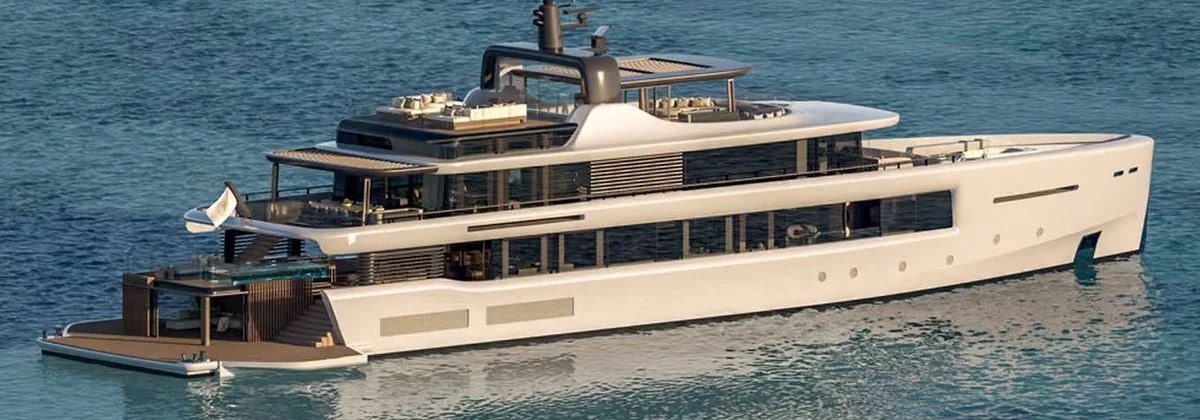
Quick answer: A tri-deck yacht stacks three usable exterior levels, main deck, upper deck, and sun deck, so owners get more outdoor living space without lengthening the hull as much as a single-level design would require. You see this layout from roughly 75 feet on production motor yachts and throughout the 30m+ superyacht band. Expect higher build complexity, stronger crew demand, and running costs that track superyacht economics faster than LOA alone suggests.
What Is a Tri-Deck Yacht?
A tri-deck yacht is a motor yacht with three distinct exterior deck platforms above the hull, not a marketing label for any yacht with three interior floors. In brokerage language, the term usually means:
- Main deck: salon, galley, and often a formal dining area opening to aft cockpit or beach club.
- Upper deck: flybridge helm, skylounge, or both; sometimes owner suite access forward.
- Sun deck: top level with lounge seating, bar, hardtop or bimini, and often a jacuzzi or sun pad.
Below the main deck, many tri-deck designs still carry guest cabins, crew quarters, and machinery spaces, those are not counted as “decks” in the tri-deck description. The phrase describes vertical layering of outdoor and helm zones, which matters for windage, stability calculations, and marina air draft.
Tri-deck layouts appear across planing production yachts in the 75-95 foot band and on semi-displacement and displacement superyachts from 30m upward. They overlap with large custom explorer yachts in the 40m+ range but are not exclusive to custom build, Sunseeker, Princess, Azimut, and Benetti all market explicit tri-deck models.
How Does a Tri-Deck Layout Differ From a Flybridge?
A conventional flybridge motor yacht, covered in our motor yachts guide, combines upper helm and outdoor seating on one elevated level. A tri-deck splits functions: helm and covered social space on the upper deck, open entertaining on the sun deck above.
| Feature | Flybridge (two levels) | Tri-deck (three levels) |
|---|---|---|
| Exterior zones | Main + flybridge | Main + upper + sun deck |
| Typical size band | 40-85 ft common | 75 ft+ common; standard 30m+ |
| Weight / windage | Lower | Higher, affects fuel and motion |
| Guest capacity feel | Strong to 65 ft | Stronger without adding LOA |
| Build / list price | Lower at same LOA | Premium for superstructure |
| Crew visibility | Captain often exposed on flybridge | Upper helm may be enclosed skylounge |
Buyers who entertain large groups in port love tri-decks for the separation of zones, cocktails on the sun deck while children stay on the main aft deck. Buyers who cruise offshore in heavy weather may prefer a simpler two-level layout with less top-heavy superstructure.
Who Should Buy a Tri-Deck Yacht?
Tri-deck yachts suit buyers who prioritize marina presence and guest experience over minimal operating cost. Strong fit profiles include:
- Mediterranean summer owners who spend long evenings in port and want multiple outdoor lounges without tender trips ashore.
- Charter-minded owners seeking layouts that match crewed charter guest expectations; see the yacht charter guide for how charter pricing relates to layout and crew.
- Families who need separate adult and child zones during dockside weeks.
- Downsizers from larger superyachts who want tri-deck aesthetics and crew workflow in a sub-30m hull.
Weaker fit profiles include budget-sensitive first-time buyers (a large flybridge delivers more hull for the money), passagemakers who rarely use upper decks, and owners who cannot staff or insure a vessel that insurers classify as mini-superyacht regardless of LOA.
Which Builders Produce Tri-Deck Motor Yachts?
Production and semi-custom builders dominate the 75-110 foot tri-deck segment; custom yards own the 40m+ niche.
Sunseeker (UK), 88 and 95 tri-deck models are staples in Mediterranean brokerage. Sporty lines, strong charter recognition, planing hulls with high peak speeds.
Princess Yachts (UK), Y85 and larger Y Class layouts offer enclosed upper helm options and British interior fit-out. Popular with Northern European owners who want weather-protected upper stations.
Azimut / Benetti (Italy), Azimut Grande and Benetti Oasis lines blend Italian styling with tri-deck social zones; Benetti moves into full superyacht tri-deck territory above 30m.
Sanlorenzo, Ferretti Custom Line, Overmarine (Mangusta), premium Italian alternatives with distinct styling; Mangusta tri-deck profiles lean performance-oriented.
Westport, Horizon, Ocean Alexander, US and Asia-Pacific production semi-custom tri-deck platforms for owners who want US service networks or Pacific build quality.
When comparing brands, ask how each builder treats sun deck hardtop height and tender storage, two specs that drive both marina clearance and resale appeal.
What Do Tri-Deck Yachts Cost to Buy?
Price scales with LOA, builder tier, and engine hours more than deck count alone, but tri-deck premiums are real at equal length.
| Segment | Typical LOA | New (indicative) | Used 5-8 years (indicative) |
|---|---|---|---|
| Production tri-deck | 75-88 ft | $3.5M-$7M | $1.8M-$4.5M |
| Premium semi-custom | 90-110 ft | $7M-$15M | $4M-$10M |
| Superyacht tri-deck | 30-40m | $12M-$35M | $8M-$25M+ |
Currency, engine package, and refit history move these bands by 20-40%. A 2018 production tri-deck with low hours and documented service often trades closer to new pricing than a cosmetically refreshed hull with deferred generator and AC work.
For purchase process and deposit timing, start with the yacht buying guide. For used-market negotiation after survey, see used yacht buying guide.
What Are Annual Running Costs on a Tri-Deck Yacht?
Tri-deck yachts cross into crew-heavy, marina-sensitive economics earlier than two-level motor yachts of similar length. Directional annual budgets for private Mediterranean use:
| Cost line | 80 ft production tri-deck | 30m custom tri-deck |
|---|---|---|
| Crew (captain + 1-2) | $180,000-$320,000 | $350,000-$600,000+ |
| Marina / berth | $45,000-$90,000 | $80,000-€150,000+ prime Med |
| Insurance | $40,000-$75,000 | $100,000-$250,000+ |
| Maintenance & paint | $80,000-$150,000 | $200,000-$400,000+ |
| Fuel (150-250 hrs) | $35,000-$70,000 | $60,000-$120,000+ |
These figures assume professional crew, dual-season or full Med summer, and no major refit year. Stack detailed modelling with the yacht ownership cost guide and superyacht running costs page if you are above 30m or charter-endorsed.
Model tri-deck ownership before you offer
Share target LOA, crew plan, and home port. We sanity-check operating bands against current listings.
What Should You Survey on a Used Tri-Deck?
A tri-deck carries more systems per foot than any other layout, so the survey should follow the complexity rather than the length. Lift and elevator mechanisms, extensive air-conditioning plant, stabilisers and the tender-handling gear are where the expensive findings sit.
Tri-deck superstructure adds inspection surface area. Prioritize:
Deck hardware and teak, three levels of teak mean three times the recaulking and fastening risk. Soft spots at deck margins often indicate core issues under fittings.
Skylounge seals and AC load, enclosed upper helms concentrate heat load. Confirm chiller capacity and that upper-deck glass seals have not leaked into helm electronics.
Sun deck drainage, jacuzzi, bar sinks, and rain runoff must exit without entering superstructure. Blocked scuppers are a common pre-purchase finding on charter-heavy histories.
Tender garage and crane, many tri-decks stow tenders on the main deck or in garage spaces; hydraulic systems need service records aligned with cycle counts.
Stabilizer and weight distribution, added superstructure height affects roll characteristics. Confirm stabilizer service and whether tankage layout matches designer intent after owner modifications.
Use the yacht survey checklist when scoping your surveyor letter. Align findings with insurance indication before hard deposit; see yacht insurance guide.
Tri-Deck vs Charter: When Does Ownership Still Make Sense?
Charter a tri-deck superyacht for two weeks in the Med and you may spend €150,000-€250,000 all-in with APA on a 30m vessel, without building equity or customizing layout. Ownership spreads fixed crew and berth cost across more owner weeks but concentrates capital and liquidity risk.
Run an honest week count. Owners using a tri-deck under six weeks per year often find charter or fractional alternatives cheaper on cash flow, compare scenarios with the charter vs own calculator. Owners above ten exclusive weeks with established crew and a secured berth may justify ownership if survey and resale assumptions stay conservative.
Where Tri-Deck Copy Outruns Reality
Three gaps open between listing copy and operating reality on this type. Sun deck usability is routinely oversold: hardtop height or crane overhang can block tender operations entirely on a deck the brochure sells as the main entertaining space. Crew quarters on a production tri-deck may sleep two where the owner’s charter endorsement plan needs four. And marina length pricing jumps once beam or a platform extension pushes the vessel into a superyacht tariff band, even on a hull under 30m.
Walk all three decks with your broker, confirm the crew cabin count against your manning plan, and measure the billed marina length including the swim platform.
Tri-deck layout economics
75-90 ft production tri-decks, Popular with owners who host frequently. Expect 3-5 crew, stabilisers, and twin tenders. Annual operating budgets commonly land at $400,000-$750,000 before major refit years.
30-40 m semi-custom tri-decks, Charter-ready layouts with beach clubs and skylounges. VAT, flag, and management fees can add 15-20% on top of quoted operating accounts, model with a management company spreadsheet, not broker marketing alone.
40 m+ custom tri-decks, Yard periods every 5-7 years may run 8-12% of hull value. Buyers should escrow refit reserves at purchase; lenders increasingly ask for post-purchase liquidity proofs on these LOAs.
Sun-deck weight (jacuzzi, toys, furniture) affects stability booklets, confirm load certificates match how the prior owner actually used the upper decks.
Tri-deck platforms in this band come mainly from Benetti and Amels, which take different positions on custom versus limited-edition build.
Frequently Asked Questions
A motor yacht with three exterior deck levels, main deck, upper deck (flybridge or skylounge), and sun deck. Common from about 75 feet and standard on many 30m+ superyachts.
Production 75-90 ft tri-decks often run $3M-$8M new and $1.8M-$5M used. Semi-custom and superyacht tri-decks from 30m commonly trade from $8M to $40M+ depending on builder and condition.
Most 75-90 ft owners run a captain plus at least one crew. Above 30m, full crew teams are normal for insurance, safety, and charter compliance.
Tri-decks offer more outdoor zones and charter appeal; flybridges are simpler, lighter, and often cheaper to run at the same LOA. Choose based on entertaining style and crew budget.
The layout is genuinely charter-friendly, with the guest zones and crew separation charter guests expect, but income is seasonal and broker-dependent, so model it as upside rather than a fixed offset. A tri-deck also costs more to operate than a flybridge at the same LOA, so the charter case has to clear a higher bar. Ask any broker projecting revenue to evidence it with a booked calendar rather than a rate card.
Teak on all decks, skylounge seals, sun deck drainage, tender garage hydraulics, stabilizers, and AC capacity across levels. Full survey with haul-out on any 70 ft+ used purchase.
Request a yacht buyer consultation
Share your budget, target LOA, and use case. We reply within one business day with matched brokers or surveyors.