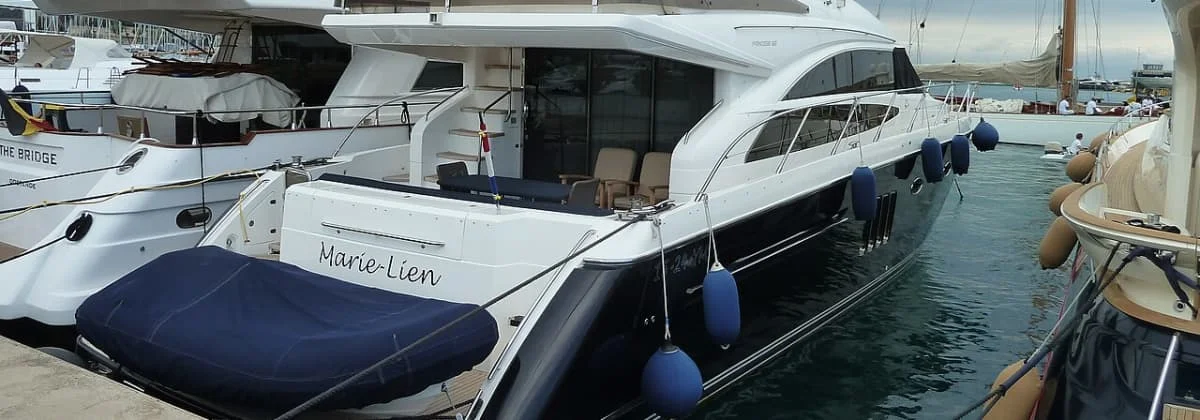
Quick answer: Princess Yachts, built entirely in Plymouth, Devon, is the United Kingdom’s premier flybridge motor yacht specialist and one of the most respected production brands globally. Majority-owned by LVMH’s investment arm since 2008, Princess operates at the premium end of the European production motor yacht market, with a range spanning from the F45 flybridge (approximately 14m) to the 40M semi-custom superyacht (approximately 40m). For buyers who prioritise flybridge design quality, British build standards, and strong resale in the UK and Northern European market, Princess is the natural reference point.
Princess Yachts: Plymouth, LVMH, and the British Premium Positioning
Princess Yachts International traces its roots to 1965 in Plymouth, a working port city whose naval and maritime engineering heritage has shaped the company’s access to skilled marine tradespeople across Devon and Cornwall for six decades.
The ownership shift that changed everything came in 2008: L Catterton, the private equity arm co-managed by LVMH, acquired a majority stake. LVMH’s portfolio includes Louis Vuitton, Dior, Bulgari, and TAG Heuer. Since the acquisition, Princess has consistently elevated its base specification, material quality, and presentation to align with LVMH luxury goods standards. The F Class interior materials, joinery density, leather quality, metal fittings, visibly improved from roughly 2012 onward, and brokers who survey across brands consistently note the difference.
For buyers, the LVMH connection has practical implications. First, the capital investment in Plymouth facilities has been substantial, the production halls have been substantially upgraded, the composite manufacturing capability expanded, and the design studio investment increased. Second, the brand’s marketing and international dealer network have benefited from LVMH’s global luxury retail relationships. Third, and most relevant to sophisticated buyers, the LVMH connection functions as a due diligence shortcut when assessing build quality and after-sales credibility.
Princess today employs approximately 3,000 people in Plymouth, across three main production sites on the Devonport waterfront and the Cattedown industrial area. The majority of Princess’s hull and deck structures are manufactured in-house using GRP hand lamination and vacuum-infusion processes; structural engineering is done by the in-house naval architecture team. Engines, propulsion, and electronics are sourced from Volvo Penta, MAN, Cummins, and Garmin/Simrad, with the specific fit-out varying by model and buyer specification.
The F Class: Why It Defines the Brand
Seven models, F45, F50, F55, F62, F65, F70, F75, plus the F95 at the top of the range (approximately 29m). No other single builder covers the 14m-29m flybridge market this comprehensively from a single design family.
Princess collaborated with Pininfarina (best known for its Ferrari partnerships) on several F Class models starting in the mid-2010s. The resulting exterior aesthetic balances Italian design flair with British pragmatism, and it works commercially. The F65 is arguably the most visually accomplished production flybridge in its length range, a claim that Azimut and Sunseeker dealers privately acknowledge even if they’d never say it publicly. The resulting visual identity, sweeping hull sides, continuous sheerlines, and a flybridge profile that provides substantial sun space without creating excessive windage, differentiates F Class models from the more aggressive Sunseeker and the more classical Azimut in the same length range.
The flybridge on F Class models is arguably the best-executed in the production segment. Princess’s architects have consistently prioritised: ergonomic helm stations with excellent all-round visibility, protected seating arrangements that allow the flybridge to be used underway in all but the worst conditions, integrated sunpad and social areas aft, and wet bar provisions that genuinely function for entertaining. This flybridge quality is consistently cited in buyer and surveyor reviews as Princess’s primary competitive advantage over equivalently priced alternatives.
Interior finish on F Class models is a step above the production norm for this price bracket. Princess uses more solid joinery and higher-grade upholstery materials than Azimut at equivalent size, and the material specification is comparable or superior to Sunseeker’s equivalent offering. The galley-down layout, in which the galley is positioned on the lower deck with the salon above, is preferred by many experienced owners for the separation it creates between cooking and guest social areas; Princess offers this layout across most of its flybridge range.
The S Class and Wider Portfolio
Beyond the flagship F Class, Princess’s commercial range includes several other series addressing distinct buyer use cases.
S Class (S60, S62, S65): The S Class is Princess’s sport cruiser interpretation, lower profile than a flybridge, with a focus on performance characteristics and a more masculine exterior aesthetic. The S65 competes with the Sunseeker Sport Yacht 65 and the Azimut S6. Buyers choosing the S Class over the F Class are typically prioritising speed, low-profile aesthetics, and performance over interior volume, the same trade-off that characterises the sport versus flybridge choice across all production brands.
Y Class (Y72, Y85): The Y Class occupies a semi-custom tier between the production F/S range and the fully bespoke 30M/40M. The Y72 (approximately 22m) and Y85 (approximately 26m) offer a more individual specification process than the F Class, with broader options for interior layout configuration, exterior colour, and technical specification. The Y Class is positioned as the step-up for F75 buyers who want more, and the step before committing to the 30M programme.
30M and 40M: Princess’s entry into the semi-custom superyacht tier. Both vessels are designed with full custom interior specification: the buyer works with Princess’s in-house design team (and optionally an external designer) to develop a bespoke interior GA, with the exterior lines fixed at the platform level. The 40M has attracted notable external design collaborations, the Porsche Design-styled 40M exterior is among the most discussed production superyacht designs of the 2020s. Lead times for the 30M and 40M run 24-36 months.
| Model | Approx LOA | Price Range | Character |
|---|---|---|---|
| F45-F55 | 14-17m | €750K-€1.4M | Core flybridge, family |
| F62-F75 | 19-23m | €1.6M-€2.8M | Premium flybridge |
| F95 | 29m | €3.5M-€4.5M | Top flybridge |
| S Class | 18-20m | €1.2M-€2.0M | Sport profile |
| Y72 / Y85 | 22-26m | €3M-€5M | Semi-custom |
| 30M / 40M | 30-40m | €6M-€15M+ | Near-custom superyacht |
Who Buys Princess Yachts: Buyer Profile
Princess’s buyer base differs markedly from Azimut’s and Sunseeker’s. The brand has an almost cult-like following among British buyers, both domestic UK and British expatriates in the Mediterranean, Caribbean, and Asia-Pacific. The association with Plymouth, British craftsmanship, and LVMH backing creates an emotional proposition that Sunseeker’s Bond-era glamour and Azimut’s Italian cool simply don’t replicate for this segment.
Northern European buyers, Germany, Scandinavia, the Netherlands, consistently rate Princess build quality above equivalent Italian production. The French market is strong for the F Class range, where Princess’s Pininfarina design collaboration resonates with design-conscious buyers.
The typical Princess buyer is more quality-focused and less brand-narrative-driven than the equivalent Sunseeker buyer. Princess owners tend to be experienced motor yacht owners moving up in size, they choose Princess because the survey reveals superior build quality, not because they saw it in a film. First-time buyers are less likely to discover Princess independently and more likely to arrive via broker or owner referral. This matters for the resale story: Princess’s repeat-buyer rate in the UK is among the highest of any production brand, which sustains demand on the secondary market.
In terms of use profile, Princess owners span a broad range: weekend coastal cruisers in the UK (strong demand for the F45-F55 range), extended Mediterranean summer live-aboard families (F65-F75 range), and charter operators and semi-commercial users in the larger Y Class and 30M/40M tier.
Looking for a specific Princess model or semi-custom slot?
We connect buyers with Princess dealer inventory and pre-owned brokerage worldwide, F Class through the Y, 30M and 40M programmes.
New-Build Process at Princess
Princess sells exclusively through its authorised dealer network, the company does not sell direct to end buyers. The dealer relationship is more important for Princess than for some other brands, because the customisation process for F Class models, while constrained to factory options, requires dealer expertise to navigate effectively.
Production F Class (F45-F95): The buyer works with the dealer to select from factory option packages covering hull colour, engine specification (Volvo IPS or shaft drives), interior trim packages, electronics suite, and individual equipment items. The options list is comprehensive, a well-specified F65 can differ significantly from a base-specification example in equipment, finish, and on-the-water character. Deposits are typically 20-30% at order placement, with balance due at delivery. Production lead times for F Class models currently run 10-18 months from confirmed order, depending on production slot availability.
Y Class, 30M, 40M: For these semi-custom models, the buyer engages directly with Princess’s project team (typically coordinated through the dealer). Interior GA options, specification packages, and finish selections are worked through a structured design process over several months before contract execution. Change order discipline is important, specification changes after production commencement carry cost and schedule penalties similar to those at a full custom yard. An independent buyer’s representative is advisable for 30M and 40M contracts.
Sea trials: Princess conducts sea trials in Plymouth Sound and the adjacent English Channel, providing realistic open-water conditions. Buyers should travel to Plymouth for acceptance trials, inspecting the vessel in-person at the yard, before sea trial and before delivery, is strongly advisable.
Princess Resale: Values and Market Dynamics
Princess holds its value better in the UK market than virtually any other production motor yacht brand. This is a function of several reinforcing factors: strong domestic brand loyalty, a well-organised national dealer network that maintains consistent pricing expectations, and genuine build quality that surveyors consistently report favourably.
Value retention benchmarks for Princess F Class:
- Year 0-2: 12-22% depreciation (slightly better than industry average, reflecting the brand’s premium perception)
- Years 3-7: Stable middle phase; well-maintained F65s at year 5 in UK brokerage commonly retain 60-72% of original MSRP
- Years 8-15: Values remain above equivalent Italian production at the same age, the quality differential becomes a quantifiable premium in survey-driven valuations
Key resale markets for Princess:
- UK: Primary market, strongest liquidity, best relative pricing
- France and Northern Europe: Strong secondary market with premium over Italian equivalents
- Mediterranean (Mallorca, French Riviera, Croatia): Active market but slightly lower premiums than UK, the Italian competition (Azimut, Ferretti) is stronger in home-market territory
- Fort Lauderdale and US Atlantic: Active but smaller than Italian and British competition; Sunseeker has a stronger US commercial position
When buying a used Princess, survey focus areas include: gel coat condition and osmosis checking below the waterline (Princess GRP construction is robust but consistent with industry standards); flybridge teak condition (UV exposure in Med and Caribbean service); engine room cleanliness and service documentation; and IPS drive condition if fitted (pod drives require specific maintenance attention at service intervals).
Running Costs and Total Ownership Economics
Princess ownership costs are consistent with the European production motor yacht standard for this tier. The following provides planning benchmarks:
Princess F55 (approximately 17m), private use, 200-350 hours annually, UK or Mediterranean-based:
- Marina/berthing: €12,000-€40,000 annually depending on location
- Insurance: €8,000-€18,000 annually
- Maintenance and service: €15,000-€35,000 annually (includes annual engine service, antifouling, minor repairs)
- Fuel: €10,000-€25,000 for moderate use
- Total indicative annual cost: €50,000-€120,000, approximately 8-13% of vessel value
Princess F75 (approximately 23m), semi-professional use with captain, Mediterranean:
- Captain: €60,000-€90,000 annually
- Marina/berthing: €25,000-€65,000 annually
- Insurance: €20,000-€40,000 annually
- Maintenance and service: €35,000-€75,000 annually
- Fuel: €20,000-€50,000
- Total indicative annual cost: €170,000-€340,000, approximately 9-14% of vessel value
The princess advantage in running costs is primarily in maintenance: the Bristol-based and Plymouth-based service network provides competitive labour rates and good parts availability for UK-based owners, and the brand’s build quality reduces the frequency of unscheduled repair work that can inflate maintenance budgets on lesser-built alternatives.
Princess vs Sunseeker and Azimut: Where Each Brand Wins
This is the comparison that most buyers in the 50-75ft production flybridge market will face. Here is an evidence-based assessment:
Choose Princess when: flybridge design quality is your primary criterion; you base primarily in the UK or Northern Europe where Princess’s resale market is strongest; you prioritise material finish quality above price per foot; the LVMH brand association matters for secondary-market positioning.
Choose Sunseeker when: you prefer the more aggressive sport aesthetic; you base primarily in the Atlantic (Florida, Bahamas, Caribbean) where Sunseeker’s US market position and Fort Lauderdale service infrastructure are stronger; you want the Bond-era brand narrative as part of the ownership experience.
Choose Azimut when: you base primarily in the Southern Mediterranean (Italy, Croatia, Greece) where Azimut’s home-market dealer density and resale liquidity are unmatched; interior volume per foot is your priority; you want the lowest purchase price in the production flybridge segment; or you are considering a step-up to the Azimut Grande / Benetti semi-custom track.
The fundamental buyer truth: at the 55-75ft production flybridge level, Princess, Sunseeker, and Azimut are all competent, well-supported products with comparable total ownership economics. The decision should rest on where you sail, what you prioritise in design, and which secondary market is most accessible when it comes time to sell.
Source Note for Princess Yachts
For Princess Yachts, brand, order-book, resale, and running-cost references are buyer-intelligence benchmarks, not manufacturer representations or live inventory. Confirm current delivery slots, warranty terms, closed-sale comparables, and service support with the yard, central agents, and independent surveyors.
Related Guides
Red Flags and Buyer Checklist
Check the build record against the boat in front of you before the survey, not after.
- Red flag specific to Princess: engine and generator hours that do not match a documented service interval, on hulls where systems complexity drives the maintenance curve.
- Confirm the build number and model year, then check the specification against the original order form.
- Request the last two services on steering, trim and stabiliser systems.
- Ask whether the hull came through the dealer network or as a grey import, warranty transfer differs.
- Verify deck moisture around hardtop and flybridge fittings on any hull past its first decade.
- Compare a UK-located example before accepting a location premium.
Resale timing follows the market cycle; the used yacht market report 2026 has the current picture.
Frequently Asked Questions
Princess Yachts are built entirely in Plymouth, Devon, on the southwest coast of England. The company was founded in 1965 as Marine Projects and became Princess Yachts International. LVMH Group (the French luxury conglomerate) became a majority shareholder in 2008, acquiring its stake through L Catterton, LVMH's consumer-focused private equity vehicle. The LVMH connection has shaped Princess's positioning toward the premium end of the European production motor yacht market, an association with the world's leading luxury goods group provides brand credibility in HNWI markets globally. Production, engineering, and design all remain in Plymouth.
Princess's flybridge models centre on the F Class series: F45, F50, F55, F62, F65, F70, F75, and the F95 at the top of the range (approximately 29m). The F Class represents Princess's most important commercial line and the yacht for which the brand is most consistently benchmarked. The Y Class (Y72 and Y85) offers a semi-custom large-format option. In addition, the S Class (S60, S62, S65) provides a sport cruiser/lower-profile alternative. The 40M and 30M represent Princess's entry into the semi-custom superyacht tier.
In the 45-70ft flybridge segment, Princess F Class models are consistently rated by buyers and surveyors as offering the most refined flybridge execution of the three. Princess flybridge designs typically feature more generous helm station ergonomics, better wet-weather protection, and higher-quality standard specification than equivalent Sunseeker and Azimut models in the same length range. This quality advantage is reflected in pricing, Princess typically carries a 5-15% price premium over equivalent Azimut and a roughly comparable price to Sunseeker's Manhattan series. Resale in the UK and Northern Europe favours Princess slightly over Sunseeker.
Princess F Class pricing in 2026 runs approximately: F45 from €750,000-€900,000; F55 from €1.1M-€1.4M; F65 from €1.6M-€2.0M; F75 from €2.2M-€2.8M; F95 from €3.5M-€4.5M. All figures are approximate, ex-VAT, before options and delivery. The Princess Y72 and Y85 semi-custom models start from approximately €3M and €4.5M respectively. Princess does not publish a single standard price list, pricing varies by specification, dealer, and production slot timing.
Princess has one of the best-structured resale markets of any European production motor yacht brand, particularly in the UK. The brand's long history, broad service network, and strong build reputation create a buyer base that actively seeks out used Princess models. A well-maintained Princess F55 at 5 years commonly retains 58-72% of its original MSRP in UK brokerage, slightly better than equivalent Sunseeker and broadly comparable to Azimut in the Med. The UK broker market (Poole, Southampton, Plymouth, and Scotland) is the most active single resale geography for Princess.
For a Princess F55-F65 (approximately 17-20m) in private use with moderate annual hours, Med or UK coastal based: annual marina costs €12,000-€40,000 depending on location; insurance €8,000-€18,000; maintenance and service €15,000-€35,000; fuel €10,000-€25,000. Total indicative annual cost: €50,000-€120,000, representing approximately 8-13% of current vessel value. These costs are broadly consistent with equivalent Azimut Flybridge and Sunseeker Manhattan models at the same size range, brand choice does not significantly alter total ownership economics at this tier.
Yes, Princess's 40M and 30M are semi-custom motor yachts at approximately 40m and 30m LOA, developed with more individual specification flexibility than the production F Class. The 40M competes with Azimut Grande 35M, Sunseeker 131/155 Yacht, and entry Benetti B.Now in the near-40m semi-custom segment. Princess also offers design collaboration with external designers for the 40M, with Porsche Design Studio having contributed to exterior styling. Lead times for the 40M and 30M run approximately 24-36 months.
Request a yacht buyer consultation
Share your budget, target LOA, and use case. We reply within one business day with matched brokers or surveyors.