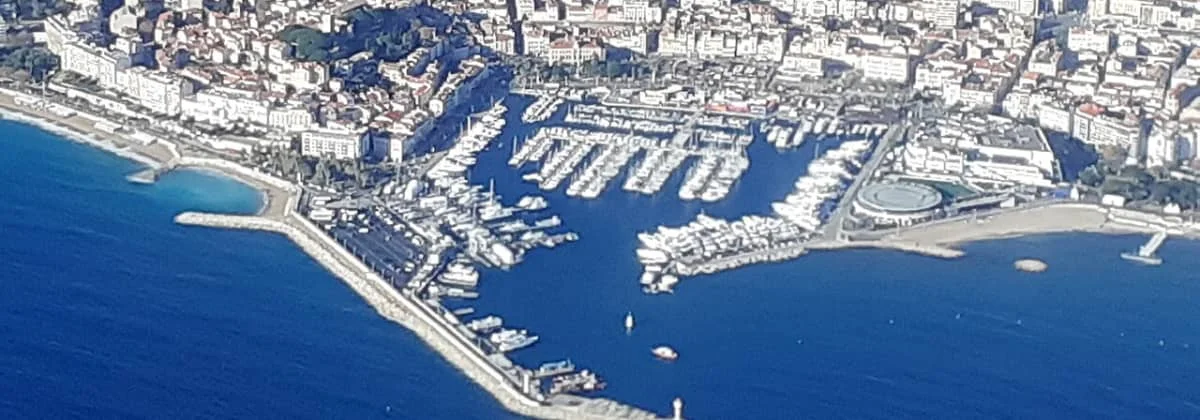
Quick answer: Antibes does two jobs the rest of the Riviera cannot. Port Vauban is Europe’s largest marina by tonnage with more than 1,500 berths from 4.5 to 165 metres, and the 18 superyacht berths on the Quai des Milliardaires set the ceiling of the European market. Around them lives the crew force for the whole Mediterranean fleet.
What Makes Port Vauban Unusual?
Its range, more than its size. Most marinas serve a band: small boats, or medium ones, or the very large. Port Vauban takes vessels from 4.5 metres to 165 metres inside one basin, with more than 1,500 berths in total, and that span is what produces the town’s double economy.
The consequence is visible on the water. A 6-metre day boat and a 100-metre motor yacht share the same harbour entrance, and the businesses ashore serve both. No other European port of this importance keeps that mixture.
| Feature | Port Vauban |
|---|---|
| Standing in Europe | Largest marina by tonnage |
| Berths | More than 1,500 |
| Size range accepted | 4.5 m to 165 m |
| Superyacht section | International Yacht Club d’Antibes |
Why Do Eighteen Berths Matter So Much?
Because there is nothing behind them. The Quai des Milliardaires offers 18 superyacht berths taking yachts up to 160 metres, and for vessels of that size on this coast the alternatives are few and mostly smaller. When supply is measured in tens rather than hundreds, a berth stops behaving like a service and starts behaving like an asset.
That changes how owners approach the market. A berth here is negotiated, inherited, sublet and fought over in a way that a marina space in a normal market never is, and its availability shapes which yachts can realistically be based on this part of the coast at all.
- Establish whether a berth is attached to a vessel or to an owner before buying either.
- Ask what the contract says about a change of vessel length.
- Confirm the term, the renewal mechanism and whether it can be transferred.
- Treat an existing berth arrangement as part of the price of the boat.
Where Does the Crew Economy Fit?
Directly on top of it. Antibes is where superyacht crew live between contracts, where the agencies place them, and where the training courses, uniform suppliers and chandlers that support them operate. The town’s role in the fleet is not the berths alone; it is that a captain looking for an engineer on a Tuesday can find one by Thursday.
That density has consequences an owner feels in the budget. Positions fill faster here than anywhere else in the Mediterranean, relief crew for a single passage can be arranged at short notice, and the same abundance gives crew choices that keep wages competitive. Our guide to the yacht crew employment agreement covers what those contracts have to contain.
| What the crew economy provides | Effect on the owner |
|---|---|
| Agencies with resident candidates | Positions filled in days rather than weeks |
| Training providers on site | Certification maintained without travel |
| Relief and rotational crew | A season that survives a resignation |
| A competitive labour market | Wages set by alternatives, not by goodwill |
How Does Antibes Compare With Its Neighbours?
By function rather than by prestige. Monaco is a jurisdiction with a port attached and allocates berths accordingly. Cannes is a show town with an anchorage. Antibes is where the fleet actually works, and it is the only one of the three where a 12-metre boat is an ordinary customer.
| Port | Its function | Who it suits |
|---|---|---|
| Antibes | Working port and crew centre | Owners at almost any size |
| Monaco | Administered berths, residency-led | Residents and the largest yachts |
| Cannes | Shows and anchorage | Seasonal visitors and sellers |
| Saint-Tropez and the wider coast | Summer destination | Guests rather than operations |
What Does the Season Do to Availability?
It empties and fills the basin twice a year. Summer brings the visiting fleet and the berths that exist are occupied; winter brings the yard work and the crew changes, and the town shifts from hosting yachts to servicing them. An owner arriving in July to arrange anything is arriving at the wrong time.
Plan the year backwards from that. Contracts, yard bookings and crew recruitment all happen more easily between October and March, when the people who make those decisions are not running a season.
What Should an Owner Verify Before Committing?
The berth, in writing, before the boat. Everything else about Antibes is available on demand: trades, crew, provisioning and yard capacity. The berth is the only genuinely scarce input, and an owner who buys a yacht on the assumption that space will appear has bought a problem.
Get the berth arrangement documented first. A vessel with a secured berth on this coast is worth more than the same vessel without one, and the difference is not sentimental.
How Does the Trades Economy Work Here?
At two price levels, in the same streets. The superyacht side supports specialists who work to the standards the largest vessels require, while the working port supports ordinary marine trades at ordinary rates. Both are available to any owner who asks, and the difference in quotation can be substantial.
- Ask whether a quote is priced for a superyacht programme or for a private owner.
- Get more than one quote, because the two economies overlap.
- Confirm who actually performs the work rather than who invoices for it.
- Establish the yard’s experience with your specific systems, not with your size.
The difference between the two price levels is not a scandal, and the lower one is not always the right choice. A superyacht programme buys documentation, scheduling discipline and a project manager who answers the telephone; a private-owner rate buys the work and nothing around it. Decide which you are paying for before comparing the numbers.
Looking for a berth or a crew on the Riviera?
Send the vessel length, the season you need covered and whether the priority is berthing or people. We will point you at the operators who work Port Vauban rather than at a directory.
What Are the Advantages and Disadvantages?
Depth of service against scarcity at the top. The advantages are a marina that takes almost any size, the best crew market in the Mediterranean and trades at two price levels. The disadvantages are 18 berths at the top of the range, summer congestion and a town whose costs reflect its address.
- Advantage: berths from 4.5 to 165 metres in a single basin.
- Advantage: the deepest crew and trades market on the coast.
- Disadvantage: superyacht berthing is measured in tens, not hundreds.
- Disadvantage: everything is harder to arrange between June and September.
How Does the Winter Change the Town?
It turns a marina into a workshop. From October the visiting fleet leaves, the berths that were fought over in July sit empty, and the town’s business becomes maintenance, crew turnover and contracts for the following season. Anyone who has only seen Antibes in August has met the wrong half of it.
That inversion is the practical reason to engage with this port out of season. A berth conversation in November gets an answer; the same conversation in July gets a waiting list. Contractors have capacity, crew are available for interview, and the people who decide things are at their desks rather than on a passerelle.
| Period | What the port is doing | What you can arrange |
|---|---|---|
| June to September | Running a season | Very little beyond using the boat |
| October to December | Emptying and hauling | Yard work, contracts, recruitment |
| January to March | Working | Major projects, crew training |
| April to May | Commissioning | Final preparation, positioning |
What Happens Here in September?
The European market arrives in one place. The Cannes Yachting Festival runs 8 to 13 September 2026 and is the opening of the Mediterranean autumn, with new boats displayed at the Vieux Port and sailing yachts along with second-hand yachts for sale and charter at Port Canto. Six days, two sites, and most of the continent’s brokerage in attendance.
For anyone selling, the split is the operative detail. Being at Port Canto puts a boat in front of buyers who came for used tonnage; being elsewhere puts it in front of people comparing new models. Those are different audiences with different budgets and different questions.
| Site | What it carries | Who walks it |
|---|---|---|
| Vieux Port | New boats from builders | Buyers comparing current models |
| Port Canto | Sailing yachts, used yachts, charter | Brokerage buyers and charterers |
| The bay | Visiting yachts at anchor | Owners attending rather than exhibiting |
How Does the Coast Divide the Work?
By function, and the division is stable. Each port on this stretch does something the others do not, and an owner who understands the split arranges a season easily while an owner who does not spends it improvising.
| Port | Its actual job | Berth position |
|---|---|---|
| Antibes | Working port and crew centre | 1,500+ berths, 4.5 m to 165 m |
| Monaco | Administered berths and September show | About 700, allocated by residency |
| Cannes | Two-site festival, then an anchorage | Limited, with the bay as overflow |
| Saint-Tropez and the smaller ports | Summer destinations | Seasonal, and full when it matters |
Read that table before choosing anything. The Antibes yacht market, Monaco yacht market and Cannes yacht market pages each set out one column in detail.
Who Should Base a Yacht Elsewhere?
Owners who need certainty about space. If a berth cannot be secured, the honest answer is another port rather than a season of improvisation, and the Mediterranean yacht market page sets out where capacity actually exists across the basin.
Owners whose priority is refit rather than operation should look at Palma, where the yard capacity is an order of magnitude larger; our Mallorca yacht market page covers what that means in practice.
Frequently Asked Questions
It is Europe's largest marina by tonnage, with more than 1,500 berths taking vessels from 4.5 metres up to 165 metres. That range is unusual: the same basin holds day boats and some of the largest private yachts afloat, which is why the town supports both a working trades economy and a superyacht one.
It is the superyacht section of Port Vauban, operated as the International Yacht Club d'Antibes, with 18 berths taking yachts up to 160 metres. Eighteen is a small number for a coastline this important, and it is the reason those berths are treated as assets rather than as services.
Because the work is here and the town is affordable relative to its neighbours. Crew agencies, training providers, uniform suppliers and the informal network that fills a last-minute position all sit within walking distance of the port, which makes Antibes the recruitment centre for the whole Mediterranean fleet.
Yes, and that is what distinguishes it from Monaco. Port Vauban's berth range starts at 4.5 metres, so a 12-metre boat is a normal customer rather than an afterthought, and the surrounding trades serve it at prices that reflect a working port rather than a resort.
Cannes lies about 11 kilometres west and Monaco about 30 kilometres east, so the three sit within an easy passage of each other. That proximity is why the Riviera works as one market with different functions rather than as three competing ones.
Sources: marina scale and the superyacht quay from Port Vauban, the town of Antibes Juan-les-Pins and Bespoke Yacht Charter on Port Vauban.
Request a yacht buyer consultation
Share your budget, target LOA, and use case. We reply within one business day with matched brokers or surveyors.