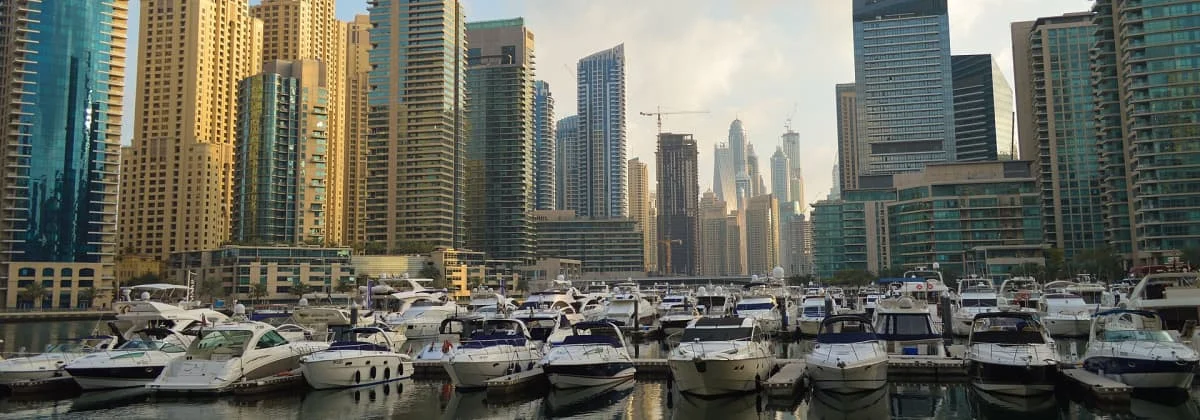
Quick answer: Dubai is the one place in the Gulf where a yacht can be bought and later sold without exporting it first. That comes from 22 marinas and over 3,750 wet berths, a working charter fleet that recycles hulls, resident international brokers, and a boat show that now anchors the calendar in late November. Everything else on this page follows from those four facts.
Why Is Dubai the Only Gulf Market With a Real Exit?
Liquidity is built from four things, and this is the only city in the region holding all of them at once. There has to be enough berth capacity that a new owner can take delivery without a waiting list. There has to be a resident fleet large enough that hulls come to market for ordinary commercial reasons rather than distress. Brokers have to be physically present with international reach. And there has to be a moment in the year when buyers and sellers are in the same place.
Doha has the first, partly. Abu Dhabi has capacity in specific size bands. Neither has the resident turnover or the concentrated buying moment. That is why an owner in the region who cares about resale usually ends up berthing here even when the lifestyle argument points elsewhere.
| Ingredient | Dubai | Elsewhere in the Gulf |
|---|---|---|
| Berth capacity | 22 marinas, 3,750+ wet berths, 640 dry | Concentrated in one or two facilities |
| Resident fleet turnover | Large charter and private fleet | Thin, mostly private |
| Broker presence | International brokers resident | Visiting or represented |
| Annual buying moment | Boat show at Dubai Harbour | Smaller regional shows |
How Deep Is the Berth Supply Behind That Liquidity?
Capacity is the precondition, and the numbers here are unusual for a city of this size. More than 3,750 wet berths and 640 dry berths sit across 22 facilities. Dubai Harbour contributes 700 of the wet total and takes vessels up to 160 metres, and its western expansion added a further 250 berths built specifically for the 30 to 60 metre band, with customs clearance, fuelling and provisioning arranged on site.
That last detail is worth pausing on. The 30 to 60 metre band is precisely where berth scarcity bites hardest in the Mediterranean, and it is the band in which a Gulf-based owner is most likely to be locked into whatever contract they signed. Purpose-built capacity in that range changes the negotiating position of every owner in it.
- Dubai Harbour operates as two distinct marinas, one for charter vessels and one for superyachts and private owners.
- The expansion berths were configured around 30 to 60 metres rather than added as generic pontoon.
- Customs clearance on site matters for any hull arriving from outside the GCC.
- Dry storage of 640 places gives smaller boats an alternative to paying for water.
What Does the Charter Fleet Do to Used Inventory?
A commercial fleet is a supply engine. Charter boats are bought, worked on a depreciation schedule and sold, which puts a predictable stream of hulls onto the brokerage market every year and gives the market something Doha and Abu Dhabi cannot easily manufacture: comparable sales. Prices become discoverable because similar boats keep trading.
The same engine creates the market’s central risk. A commercially worked hull has run more hours, carried more guests and absorbed more wear than a privately used sister ship of the same year, and the listing will rarely lead with that. Dubai Harbour’s split between a charter marina and a private-owner marina gives a buyer a usable first filter before any paperwork is opened.
| Signal | Privately used hull | Commercially worked hull |
|---|---|---|
| Guest load | Occasional | Continuous in season |
| Interior wear | Light for the age | Heavy soft furnishing turnover |
| Service records | Owner-driven, uneven | Operator-driven, often better |
| Where it berthed | Private-owner marina | Charter marina |
Better records on the commercial side surprises people. An operator running a fleet keeps schedules because downtime costs bookings, while a private owner defers what is not urgent. Neither is automatically the safer buy; read the boat rather than the category.
When Does the Selling Calendar Actually Peak?
Late November now sets the rhythm. The Dubai International Boat Show runs 25 to 29 November 2026 at Dubai Harbour, and the move out of April is permanent rather than a one-off reschedule. A show of that size concentrates brokers, buyers and comparable stock into five days, and prices in the weeks either side reflect it.
For a seller this changes the preparation timetable. Work that used to be timed for a spring show now needs finishing by early November, which means booking yard slots in the quiet part of the summer when they are available rather than in the autumn rush. For a buyer the useful window sits just after the show, when the boats that did not sell have visible owners who now know it.
Practical timing: a seller should aim to be listed, surveyed and photographed six to eight weeks before the show opens. A buyer looking for leverage should watch the same listings in the first fortnight of December.
What Does Eight Months of Air-Conditioning Do to a Used Boat?
It ages the systems nobody photographs. A yacht kept in this climate runs chillers, air handlers, seawater pumps and generators at high load for most of the year, and that load falls on components whose condition does not appear in an engine hour reading or a winter walk-through. A hull can present immaculately and be tired underneath, because detailing standards here are high.
Build the survey scope around that reality instead of the standard template. The yacht survey checklist covers the general scope; these are the checks this climate specifically justifies.
- Compare generator hours against main engine hours, and ask for an explanation of any large gap.
- Put the chilled water loop, air handlers, seawater pumps and strainers explicitly in the survey scope.
- Ask the marina for shore power consumption records covering July and August.
- Check battery replacement dates against charger logs, since heat shortens battery life materially.
- Inspect teak seams, caulking, sealants and clear coat for ultraviolet damage that arrives years earlier here.
- Sea-trial at midday with every hotel system loaded, not at dawn with the boat empty.
How Should You Price a Yacht for This Buyer Pool?
Price against local comparables and against the cost of importing an alternative. A buyer in this market has a genuine substitute: a similar hull from Europe, landed here, carrying freight, duty at 5% and the VAT position on the purchase. That landed cost is the ceiling your asking price competes with, and a seller who ignores it will sit on the market while brokers quietly quote the import route to their clients.
The floor is set differently. It comes from what the boat costs to keep while unsold, which in this market means a berth in one of the busier facilities, crew if the vessel carries any, and the maintenance that a hot climate does not allow you to defer. Our yacht pricing guide works through the general method; the Gulf-specific input is that the holding cost is high enough to make a slow sale expensive.
| Input to your asking price | Where it comes from |
|---|---|
| Ceiling | Landed cost of an equivalent import including duty and VAT |
| Anchor | Recent local sales of comparable hulls |
| Floor pressure | Monthly cost of berth, crew and deferred maintenance |
| Timing premium | Proximity to the November show |
Who Should Buy Here Rather Than in Abu Dhabi or Doha?
Choose Dubai when the exit matters more than the address. Owners who expect to change boats within a few years, owners who want a broker they can meet, and owners who need the option of selling without shipping the hull out of the region all belong here. So does anyone in the 30 to 60 metre band who wants a berth built for that size rather than adapted to it.
The alternatives make sense for different reasons and are covered in detail elsewhere. Abu Dhabi is an access market whose berth stock is weighted very differently. Qatar offers no consumption tax on purchase and a superyacht facility with few regional peers. The wider jurisdictional picture, including which authority licenses the hull, sits on the UAE yacht market page.
Buying used in Dubai, or getting ready to sell one?
Send us the model, the year and whether the hull was privately used or commercially chartered. We will line up an independent surveyor and brokers who work this market rather than a listing portal.
What Should a Seller Prepare Before Listing?
Assemble the evidence a cautious buyer will ask for anyway. In a market where the buyer’s default assumption is heavy use, documentation is what separates a quick sale from a long one, and most of it can be gathered in a fortnight.
- Service history for the generators and air-conditioning plant, not only the main engines.
- The craft licence and its renewal date, since a lapsed licence complicates any dealing with the vessel.
- The berth agreement, including whether it transfers to a buyer, which is a real asset in a busy marina.
- Recent survey or class documentation, if the vessel carries class.
- An honest statement of commercial use history, because it will be discovered and it costs more when it is discovered late.
Frequently Asked Questions
Dubai hosts 22 marinas with more than 3,750 wet berths and 640 dry berths. Dubai Harbour alone accounts for 700 berths taking vessels up to 160 metres, and a western expansion added 250 more sized for the 30 to 60 metre band with customs clearance, fuelling and provisioning on site.
The show runs 25 to 29 November 2026 at Dubai Harbour. The April edition was rescheduled and November is now the permanent slot, which moves the market's price-discovery moment from spring to late autumn and changes when a seller should be ready to list.
Yes, on structure rather than sentiment. Dubai has the region's deepest berth supply, a large resident charter fleet that turns hulls over on a commercial cycle, an international broker presence and an annual show that concentrates buyers. Those four things together are what a liquid secondary market is made of, and no other Gulf city has all four.
Air-conditioning and generator condition come before cosmetics. A boat that runs hotel load through a Gulf summer ages its chillers, pumps, seawater circuits and batteries faster than engine hours suggest. Compare generator hours with main engine hours, ask what the marina's power records show for July and August, and sea-trial at full hotel load in the middle of the day.
It operates as two experiences: Harbour Marina for charter vessels and Bay Marina for superyachts and private owners. For a buyer that split is useful information, because it tells you which pontoons hold commercially worked hulls and which hold privately used ones before you have read a single service record.
Sources: berth and marina figures from INTLBM on the UAE superyacht hub and Dubai Harbour Marina. Show dates from Superyacht Services Guide on the Dubai International Boat Show 2026 and the show’s own site. Duty and VAT from Dubai Customs.
Request a yacht buyer consultation
Share your budget, target LOA, and use case. We reply within one business day with matched brokers or surveyors.