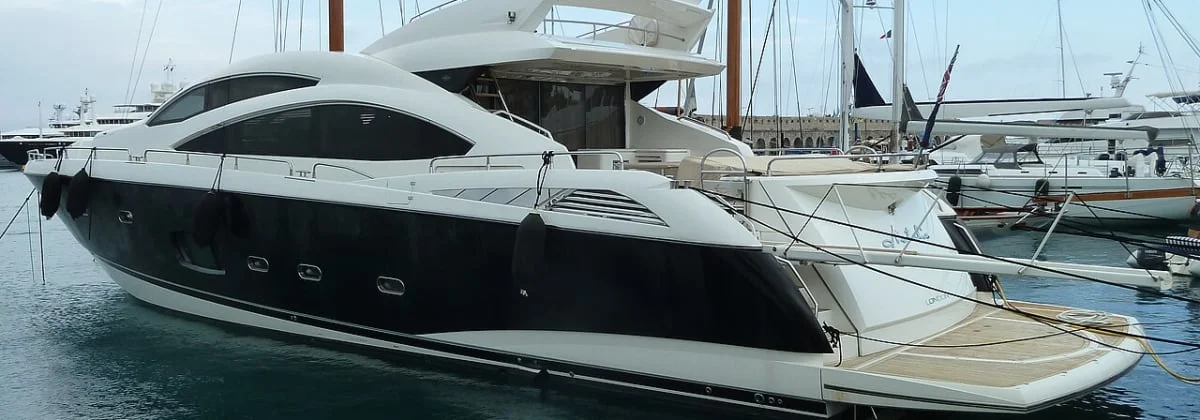
Quick answer: Express cruisers are fast, low-profile motor yachts built around a main-deck helm, open or hardtop cockpit, and below-deck accommodation. They suit owners who want 25-35 knot coastal passages, weekend cabins, sharp styling, and simpler social flow than a flybridge yacht. They do not suit buyers whose priority is maximum interior volume, slow long-range economy, or all-weather upper-deck entertaining.
What Is an Express Cruiser?
An express cruiser is a motor yacht layout built for fast coastal cruising: helm, cockpit, and main outdoor social space sit on one level, while cabins, galley, and heads sit below deck. Most examples use planing hulls, twin inboards, pod drives, sterndrives, or surface drives, and a low superstructure that gives the boat a sporty profile.
The category starts around 30 feet, where it overlaps with large cabin cruisers, and stretches into 70-foot sportscruisers from European builders. The defining trait is not length; it is the relationship between speed, profile, and layout. The owner drives from the main deck, guests sit close to the helm, and the boat is normally used for day trips, restaurant runs, overnight weekends, and short coastal passages.
In the US, the term express cruiser often appears on Sea Ray Sundancer, Formula, Tiara, Cruisers Yachts, and Regal listings. In Europe, brokers may say sportscruiser, sport yacht, open yacht, or hardtop express. Princess V Class, Sunseeker Predator, Pershing, Riva, and Fairline Targa all live in this buyer universe, even if each yard uses slightly different brand language.
Express cruisers sit inside the wider motor yachts market but are more focused than general flybridge or sedan layouts. They sell on acceleration, handling, profile, and dock appeal. A buyer stepping up from center console boats often chooses an express cruiser when they want cabins and climate control without giving up speed and outdoor helm feel.
Propulsion is the other fork in this class, and it decides resale more than layout does. Outboard vs inboard sets out the ten-year cost of each.
How Do Express Cruisers Differ From Sportscruisers and Open Yachts?
Express cruiser, sportscruiser, and open yacht overlap heavily, but the words point to slightly different buying cultures. Express cruiser is the broadest term, sportscruiser usually signals European performance styling, and open yacht usually means even more exposure to sun and weather.
| Term | Common market use | Typical layout | Buyer signal |
|---|---|---|---|
| Express cruiser | US and global brokerage | Hardtop or open cockpit, cabins below | Fast weekend cruiser |
| Sportscruiser | UK and European brands | Sleek hardtop, performance hull | Style and speed priority |
| Open yacht | Mediterranean day use | More exposed cockpit, less enclosure | Warm-climate outdoor use |
| Sport yacht | Premium brand marketing | Larger express or performance yacht | High-end owner image |
A 44-foot Sea Ray Sundancer, 48-foot Formula, 53-foot Princess V Class, and 60-foot Sunseeker Predator may all be cross-shopped by the same buyer. The difference is not always technical; it is often brand language and expected use. US express cruisers tend to emphasise weekend practicality and owner operation. European sportscruisers often lean harder into profile, cockpit theatre, and Med-style day use.
Hardtop design is the main dividing line. A soft-top or fully open boat gives better air and visibility in warm climates but more UV wear. A hardtop express with sliding roof and doors adds weather protection, air conditioning, and better resale in shoulder-season markets. If the buyer needs a genuinely open cockpit, compare open-yacht alternatives. If the buyer wants enclosed main-deck space, compare hardtop express and small flybridge options.
Express Cruiser vs Flybridge: Which Layout Fits Better?
Choose an express cruiser when speed, profile, and cockpit flow matter more than upper-deck space. Choose a flybridge when visibility, guest volume, and outdoor entertaining space matter more than a low profile and slightly cleaner performance.
| Factor | Express cruiser | Flybridge yacht |
|---|---|---|
| Profile | Low, sporty, less windage | Taller, more visual mass |
| Helm position | Main deck, close to guests | Upper helm plus often lower helm |
| Social space | Cockpit-focused | Cockpit plus flybridge |
| Interior volume | Lower at same LOA | Higher at same LOA |
| Fuel at speed | Usually better at equal LOA | Often higher due to weight |
| Weather use | Depends on hardtop | Better separation of zones |
The flybridge yacht argument is simple: more boat for the same length. A 55-foot flybridge usually has a bigger salon, stronger galley-up layout, more exterior seating, and better separation between helm and guests. Families who entertain at anchor often prefer that. Charter-minded buyers usually prefer it too, because guests value space more than the captain values top speed.
The express cruiser argument is equally clear. Less height means less windage, a cleaner profile, and often better speed-to-fuel performance. Docking can be easier because the driver is closer to the cockpit and stern. The boat looks faster at rest and feels more connected underway. Many owner-operators prefer this intimacy: guests are not split between flybridge, cockpit, and salon; everyone is near the helm.
The weak point is volume. A 50-foot express cruiser may only have two cabins and a compact galley below. A 50-foot flybridge may have three cabins, larger windows, a main-deck galley, and a real upper lounge. If the boat will host six people overnight, a flybridge deserves a serious look before committing to express styling.
Why Do Planing Hulls Define Express Cruisers?
Planing hulls define the express cruiser experience because they lift the boat partly out of the water at speed. That reduces wetted surface, increases speed, and creates the fast coastal rhythm buyers expect from this category.
At low speed, every hull moves through the water in displacement mode. As power increases, a planing hull climbs onto the surface and runs flatter. The reward is speed: many 40-55 foot express cruisers cruise comfortably at 25-32 knots and can reach 35-45 knots depending on engines, weight, sea state, and bottom condition. The penalty is fuel burn. Moving fast requires large engines, clean props, clean bottom paint, and steady maintenance.
| Hull mode | Typical speed band | Fuel profile | Express cruiser relevance |
|---|---|---|---|
| Displacement | 6-10 knots | Lowest litres per hour | Slow harbour or bad weather running |
| Semi-planing | 12-20 knots | Often inefficient transition zone | Useful only on some hulls |
| Planing cruise | 24-32 knots | High but predictable | Main express cruiser use case |
| Sprint speed | 34-45 knots | Very high burn and wear | Short bursts, not daily economy |
The most expensive mistake is judging efficiency by litres per hour alone. A boat burning 180 litres per hour at 30 knots may be more efficient per mile than the same boat pushing through the transition zone at 16 knots. The right metric is litres per nautical mile at realistic cruise. During sea trial, ask the captain or surveyor to record fuel flow, RPM, speed over ground, engine load, and trim-tab position at several speeds.
Planing hulls also care about weight. Full fuel, full water, tender, Seabobs, extra batteries, gyro stabiliser, hardtop options, and owner gear can turn a sharp 30-knot cruiser into a stern-heavy 24-knot boat. This matters on used examples where accessories have accumulated over years. If the boat cannot reach rated RPM with clean bottom and normal load, the problem may be prop pitch, engine health, dirty running gear, or simply too much weight.
What Are the Speed and Fuel Tradeoffs?
Express cruisers buy time with fuel. They are excellent when the owner values a 40-mile lunch run, a quick weather window, or a Friday evening passage before dark; they are expensive when used like a trawler for long mileage at high speed.
| Example size | Realistic cruise | Approximate fuel burn | Best use |
|---|---|---|---|
| 35-40 ft express | 24-30 knots | 80-150 litres per hour | Day trips, weekends |
| 45-50 ft express | 26-32 knots | 140-240 litres per hour | Coastal hops, family weekends |
| 55-60 ft sportscruiser | 28-34 knots | 220-380 litres per hour | Med island runs, premium day use |
| 65-70 ft performance cruiser | 30-40 knots | 350-650 litres per hour | High-budget fast passages |
These bands are indicative, not promises. Propulsion changes the result. Twin diesels with shafts are robust and widely understood. IPS pods improve manoeuvrability and packaging but demand strict service intervals and careful inspection. Surface drives can deliver very high speed on Pershing-style yachts but require specialist maintenance and a buyer who understands trim, rooster tail, and shallow-water limitations.
Fuel burn has three layers. First is engine burn at cruise. Second is generator and hotel load: air conditioning, refrigeration, stabilisers, galley, and battery charging. Third is wasted burn from poor setup: fouled bottom, damaged props, wrong trim, overloaded lockers, and running too fast for the sea state. A clean, correctly propped 50-footer can feel transformed after a proper bottom service.
For buyers who cruise mostly under 12 knots, express cruisers are often the wrong platform. The boat can run slowly, but the hull, cockpit, and accommodation were not optimised for silent long-range economy. A displacement trawler or explorer design will feel calmer and cheaper per mile. For buyers who cruise 30-80 nautical miles between marinas, the express cruiser makes more sense: speed turns geography into a day-use playground.
Which Express Cruiser Brands Should Buyers Compare?
The strongest express cruiser brands combine hull reputation, parts support, engine access, and resale liquidity. Princess V Class and Sunseeker Predator are core UK names; Pershing and Riva bring Italian performance and design; US builders such as Sea Ray, Formula, Tiara, and Cruisers Yachts dominate the sub-50-foot brokerage pool.
Princess V Class is one of the cleanest reference points. The V line gives buyers the Princess build culture in a lower, sportier package than the brand’s flybridge models. The appeal is balance: performance without becoming extreme, refined interiors without losing cockpit focus, and strong recognition among UK, Med, and international buyers. A clean Princess V50, V55, or V65 usually attracts broader demand than an obscure boutique sportscruiser.
Sunseeker Predator is the more aggressive British alternative. The Predator line carries strong brand recognition, especially in the Mediterranean and Middle East, and buyers often associate it with performance, noise, and dock presence. Older Predators can be excellent value, but survey discipline matters: big engines, hard use, teak, hydraulic platforms, and complex electronics can turn a cheap asking price into a heavy first-year bill.
Ferretti Yachts itself is better known for flybridge and larger motor yacht lines, but Ferretti Group is central to the express buyer because it owns Pershing and Riva. Pershing is the high-performance choice: surface drives, sharp styling, and serious speed. Riva is the design and heritage choice: more emotional, often more expensive, and strongly supported by brand desirability.
| Brand family | Express cruiser relevance | Strength | Watch item |
|---|---|---|---|
| Princess V Class | Premium UK sportscruiser | Balanced resale and usability | Option load and service records |
| Sunseeker Predator | Performance British icon | Brand pull and speed | Hard-used Med examples |
| Pershing | Ferretti Group performance | High speed and status | Surface-drive expertise |
| Riva | Ferretti Group design | Heritage and desirability | Premium pricing |
| Sea Ray Sundancer | US express benchmark | Huge used market | Moisture and ageing systems |
| Formula / Tiara | US quality cruisers | Owner-operator practicality | Engine and drive service |
Brand should not outrank condition. A tired premium sportscruiser can be worse than a well-kept mainstream express. Buyers should compare engine access, maintenance history, parts availability, and local yard familiarity before paying for a badge.
Comparing express cruiser listings?
Send us size, market, use case, and target budget. We help frame the shortlist before you spend survey money.
How Much Do Express Cruisers Cost in 2026?
Express cruisers in 2026 range from roughly $150K for older 32-38 foot used boats to $10M+ for new 70-foot performance sportscruisers. Most family buyers land in the 40-50 foot band at $350K-$1.2M used or $900K-$2.2M new. Split the market by length, brand, propulsion, and refit risk rather than chasing one average price.
| Segment | Typical LOA | Used benchmark | New benchmark |
|---|---|---|---|
| Entry cabin express | 30-38 ft | $150K-$450K | $350K-$900K |
| Mid-size family express | 40-50 ft | $350K-$1.2M | $900K-$2.2M |
| Premium sportscruiser | 52-62 ft | $800K-$2.5M | $2M-$5M |
| Large performance express | 65-75 ft | $1.8M-$5M | $5M-$10M+ |
Age matters, but condition matters more. A 10-year-old 52-footer with documented annual engine service, recent batteries, refreshed electronics, and clean upholstery may be cheaper to own than a 5-year-old boat with deferred pod service and no generator history. Engine hours also need context. Low hours can mean gentle use, or it can mean long idle periods, stale fuel, seals drying out, and neglected annual maintenance.
Running cost is the second price. For a privately used express cruiser, annual operating cost often lands around 8-15% of vessel value depending on marina, insurance, fuel, service labour, and how much work is deferred. A $900K express cruiser can easily consume $80K-$140K in a normal year before upgrades. Add more if the boat needs teak replacement, air conditioning overhaul, new electronics, or pod-drive catch-up service.
Financing may be easier on mainstream brands with clean comps and strong survey results. Lenders like recognisable collateral. Insurers like documented maintenance, conservative owner experience, and realistic navigation limits. A high-performance 60-foot sportscruiser may need a captain clause, hurricane plan, or named-storm haul-out requirement depending on region.
What Should Buyers Know About the Used Express Cruiser Market?
The used express cruiser market rewards patient buyers because many listings look similar online but differ sharply once survey, engine diagnostics, and sea trial numbers are reviewed. Condition gaps are large in this category because express cruisers live hard: sun, salt, speed, cockpit upholstery, teak, generators, and air conditioning all age visibly.
Used inventory is strongest in South Florida, the US Northeast, the Great Lakes, the UK South Coast, Western Mediterranean ports, and major Australian coastal markets. The Mediterranean has deep Sunseeker, Princess, Pershing, Riva, Fairline, and Azimut sport inventory. The US has a broad Sea Ray, Formula, Tiara, Regal, Cruisers Yachts, and Boston Whaler Realm-style crossover pool. Currency and tax position can make cross-border buying attractive, but import duty, VAT status, CE or US compliance, and shipping can erase headline savings.
The best used examples share four traits. First, service records are complete and easy to read. Second, the boat reaches rated RPM during sea trial. Third, the seller has solved known model issues rather than hiding them behind cosmetic detailing. Fourth, the asking price reflects real comps, not emotional upgrade spend. New upholstery and a stereo do not offset overdue engine service.
Red flags are repetitive. Boats that sit unused for 18 months need deeper mechanical checks. Fresh bottom paint with no explanation can hide blister or grounding history. Wet cockpit coring around hardtop supports or deck hardware is expensive. Pod drives without service invoices are a negotiation issue. Generator faults can reveal poor maintenance culture. Heavy mildew below deck can point to air conditioning, hatch, or drainage problems.
Use the yacht survey checklist before you make an offer unconditional. A proper express cruiser survey should include hull moisture readings, sea trial at multiple RPM points, engine computer downloads where available, thermal checks, generator load test, drive inspection, electrical panel review, safety gear, and verification that all major options work under load.
What Are the Pros and Cons of Express Cruisers?
Express cruisers are strongest when the owner wants speed, style, and direct connection to guests underway. Their disadvantages appear when the same owner expects flybridge volume, displacement-yacht economy, or all-season protection.
| Pros | Why it matters |
|---|---|
| Fast coastal range | 30-80 nautical mile days become easy in good weather |
| Low profile | Better styling, less windage, easier bridge clearance |
| Social helm | Driver and guests share the same cockpit zone |
| Strong used supply | Many brands and budgets in active brokerage markets |
| Owner-operator fit | Many sub-55-foot models can be run without full-time crew |
| Cons | Why it matters |
|---|---|
| Fuel burn at speed | Planing performance is expensive over distance |
| Less volume | Cabins and galley are smaller than flybridge equivalents |
| Weather exposure | Open cockpits and sunroofs age faster |
| Complex propulsion | Pods, surface drives, and big diesels need strict service |
| Limited charter appeal | Guest space can trail flybridge or tri-deck layouts |
The decision is not about whether express cruisers are good boats. It is about whether the category matches the owner’s calendar. If most use is day boating, marina lunches, beach clubs, and short overnight trips, an express cruiser can be ideal. If most use is extended cruising with family, remote anchorages, or charter income, a flybridge, trawler, or larger motor yacht may be a better tool.
What Should You Check Before Buying One?
The most important checks on an express cruiser are propulsion, water intrusion, high-load systems, and sea-trial performance. Cosmetic condition matters, but mechanical and structural condition decide whether the boat is fairly priced.
Start with engine and drive history. Confirm annual services, heat exchanger or aftercooler intervals, oil samples, impellers, belts, batteries, and fuel filters. On pod-drive boats, check gear oil, seals, corrosion, joystick function, and service campaign history. On shaft boats, inspect alignment, mounts, cutless bearings, shafts, props, and vibration at cruise. On surface-drive boats, use a specialist who knows the system.
Then move to the cockpit and hardtop. Express cruisers often have large sliding roofs, glass doors, hydraulic sun pads, electric tables, garage doors, swim platforms, and cockpit grills. Each option is a future maintenance line. Test everything. A $2M sportscruiser with a non-working sunroof and tired hydraulics is not ready for carefree ownership.
Sea trial should be structured. Record idle, 1,500 RPM, displacement speed, transition speed, normal cruise, wide-open throttle, engine load, fuel flow, temperatures, pressures, and smoke. The boat should plane cleanly, hold temperature, steer predictably, and reach rated RPM within manufacturer tolerance. If the seller refuses a proper sea trial, treat that as a pricing signal.
Finally, check ownership context. Ask where the boat lived, how it was stored, who serviced it, why it is being sold, and whether VAT or duty status is clear. For a cross-border purchase, follow a closing process with escrow, title search, lien checks, deletion or registration steps, and written equipment inventory. The yacht buying guide covers the transaction sequence.
Which Buyer Profiles Fit Express Cruisers Best?
Express cruisers fit buyers who use speed frequently and overnight space occasionally. They are weaker for buyers who imagine long liveaboard seasons, low fuel budgets, or charter-style guest volume.
Strong buyer profile: a couple or family based in South Florida, the Med, the UK South Coast, or the Great Lakes who wants fast weekend access to nearby islands, restaurants, or marinas. They value 28-knot cruise, a social cockpit, two cabins, and owner operation. They are comfortable paying for fuel when speed saves half a day.
Borderline profile: a buyer who wants a first yacht for family cruising and is choosing between a 48-foot express and a 48-foot flybridge. If guests sleep aboard often, the flybridge may win. If the boat is mostly for day use and occasional weekends, the express may feel more exciting and easier to handle.
Weak profile: a buyer planning long passages, year-round cold-weather cruising, or charter income. Express cruisers can do coastal passages, but they are not usually the right platform for slow ocean mileage or maximum guest separation. For that use, start with displacement, explorer, raised pilothouse, or larger flybridge designs.
Insider tip: ask yourself how often you will actually cruise above 24 knots. If the honest answer is rarely, do not pay the fuel, depreciation, and maintenance premium for a boat designed around planing speed. If the honest answer is every good weekend, the category makes sense.
How Should You Shortlist an Express Cruiser?
Build the shortlist from use case first, not brand first. Decide length, climate, cockpit enclosure, cabin count, propulsion tolerance, annual fuel expectation, and service access before falling in love with a profile photo.
A practical shortlist starts with five filters. First, pick the true LOA band: 38-45 feet for owner-operated weekend use, 46-55 feet for family comfort, 56-65 feet for premium Med-style sportscruising, and 65 feet or larger for high-budget performance ownership. Second, decide hardtop vs open cockpit. Third, decide whether pods are acceptable. Fourth, map local yard support for engines and drives. Fifth, set a first-year reserve.
For first-year reserve, be conservative. Used express cruisers often need batteries, canvas, upholstery, electronics refresh, bottom work, prop tuning, HVAC service, safety gear, and generator attention after closing. Even clean boats can need $30K-$100K in catch-up depending on size. Large premium sportscruisers can exceed that quickly if teak, hydraulics, or drive systems are due.
The best purchase is rarely the cheapest listing. It is the boat with the clearest records, correct spec, realistic seller, clean sea trial, and supportable price. If two boats are close, choose the one with better service access in your home port. Express cruisers are meant to be used often; a boat waiting six weeks for specialist parts loses the whole point of the category.
Where Does an Express Cruiser Fit in the Yacht Journey?
An express cruiser is often the bridge between fast boats and full motor yacht ownership. It gives a center-console owner cabins, a generator, air conditioning, and real cruising capability, while preserving speed and owner-driver feel.
Many owners start with a 34-40 foot express, move into a 45-55 foot hardtop sportscruiser, then choose one of two paths. Some stay with performance and step into Princess V Class, Sunseeker Predator, Pershing, or Riva. Others realise they want more space and move toward flybridge yachts, trawlers, or larger semi-displacement motor yachts.
There is no wrong path if the boat matches the calendar. The wrong purchase is using express styling to solve a flybridge problem, or buying flybridge volume when what you really wanted was a fast cockpit boat. Start with honest use, verify the machinery, and let the sea trial decide whether the listing deserves your offer.
Want a clean express cruiser shortlist?
Tell us your market, LOA range, cabin needs, and speed expectations. We help compare express, flybridge, and performance alternatives before you commit.
In this segment the recurring shortlist is Princess and Sunseeker, with Riva at the design-led end.
For the smaller and trailerable end of the market, the boats hub covers centre consoles, fishing boats and pontoons rather than yacht-scale hulls.
Frequently Asked Questions
A fast motor yacht or large cabin cruiser with main-deck helm and cockpit, cabins below, and usually a planing hull. It is built for coastal speed and weekend cruising.
Usually yes, the two describe the same configuration. Sportscruiser is the common term in UK and European brand language, express cruiser in US brokerage. Both mean a single-level helm and cockpit with accommodation below and no flybridge. The label matters when searching listings across markets, since the same hull can appear under either term depending on where it is listed.
Choose express for speed, a low profile that clears more bridges, and the connection between helm and cockpit. Choose flybridge for interior volume, upper-deck entertaining and better guest separation at the same length. The trade is real in both directions: an express gives up volume and weather protection, a flybridge gives up air draft and some top-end speed.
Many 40 to 55ft express cruisers cruise at 25 to 32 knots and reach 35 to 45 knots depending on hull, engine package, load and sea state. Treat brochure figures as light-boat numbers: fuel, water, tender and a full guest load routinely cost several knots. Sea-trial at your realistic load and confirm the boat reaches its rated revs, since falling short indicates a prop or engine problem.
A 45-50 foot express cruiser may burn roughly 140-240 litres per hour at planing cruise. Larger 60-foot sportscruisers can burn 220-380 litres per hour or more.
Princess V Class, Sunseeker Predator, Pershing, Riva and Fairline Targa on the European side; Sea Ray Sundancer, Formula, Tiara and Cruisers Yachts on the US side. The European performance brands price higher and hold value on brand strength, while the US builders offer more boat per dollar. Compare on engine package and documented hours rather than on badge, since that is what the next buyer discounts.
Request a yacht buyer consultation
Share your budget, target LOA, and use case. We reply within one business day with matched brokers or surveyors.