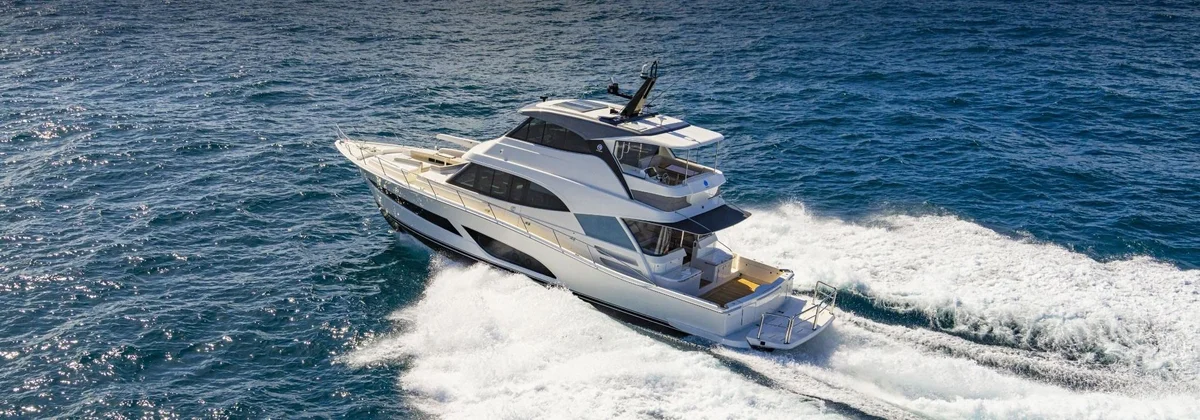
Quick answer: Flybridge yachts are motor yachts with an upper helm and outdoor deck above the main salon, built for buyers who want visibility, guest space, and proper overnight cruising comfort. The sweet spot is 45-65 feet: large enough for cabins, galley, cockpit, and a usable bridge, but still manageable for private owners with occasional captain support.
What Is a Flybridge Yacht?
A flybridge yacht is a motor yacht with a second helm station and outdoor lounge area above the main deck. That upper level is the difference: it changes how the boat is driven, how guests use the boat at anchor, and how much usable living space the owner gets per foot of length.
On a typical flybridge design, the main deck contains the salon, galley, lower helm, aft cockpit, and access to cabins below. The flybridge above usually includes a helm, companion seating, sunpad, wet bar, grill, dining table, and sometimes a hardtop. On larger vessels, the bridge can feel like a second open-air salon.
That is why flybridge yachts dominate the family motor yacht segment. They are not the fastest layout, and they are not the cheapest to run, but they solve the problem most private buyers actually have: they want a boat where six to ten people can spend a day comfortably without crowding one cockpit.
If you are still comparing the basic categories, start with the broader motor yachts guide first. This page goes deeper on flybridge-specific decisions: layouts, brand positioning, price bands, running costs, survey risks, and the buyer checklist that separates a clean vessel from a beautiful problem.
Why Do Buyers Choose Flybridge Yachts Over Express Cruisers?
Buyers choose flybridge yachts when outdoor space, guest comfort, and helm visibility matter more than a low sporty profile. An express cruiser can be faster and sleeker, but a flybridge usually gives more usable living area, better separation between guests and crew, and a more relaxed cruising rhythm for families.
The flybridge is especially useful in the Mediterranean, South Florida, the Caribbean, Australia, and Southeast Asia, where boats spend long days at anchor and social space matters. Guests naturally split between the aft cockpit, salon, bow, and upper deck. Nobody is forced to sit in a single cockpit behind the helm.
From the owner’s perspective, the upper helm also changes manoeuvring. Docking from the flybridge gives better sightlines down both sides of the yacht, clearer awareness of stern position, and easier communication with crew or family handling lines. Many owner-operators prefer this visibility to a lower helm, especially in tight marinas.
There are trade-offs. The extra upper structure adds weight and windage. A flybridge yacht typically burns more fuel than an equivalent express cruiser at the same speed, and the higher profile increases bridge-clearance issues on inland routes. The top deck also creates more canvas, cushions, drainage, gelcoat, and stainless hardware to maintain.
The practical buying question is simple: will you use the upper deck every trip? If yes, a flybridge is usually worth the added cost. If you mainly want fast two-person weekend runs, a sport or express profile may be a cleaner fit.
Which Flybridge Yacht Size Should You Buy?
The right size depends on how many people sleep aboard, whether you need crew, and how confident you are handling beam, windage, and docking. Most private buyers should think in bands rather than chasing one exact length, because a well-designed 52ft yacht can feel larger than a poorly laid-out 58ft yacht.
| Size Band | Typical Buyer | Practical Notes |
|---|---|---|
| 40-45ft | First flybridge, couple or young family | Owner-operator friendly, two cabins common, limited crew space |
| 46-55ft | Core family cruiser | Three cabins possible, strong resale, manageable annual cost |
| 56-65ft | Experienced owner, bigger guest load | More systems, higher marina cost, captain support often sensible |
| 66-78ft | Semi-crew operation | Better range and comfort, but survey and refit exposure rises |
| 80-90ft | Entry superyacht feel | Crew, compliance, insurance, and berthing become central decisions |
The 45-55ft range is the normal entry point for serious flybridge buyers. You get a proper salon, lower helm, galley, two or three cabins, usable bridge seating, and enough engine room access for maintenance. It is also the range with the broadest inventory and the most predictable resale data.
The 56-65ft bracket is where the yacht begins to feel substantially more comfortable. Cabins improve, storage improves, the galley becomes more workable, and the flybridge can carry a wet bar, grill, dining table, and larger sunpad. But the cost curve steepens. Berths are more expensive, fuel burn rises, and annual maintenance can surprise buyers coming from smaller boats.
Above 65ft, the ownership model changes again. Many owners still operate privately, but the boat starts to want professional help. Engines are larger, systems are duplicated, air conditioning capacity increases, and hydraulic equipment becomes more complex. A buyer who wants independence should be honest about whether they enjoy managing machinery, crew scheduling, and yard periods.
What Layout Features Matter on a Flybridge Yacht?
Five layout decisions matter most on a flybridge yacht: galley position, flybridge access, hardtop versus canvas, cabin usability, and service access. A boat where cockpit, salon, helm, stairs, and bridge connect cleanly beats one with a longer option list. Most buyer regrets trace back to a layout that looked impressive at a boat show but felt impractical at anchor.
Start with the galley position. Aft-galley layouts, common on modern Azimut, Princess, Galeon, and Prestige models, connect the cockpit to the salon and make entertaining easier. Forward-galley layouts can create a more formal salon, but they separate food prep from the cockpit and upper deck. Neither is automatically better; the right answer depends on how you host.
Next, look at flybridge access. Stairs should be wide enough to use safely underway, with proper handholds and no awkward step geometry. If older family members or children will be aboard, this matters more than glossy marketing photos. A flybridge that is hard to access becomes underused.
Hardtop versus bimini is another real decision. A hardtop costs more and adds weight, but it protects electronics, creates shade, and increases perceived quality in resale. Canvas is cheaper and lighter, but it ages faster in UV-heavy climates and can become noisy at speed. In tropical markets, shade is not a luxury. It decides whether the upper deck is usable at noon.
Cabin layout deserves equal scrutiny. Three-cabin layouts are common around 50ft, but not all third cabins are equal. Some are usable guest cabins; others are narrow bunk rooms that become storage. If charter is part of your ownership plan, cabin usability directly affects revenue potential. If the yacht is private, a two-cabin layout with better heads and storage may be more comfortable.
Finally, inspect service access. A glossy flybridge yacht with poor engine access is a future yard bill. You want safe access to engines, filters, seacocks, batteries, generator, air conditioning units, and water systems. The easier the boat is to maintain, the more likely it is to be maintained correctly.
Which Brands Build the Best Flybridge Yachts?
The strongest flybridge brands combine design, dealer support, parts availability, resale liquidity, and enough model volume for surveyors to know their weaknesses. Azimut, Princess, Sunseeker, and Ferretti carry the deepest global recognition and resale data, while Absolute, Fairline, Galeon, Prestige, Riviera, and Maritimo can be excellent choices depending on region.
Azimut is the volume leader in Italian flybridge yachts. The brand’s strength is market depth: many models, many dealers, broad parts familiarity, and strong Mediterranean inventory. Azimut flybridge yachts often prioritise interior volume, contemporary styling, and lifestyle features. Used examples are easy to compare because there are usually multiple similar listings on the market.
Princess Yachts is a benchmark for British flybridge build quality in the 45-75ft range. Princess tends to attract buyers who value balanced hulls, restrained interiors, and strong service reputation. Their F Class range is especially relevant for buyers who want a practical family flybridge rather than a fashion-led boat.
Sunseeker sits sportier. The Manhattan and Yacht lines serve flybridge buyers who still want aggressive styling and higher performance cues. Sunseeker resale is strong in the UK, Mediterranean, and South Florida, but condition varies widely because many boats are used intensively in charter or high-season private programmes.
Ferretti Yachts remains a serious choice for buyers who want Italian pedigree with a slightly more conservative ownership profile than some design-led competitors. Ferretti’s fit-out, systems thinking, and dealer depth can be strong, particularly in Europe. Riva and Custom Line, also within Ferretti Group, serve different buyer emotions and budgets.
For value, do not ignore Prestige, Galeon, Fairline, Absolute, Riviera, and Maritimo. Prestige is often attractive for buyers seeking newer boats at lower entry cost. Galeon has gained attention with transformable balconies and entertaining layouts. Riviera and Maritimo are especially respected in Australian and long coastal cruising contexts, where seakeeping and machinery access matter.
| Brand | Buyer Appeal | Watch Carefully |
|---|---|---|
| Azimut | Volume, style, resale liquidity | Older electronics, air conditioning, cosmetic wear |
| Princess | Balanced build, strong UK reputation | Price premium, survey history, service records |
| Sunseeker | Sporty image, charter appeal | Engine hours, hard use, teak and upholstery |
| Ferretti | Italian pedigree, systems maturity | Regional parts support outside Europe |
| Prestige | Value and modern layouts | Depreciation, spec depth, fit-out durability |
| Riviera | Long coastal practicality | Import pricing outside core markets |
How Much Do Flybridge Yachts Cost in 2026?
Flybridge yacht prices depend on length, brand, age, engine package, options, location, and survey condition. A clean used 50ft production flybridge can be a rational $600,000 purchase, while a new 70ft yacht with options can exceed $4M before tax, delivery, and owner supplies.
| Flybridge Size | Used Price Range | New Price Range | Typical Annual Cost |
|---|---|---|---|
| 40-45ft | $300K-$750K | $700K-$1.3M | $45K-$120K |
| 46-55ft | $450K-$1.4M | $900K-$2.2M | $70K-$220K |
| 56-65ft | $850K-$2.5M | $1.8M-$3.8M | $130K-$380K |
| 66-78ft | $1.8M-$5M | $3.5M-$7M | $280K-$800K |
| 80-90ft | $3M-$8M+ | $6M-$12M+ | $500K-$1.5M+ |
These are planning ranges, not valuation opinions. Two yachts with the same model year can differ by hundreds of thousands of dollars after survey. Stabiliser condition, engine hours, generator hours, paint, teak, upholstery, navigation electronics, tender package, tax status, and recent yard work all change fair value.
The used market is often the better starting point for first-time flybridge buyers. Production yachts depreciate heavily in early years, and many 5-10 year old vessels still have modern layouts, joystick docking, stabilisers, large glass, and current electronics. The key is buying the maintained one, not the cheapest one.
New builds make sense when the buyer wants a specific configuration, warranty period, current model styling, or a tax and registration plan that favours new purchase. But options can move the final price sharply. Gyro stabilisers, hardtop, upgraded generators, tropical air conditioning, hydraulic platform, watermaker, premium navigation package, and upgraded audio can add significant cost.
Before placing a deposit, model the full purchase stack in the yacht buying guide: purchase price, tax or VAT, survey, sea trial, closing, registration, insurance binders, delivery, commissioning, initial service, safety equipment, berth deposit, and first-season defects.
What Are the Real Running Costs of a Flybridge Yacht?
Running costs for flybridge yachts are higher than many buyers expect because the layout adds systems: upper helm electronics, exterior upholstery, drainage, hardtop or canvas, wet bar, grill, refrigeration, speakers, lighting, and sometimes hydraulic equipment. Annual cost is not just engines and fuel.
The standard planning rule is 8-15% of vessel value per year for private use. A lightly used $800,000 yacht might sit near the lower end if it is well maintained and berthed affordably. A $2M yacht in South Florida, the Balearics, or the French Riviera can easily sit higher once berth, insurance, detailing, crew support, and yard periods are included.
Fuel is the most visible variable. A 50-55ft flybridge running at 22-25 knots may burn roughly 100-160 litres per hour depending on engines, load, hull, sea state, and fouling. Slowing down can change the budget dramatically. For detailed fuel modelling, use the yacht fuel costs guide before you shortlist boats.
Insurance has tightened in several regions. Hurricane exposure, owner experience, vessel age, survey findings, flag, and cruising area all affect premiums. Some insurers require captain sign-off, named storm plans, updated surveys, or restricted navigation zones.
Maintenance is where cheap boats become expensive. Air conditioning, generator, batteries, chargers, hydraulic platform, stabilisers, windlass, passerelle, tender lift, toilets, pumps, and electronics all age. A flybridge yacht with deferred maintenance can look beautiful from the dock and still require a six-figure first-year correction.
Use the yacht ownership cost guide to build a full annual budget, then add a first-year reserve. The first season after purchase often reveals the items that the seller tolerated but the new owner wants fixed.
What Should You Check Before Buying a Used Flybridge Yacht?
A used flybridge yacht needs a deeper inspection than a simple cosmetic walkthrough. The upper deck creates specific failure points: water ingress around fittings, worn exterior upholstery, blocked drains, tired bimini hardware, cracked hardtop mounts, corroded rails, and electronics exposed to years of sun and salt.
The pre-purchase sequence should include document review, broker comparable review, written offer with survey contingencies, haul-out, hull survey, machinery survey, sea trial, oil sampling, electronics check, systems test, and final defect negotiation. The yacht survey checklist covers the broader inspection process, but flybridge buyers should add a few layout-specific checks.
Start with water. Inspect the underside of the flybridge deck, salon headliner, window frames, stair area, hardtop bases, and any cabinet below upper-deck fittings. Small leaks can travel through wire chases and appear far from the source. Staining, swollen veneers, musty smell, or mismatched headliner panels deserve attention.
Then test every flybridge system under load. Upper helm steering, throttles, joystick, bow thruster, trim tabs, autopilot, chartplotter, VHF, engine displays, horn, windlass controls, lights, refrigerator, grill, icemaker, stereo, and wet bar pumps should all be tested. A seller saying “we never use that” is not a pass.
Engine room access matters. A flybridge yacht often carries larger engines than an express cruiser of similar length because it has more structure and weight. Surveyors should check mounts, shaft alignment, cooling systems, exhaust, turbo condition, fuel tanks, batteries, chargers, and service intervals. Oil analysis is inexpensive compared with engine rebuild exposure.
Finally, evaluate the boat as a resale asset. Highly personalised upholstery, unusual colour schemes, non-standard electronics installations, DIY wiring, and missing service history reduce the future buyer pool. A yacht can be enjoyable and still be a weak resale candidate.
Are Flybridge Yachts Good for Charter?
Flybridge yachts can work well in charter when the layout, cabin count, location, and compliance package match market demand. The upper deck is a strong guest feature, but charter revenue should be treated as an offset, not a guaranteed way to pay for the yacht.
The best charter candidates usually have three or four guest cabins, separate crew accommodation where required, stabilisers, reliable air conditioning, strong shade, water toys, modern AV, and a clean safety and compliance file. Mediterranean and Caribbean charter guests care about sun space, dining areas, cabins, crew service, and photos. The flybridge helps with all of that.
But charter use increases wear. Upholstery, teak, tender, galley equipment, toilets, air conditioning, and soft goods work harder. Insurance and compliance costs rise. Crew management becomes more formal. The yacht may need coding or inspection depending on jurisdiction and flag.
If charter is part of your plan, buy for charter from the beginning. Do not buy a private-spec yacht and assume revenue will appear. Ask charter managers for comparable booking data, realistic weeks per season, commission structure, cleaning cost, crew requirement, and maintenance impact. A conservative plan beats a glossy income projection.
Which Flybridge Yacht Is Best for Owner-Operators?
The best owner-operator flybridge yacht is usually 45-55ft, with bow and stern thrusters, clear sightlines, simple systems, good side-deck access, manageable beam, and a service network in the home port. Bigger can be comfortable, but bigger also increases stress when weather and marina space get tight.
Look for predictable handling rather than maximum interior volume. Joystick docking is useful, but it should not be a substitute for basic boat-handling skill. Windage on a flybridge matters. A boat with high topsides, hardtop, and large side area can move quickly in crosswind during docking.
Side decks should be safe. Rail height, deck width, handholds, and foredeck access matter when a couple is handling lines without crew. A gorgeous boat with narrow side decks can be frustrating in real use.
Engine and generator access should also be owner-friendly. If routine checks require crawling over hot machinery, maintenance will be skipped. Daily inspections need to be easy: oil, coolant, strainers, belts, bilges, batteries, and seacocks.
For first-time buyers, the cleanest path is often a well-maintained 48-52ft yacht from Azimut, Princess, Prestige, Fairline, Riviera, or Galeon, purchased after a strict survey. It gives enough yacht to learn on without pushing immediately into crew-level complexity.
Shortlisting flybridge yachts by budget?
Send your target length, region, and annual budget. We will help you pressure-test the shortlist before you commit to survey.
How Should You Compare Two Flybridge Listings?
Compare flybridge listings by total risk, not asking price. The cheaper boat is not cheaper if it needs engines, teak, air conditioning, batteries, electronics, upholstery, and a berth change. The right comparison stacks age, hours, service history, options, location, tax status, survey findings, and resale liquidity.
Start with model comparables. If three similar 2017-2019 yachts are listed, look beyond headline price. Which one has stabilisers? Which has updated electronics? Which has current engine service? Which has VAT paid status in Europe? Which one has new exterior cushions? Which has a documented yard history?
Then compare cost to own in your location. A yacht priced attractively in one country may require delivery, import, tax planning, re-registration, insurance changes, and local compliance work. A local boat at a higher sticker price can sometimes be cheaper after all-in closing and first-year costs.
Finally, compare exit. Azimut, Princess, Sunseeker, and Ferretti often win on resale depth because there are more buyers, brokers, and surveyors who understand the models. A lesser-known brand can be a smart purchase if you buy at the right price and plan to hold, but it may take longer to sell.
Buyer Checklist for Flybridge Yachts
A disciplined flybridge purchase starts before the viewing. Decide the maximum length you can berth, the number of cabins you need, your annual budget, whether you will hire captain support, your cruising grounds, and whether charter matters. Without those answers, every glossy listing looks tempting.
Use this checklist before making an offer:
- Confirm home berth availability before choosing length.
- Build a full annual budget, not just a purchase budget.
- Check engine and generator service records against hours.
- Confirm stabiliser type, service history, and parts support.
- Inspect flybridge drainage, hardtop, canvas, cushions, and helm electronics.
- Test both helms, thrusters, steering, throttles, navigation, and communication systems.
- Review VAT, tax, flag, registration, title, liens, and ownership documents.
- Require haul-out, sea trial, machinery survey, and oil analysis.
- Negotiate survey findings with written cost estimates, not rough guesses.
- Keep a first-year reserve for defects that appear after closing.
The strongest deals are rarely the most emotional ones. They are the boats where the owner understands the budget, the surveyor has room to be strict, the broker can provide real comparables, and the seller has maintained records well enough to defend the asking price.
GlobalYachtGuide Editorial Note on Flybridge Yacht Buying
Flybridge yachts are popular because they match how private owners actually use boats: short coastal passages, long lunches at anchor, family weekends, marina evenings, and occasional longer runs. The layout is forgiving, sociable, and easy to understand. That popularity also means the brokerage market contains everything from carefully maintained owner boats to tired charter platforms with polished photos.
Our strongest guidance: do not buy a flybridge yacht only from the salon. Spend time on the upper deck, move around the side decks, open lockers, sit at both helms, inspect the engine room, and imagine a windy docking day with guests aboard. A good flybridge yacht should feel practical, not just impressive.
For most buyers, the best risk-adjusted purchase is a mainstream 5-10 year old model from a brand with dealer support in the intended cruising region. Let the survey decide whether the deal is good. The brand gets you into the right market; the individual vessel’s condition determines whether you should buy.
Flybridge platforms in this band come mostly from a handful of yards: see the brand guides for Pershing, Riviera and Ocean Alexander for model ranges and resale notes.
Frequently Asked Questions
A flybridge yacht is a motor yacht with an elevated upper helm and outdoor deck above the main salon. The flybridge adds visibility, sun space, dining, and social seating, making it one of the most popular layouts for 40-90ft family motor yachts.
Used 40-50ft flybridge yachts can start around $300,000-$800,000 depending on age and condition. New 45-65ft production flybridge yachts commonly range from $800,000 to $3M. Larger 70-90ft flybridge yachts often run $3M-$8M+ before options, tax, delivery, and commissioning.
A flybridge yacht can be a good first yacht if the buyer has realistic expectations about berthing, fuel, maintenance, and handling. The 45-55ft range is the usual entry point for owner-operators. Above roughly 60ft, most buyers benefit from a captain, at least for delivery, training, and busy marina manoeuvres.
Azimut, Princess, Sunseeker, Ferretti, Fairline, Absolute, Prestige, Galeon, Riviera, and Carver are among the most visible flybridge builders. For resale liquidity, Azimut, Princess, Sunseeker, and Ferretti have the strongest global recognition in the 45-75ft brokerage market.
Annual ownership cost commonly runs 8-15% of vessel value for privately used flybridge yachts. A $1M flybridge yacht may cost $80,000-$150,000 per year before major refit events. Fuel, marina berth, insurance, maintenance, crew or captain support, and haul-out are the main budget lines.
Inspect engines, generator, shafts or pods, stabilisers, air conditioning, flybridge deck drains, bimini or hardtop structure, electronics age, window seals, teak, hydraulic passerelle, and evidence of water intrusion below the upper deck. Always commission an independent survey and sea trial before closing.
Request a yacht buyer consultation
Share your budget, target LOA, and use case. We reply within one business day with matched brokers or surveyors.