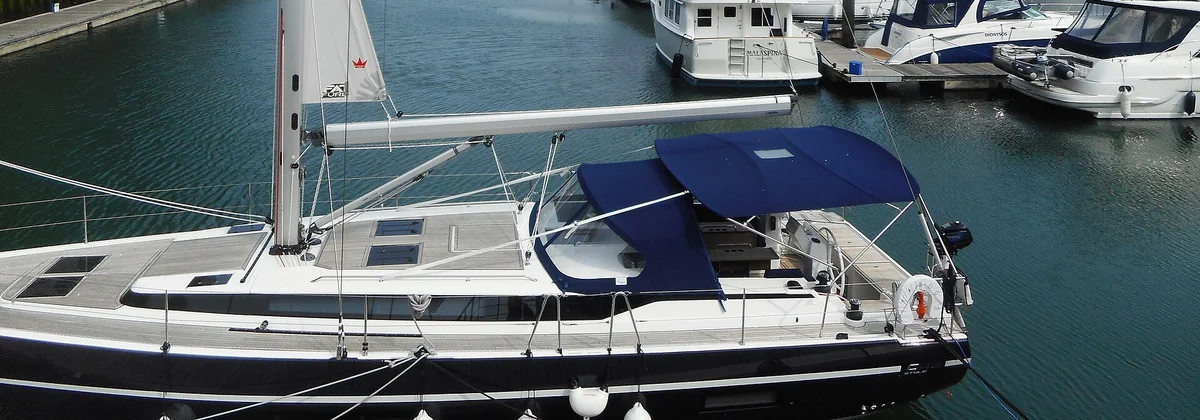
Quick answer: UK boat finance divides into a marine mortgage, secured against the vessel and registered on Part 1 of the UK Ship Register, and unsecured personal lending, which is quicker and dearer. The marine mortgage is the cheaper money and it comes with three conditions buyers underestimate: a deposit commonly of 20% to 30%, Part 1 registration with the mortgage recorded against it, and documentary evidence of VAT status, because an unresolved VAT question sits on the very asset the lender is securing.
Marine Mortgage or Personal Loan?
The two routes serve different buyers and the crossover is mostly about the boat rather than the borrower.
| Marine mortgage | Unsecured personal loan | |
|---|---|---|
| Security | The vessel, registered on Part 1 | None |
| Rate | Lower | Several percentage points higher |
| Deposit | Commonly 20% to 30% | Not applicable |
| Registration required | Part 1, UK Ship Register | None |
| VAT evidence required | Yes, normally a condition | Not usually |
| Survey required | Yes on used boats | No |
| Time to complete | Weeks, registration is the long pole | Days |
| Typical size | Larger purchases | Smaller amounts, older boats |
| Insurance condition | Comprehensive, lender noted | Not a loan condition |
An unsecured loan is the right answer for a modest boat, an older hull no lender will secure against, or a buyer who needs to move quickly. For how the same decision looks in another market, the Australian boat finance page sets out a system where vessel age caps the term in much the same way. For anything of real value the marine mortgage is materially cheaper money and worth the extra weeks.
The general mechanics of secured marine lending, including how a preferred mortgage behaves on a sale, are covered in the marine mortgage guide. This page is the UK market specifically.
What Rates and Terms to Expect
Bands below are directional planning figures for September 2026 and are not quotes. UK marine lending prices from base rate, from the loan-to-value position and from the boat’s age, in roughly that order.
| Profile | Structure | Term often available |
|---|---|---|
| New or near-new boat, 30% deposit | Marine mortgage | Up to 15 years on higher values |
| Used boat under 10 years, 25% deposit | Marine mortgage | 10 to 12 years |
| Used boat 10 to 15 years | Marine mortgage | 5 to 10 years |
| Used boat over 15 years | Often unsecured only | 1 to 7 years |
| Any age, borrower needs speed | Unsecured personal | 1 to 7 years |
The fee schedule matters as much as the headline rate on a shorter term.
| Fee | Who charges it | Notes |
|---|---|---|
| Arrangement or facility fee | Lender | Sometimes a percentage of the advance |
| Broker fee | Marine finance broker | Should be disclosed in writing up front |
| Valuation or survey | Buyer, via the surveyor | Needed anyway on a used boat |
| Part 1 registration | UK Ship Register | Plus tonnage measurement |
| Mortgage registration | UK Ship Register | Recording the lender’s interest |
| Early repayment charge | Lender | The one that bites if you sell early |
Insider tip: ask for the early repayment charge as a figure at year 3 and year 5, in writing, before you accept the offer. Boats change hands sooner than borrowers plan, and an early repayment charge that seemed academic at drawdown is a common reason a sale two or three years later does not work.
Why Part 1 Registration Sets the Timeline
This is the mechanical fact that shapes a financed UK purchase, and it catches buyers who have only financed property or cars.
A registered marine mortgage is recorded against the vessel’s Part 1 entry. If the boat is not on Part 1, there is nothing to record the mortgage against, so the lender cannot take the security it has agreed to. That means the sequence is: register the boat on Part 1, then register the mortgage, then draw down.
| Step | Who does it | Effect on the date |
|---|---|---|
| Tonnage measurement | Authorised measurer | Must be booked, adds days or weeks |
| Part 1 application | Owner or an agent | Processing time at the registry |
| Carving and marking note | Owner, with evidence | Physical marking on the vessel |
| Mortgage registration | Lender, once Part 1 is live | Follows registration |
| Drawdown | Lender | Only after the security is in place |
The practical consequence is that a completion date agreed with a seller before the registration process has started is a hopeful date rather than a real one. Start the registration conversation with the lender at offer stage, not after survey. The UK buying guide sets the registration question in the wider purchase sequence.
Financing a boat in the UK?
Send us the boat, its age and the deposit you have. We will map the likely structure, the registration timeline and what the monthly figure looks like alongside berth and insurance.
VAT Status and the Lender
British lenders take VAT status seriously because the liability attaches to the vessel, which is their security.
A boat with a clean VAT history and documents to prove it is straightforward. A boat with an unclear position is a boat the lender may be securing against an asset carrying an unknown future charge, and most will either decline or require the position resolved as a condition.
| VAT position | Effect on the application |
|---|---|
| Original invoice showing VAT paid, chain intact | Straightforward |
| Evidence of UK location at the relevant date | Usually acceptable with supporting paper |
| Returned Goods Relief documentation in order | Acceptable where properly evidenced |
| Boat in EU waters since Brexit, position unexamined | Commonly stalls the application |
| Paperwork lost, seller asserts VAT paid | Often declined, or heavily conditioned |
Resolve this before you apply rather than during. The UK VAT guide sets out what each document does and what to ask a seller for.
What a Marine Finance Broker Adds
The UK has a well-established marine finance broking market, and whether it is worth using depends on the case.
A broker is worth it when the case is not vanilla: an older boat, a self-employed borrower, a boat lying abroad, a part-exchange, or a purchase where the registration and VAT position needs handling alongside the lending. A broker knows which lenders will look at which profile, which saves the borrower from collecting declines.
A broker adds less when the case is simple and the borrower is strong, because a direct approach to a marine lender or a private bank will reach the same place without the fee.
| Use a broker when | Go direct when |
|---|---|
| The boat is older than 10 to 15 years | New or near-new boat |
| Income is self-employed or non-standard | Straightforward employed income |
| The boat is lying overseas | Boat is in the UK with clean paper |
| VAT or registration needs coordinating | Registration already in place |
| You want several lenders approached at once | You already bank with a marine lender |
Red Flags on a UK Boat Loan
- An offer quoted as a monthly figure with no APR and no fee schedule.
- A broker fee mentioned verbally and never confirmed in writing.
- An early repayment charge the lender will not quantify in pounds.
- A completion date agreed before Part 1 registration has been started.
- An application submitted while VAT status is still unresolved.
- Insurance arranged as an afterthought, when it is a drawdown condition.
- Any suggestion that the survey can be skipped because the boat looks well kept.
Buyer Scenarios for UK Boat Finance
First boat, under £50,000, older hull. Likely unsecured. Compare the total cost over the term rather than the monthly, and check the early repayment position, because a first boat is often sold within 3 years.
Cruising yacht, £150,000 to £400,000, 5 to 10 years old. Marine mortgage territory. Budget a 25% deposit, start Part 1 registration early, and have VAT evidence assembled before you apply.
Motor yacht, £500,000 upward. Private banking and specialist marine lenders both compete here and the pricing is genuinely negotiable. Set the repayment against berth and running cost using the ownership cost guide before you fix the term. Ask what the lender requires on survey scope, because it is often more than a buyer would commission alone.
Boat lying in the EU. The finance is the easier half. Settle VAT and the intended registration first, then approach lenders, because the answers change the offer.
Self-employed borrower. Use a broker. The difference between lenders on non-standard income is larger in marine lending than in mainstream consumer credit, and a broker knows where to start.
Pros and cons of a marine mortgage over unsecured borrowing
| Advantages | Disadvantages |
|---|---|
| Materially cheaper money on any boat of real value | Requires Part 1 registration, which sets the completion date |
| Longer terms available on newer boats, up to 15 years | Deposit of 20% to 30% has to be found up front |
| The lender’s own diligence checks title and VAT for you | An unresolved VAT position can stop the application |
| Registered security is a known, orderly framework | Early repayment charges can block a sale mid-term |
| Comprehensive insurance is enforced, which is prudent anyway | Survey and registration fees add to the up-front cost |
Buying in the UK with finance?
We can sequence the registration, VAT evidence and lender application so the completion date you agree is one you can actually hit.
Frequently Asked Questions
A loan secured against the vessel itself, registered against the boat's entry on Part 1 of the UK Ship Register. It is the marine equivalent of a property mortgage: the lender's interest is recorded publicly, it survives a sale until discharged, and it gives the lender a route to the asset if the borrower defaults. It is not the same as an unsecured personal loan used to buy a boat.
As a planning band for September 2026, a marine mortgage on a well-found boat with a substantial deposit sits meaningfully below unsecured personal lending, and unsecured borrowing to buy a boat sits several percentage points above that. Rates move with the base rate and with the individual profile, so treat any published figure as a headline and ask for the APR with all fees included.
Commonly 20% to 30% of the purchase price, and sometimes more on an older vessel or a first-time marine borrower. Lenders are securing against an asset that depreciates and can move, so they want equity in it from day one. A larger deposit generally improves both the rate and the term available.
Substantially, and lenders assess the age at the end of the term rather than at drawdown. A 15-year-old boat on a 10-year term would be 25 at maturity, and many lenders will not hold security that long on a recreational vessel. Older boats therefore get shorter terms, higher rates, or no secured offer at all.
For a registered marine mortgage, yes: the security is recorded against a Part 1 entry on the UK Ship Register, so the boat must be registered there. The Small Ships Register does not record mortgages. That is why a financed UK purchase almost always involves Part 1 registration, and why the registration timeline usually sets the completion date.
It affects whether the lender will lend at all. A boat with unclear VAT status carries a potential liability that attaches to the vessel, which is exactly the asset the lender is securing against. Most lenders will want documentary evidence of VAT status as a condition, and an unresolved question is one of the more common reasons a marine mortgage application stalls.
On a straightforward case with a new boat and employed income, usually not: a direct approach reaches the same lenders. On an older boat, self-employed income, a vessel lying abroad or a purchase where VAT and registration need coordinating, a broker earns the fee by knowing which lenders will look at the profile, which saves you from collecting declines that mark your credit file.
Request a yacht buyer consultation
Share your budget, target LOA, and use case. We reply within one business day with matched brokers or surveyors.