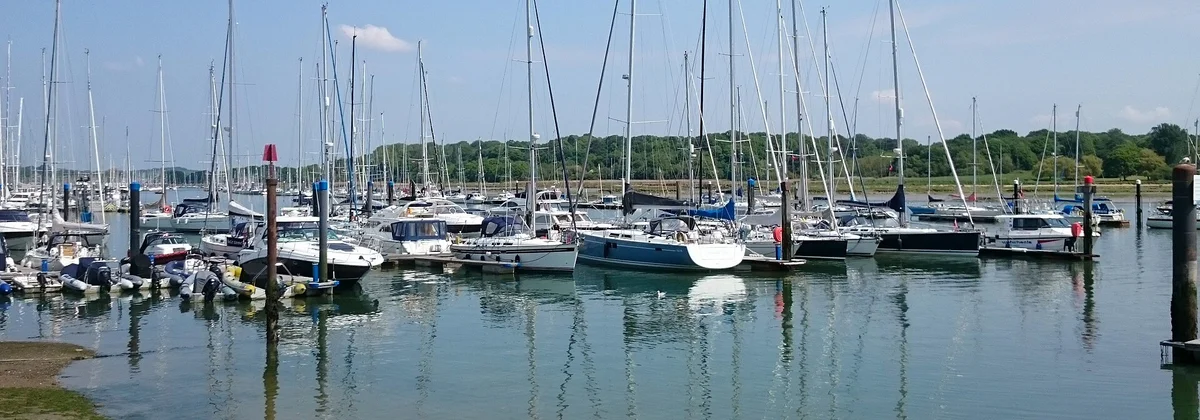
Quick answer: Buying a boat in the UK runs on a different set of rails from a US purchase. VAT status travels with the hull and must be evidenced on paper, not assumed. Registration is optional for many private boats, so a British boat may have no registration document at all, and the two routes, SSR and Part 1, do different jobs. The survey convention is a surveyor’s fee plus a separate yard lift-out charge plus a separate engine engineer, quoted as three numbers rather than one.
The UK Buying Sequence
The order matters more than any single step, because two of the checks are difficult to reverse once money has moved.
| Step | What happens | Typical time |
|---|---|---|
| 1. Set budget including running costs | Berth, insurance, maintenance, lift-out | Before viewing |
| 2. Shortlist and view | Broker or private, viewing at the berth | 2 to 8 weeks |
| 3. Offer subject to survey and trial | Written, with conditions | Same week |
| 4. Deposit, usually 10% | Held by the broker or a client account | On acceptance |
| 5. VAT and title evidence requested | Seller produces paper, buyer reads it | 1 to 2 weeks |
| 6. Survey and lift-out | Surveyor, yard, engine engineer | 2 to 4 weeks to book |
| 7. Renegotiate or accept findings | On the surveyor’s report | Days |
| 8. Completion and balance | Bill of sale, handover, keys | 1 to 3 weeks |
| 9. Registration and insurance | SSR or Part 1, cover in force | Before first use |
Two of those steps carry the real risk. Step 5, because a VAT problem discovered after completion becomes yours. And step 6, because a UK yard lift-out in the busy season can be several weeks out, and a deposit sitting under a survey condition with no survey slot is a deposit under time pressure.
Insider tip: book the lift-out slot before you agree the survey date, not after. The surveyor’s diary is usually the easier of the two to move; the yard’s crane is not. Buyers routinely discover that the surveyor is free on Tuesday and the yard cannot lift until the following month.
VAT Status: The Check That Cannot Wait
This is the single biggest difference from a US purchase and the one that costs British buyers the most money.
VAT on a boat attaches to the vessel rather than to a person. A boat on which VAT has been accounted for carries that status; a boat on which it has not may generate a liability for whoever owns it when the question is asked. Since the UK left the EU the position has become more involved, because a boat’s movements between UK and EU waters now affect its status in both places.
| Evidence a buyer should ask for | Why it matters |
|---|---|
| Original invoice showing VAT charged and paid | The strongest single document |
| Builder’s certificate and first-sale paperwork | Establishes where the boat entered the market |
| Evidence of location at the relevant date | Matters for post-Brexit UK status |
| Returned Goods Relief documentation | If the boat has been out of the UK and come back |
| Berthing and yard invoices showing history | Corroborates where the boat has actually been |
| Previous bills of sale in an unbroken chain | Shows the boat has not lost its paper trail |
A seller who cannot produce documents is not necessarily hiding anything, and plenty of older boats have genuinely lost their paperwork over decades. That is still a buyer’s problem, and it should be reflected in the price rather than waved through. The UK VAT guide sets out what each document does, and the EU VAT page covers the position on the other side of the Channel.
SSR or Part 1: Which Registration Do You Need?
Many British private boats are unregistered and legally used that way in UK waters. Registration becomes necessary rather than optional in specific circumstances.
| Small Ships Register | Part 1, UK Ship Register | |
|---|---|---|
| What it records | Nationality of the vessel | Ownership, and mortgages against it |
| Records title | No | Yes |
| Can carry a marine mortgage | No | Yes |
| Tonnage measurement required | No | Yes |
| Cost | Low, a modest fee | Higher, plus measurement |
| Time to obtain | Days to weeks | Weeks |
| Renewal | Periodic renewal required | Registration is renewed, ownership persists |
| Typical use | Coastal and occasional foreign cruising | Financed boats, serious foreign cruising |
The practical rule: if a lender is taking security over the boat, you will be on Part 1, because that is where a registered marine mortgage lives. If you are cruising to France and back with no borrowing, the SSR is generally enough. The UK boat finance page covers how registration interacts with lending.
Buying on the south coast or the east coast?
Tell us the length, the budget and where the boat will berth. We will map the survey, VAT and berth sequence before you make an offer.
What the Survey Actually Costs
British survey pricing is quoted as separate components and buyers routinely budget only the first one.
| Component | Who charges it | Notes |
|---|---|---|
| Surveyor’s fee | The surveyor | Scales with length and scope |
| Lift-out and pressure wash | The yard | Separate invoice, buyer normally pays |
| Standing time ashore | The yard | Charged if the boat stays out overnight |
| Engine survey | Marine engineer | Usually a separate specialist |
| Rig inspection | Rigger, on sailing boats | Separate again, and worth having |
| Oil analysis | Laboratory, via the engineer | Small cost, useful early warning |
| Travel and expenses | The surveyor | Material if the boat is far from them |
As a planning band for September 2026, a full pre-purchase survey on a 30 to 40 foot yacht commonly runs several hundred to a little over a thousand pounds for the surveyor alone, with the yard lift and the engine engineer meaningful additions on top. Get all three quoted before you commit to a date.
Choose the surveyor yourself. A surveyor suggested by the selling broker may be perfectly competent and is still not your appointment. The pre-purchase survey guide covers what the inspection should include and how to read the report’s severity codes.
Berthing: Settle It Before You Complete
UK berthing is genuinely constrained in the popular areas and the cost is a permanent line rather than a one-off.
| Berth type | Character | Notes |
|---|---|---|
| Marina pontoon berth | Serviced, water and power | Highest cost, waiting lists in demand areas |
| Swinging mooring | Cheaper, tender access needed | Harbour authority or club allocated |
| Drying mooring | Cheapest, boat must take the ground | Only suits certain hull types |
| Boatyard ashore over winter | Standard UK winter pattern | Lift, store, antifoul, relaunch |
| River or canal mooring | Different regime again | Licences and navigation authority rules |
The British pattern of lifting out for winter is a genuine annual cost that many overseas buyers underestimate: the boat comes out, is pressure washed, sits ashore for months, is antifouled and goes back in. Model that alongside the berth. The marina berth cost guide covers UK and European tariffs in pounds and euros per metre.
Red Flags on a UK Purchase
Insider tip: ask for the last three years of yard invoices. It is a normal request on a well-kept boat and it answers several questions at once: where the boat actually was, what has been done to it, whether the antifouling and anode schedule was kept, and whether the seller’s account of the maintenance history is supported by anything.
- VAT status asserted without documents, particularly on an older boat with an incomplete chain.
- A boat that has been in EU waters since Brexit with no thought given to its UK status.
- A surveyor recommended by the selling broker, accepted without question.
- No lift-out in the survey, because the yard was busy and the deadline was tight.
- A deposit paid into a personal account rather than a broker’s client account.
- A Part 1 registered boat where a mortgage is still recorded against it.
- Rig age undisclosed on a sailing boat, where replacement is a known cyclical cost.
Buyer Scenarios for a UK Purchase
First cruising yacht, 28 to 35 feet, south coast. Budget the survey, lift and engine check as three numbers. Expect an unregistered boat and decide whether SSR matters to you. Berth first, boat second, in the popular Solent marinas.
Motor cruiser, 30 to 45 feet, east coast or inland. Check the navigation authority regime for where you will actually use it, since river and canal use has its own licensing. Engine hours and service history carry more weight than they do on a sailing boat.
Buying a boat currently lying in the EU. The VAT question is the whole transaction. Settle status on both sides before you exchange, not after, and factor the delivery passage into the timeline and the insurance.
Financed purchase. You will be on Part 1 with a registered mortgage, which lengthens the completion timeline. Start the registration conversation with the lender early, because it is usually the long pole.
Overseas buyer purchasing in the UK. The paperwork is manageable; the VAT and export position is where the value is won or lost. Take advice before you exchange rather than after completion.
Pros and cons of buying through a UK broker
| Advantages | Disadvantages |
|---|---|
| Deposit held in a client account rather than paid to a stranger | Commission of roughly 5% to 8% is priced into the boat |
| Paperwork chain, VAT evidence and bills of sale usually assembled | The broker acts for the seller, not for you |
| Access to boats that are never advertised publicly | Viewing is scheduled around the broker, not around you |
| Familiar contract wording with survey and trial conditions | Recommended surveyors are the broker’s contacts, not neutral |
| Someone to chase the seller when completion drifts | Private sales can be cheaper if you do the diligence yourself |
Buying in the UK this season?
We can map VAT evidence, registration route, survey booking and berth into one sequence before you make an offer.
Frequently Asked Questions
Three things change. VAT status travels with the boat and has to be evidenced rather than assumed, which has no direct US equivalent. Registration is optional for many private boats, so a boat may have no registration document at all. And the survey and contract convention follows RYA and broker association practice rather than US brokerage norms, with a different deposit and completion sequence.
As a planning band for September 2026, a full pre-purchase survey on a 30 to 40 foot yacht commonly runs several hundred to a little over a thousand pounds, plus the lift-out and pressure wash, which the buyer normally pays and which is a separate yard charge. Engine surveys are usually quoted separately again. Get the surveyor's fee, the yard's lift fee and the engine engineer's fee as three numbers before you book.
Not always. Registration is voluntary for many private pleasure vessels used in UK waters, which is why plenty of British boats have no registration document. You will want registration if you intend to cruise abroad, if a lender is taking security, or if you need documentary evidence of nationality. The two routes are the Small Ships Register and Part 1 of the UK Ship Register.
The Small Ships Register is a simple, low-cost record of nationality for smaller privately owned vessels, renewed periodically, and it does not record title or mortgages. Part 1 of the UK Ship Register is full registration: it records ownership and can carry a registered marine mortgage, which is why lenders generally want it. Part 1 costs more, takes longer, and requires a tonnage measurement.
Ask for documentary evidence and read it. The original invoice showing VAT paid, or evidence the boat was in UK waters at the relevant date, or Returned Goods Relief documentation if it has been out of the country. A seller who says the boat is VAT paid but cannot produce paper is describing a belief, not a status, and the liability follows the boat rather than the seller.
Brokerage commission on a private sale is commonly in the region of 5% to 8% of the sale price, paid by the seller, with the exact figure and any minimum set in the central agency agreement. A buyer generally pays nothing to the broker directly, but should remember that the broker is the seller's agent and is not acting for the buyer.
Commonly 4 to 10 weeks. The offer and deposit happen quickly, and the timeline is then set by two bookings: the yard lift-out slot for the survey, which can be several weeks out in the busy season, and the completion paperwork. A financed purchase on Part 1 registration adds time because the mortgage registration has its own process.
Request a yacht buyer consultation
Share your budget, target LOA, and use case. We reply within one business day with matched brokers or surveyors.