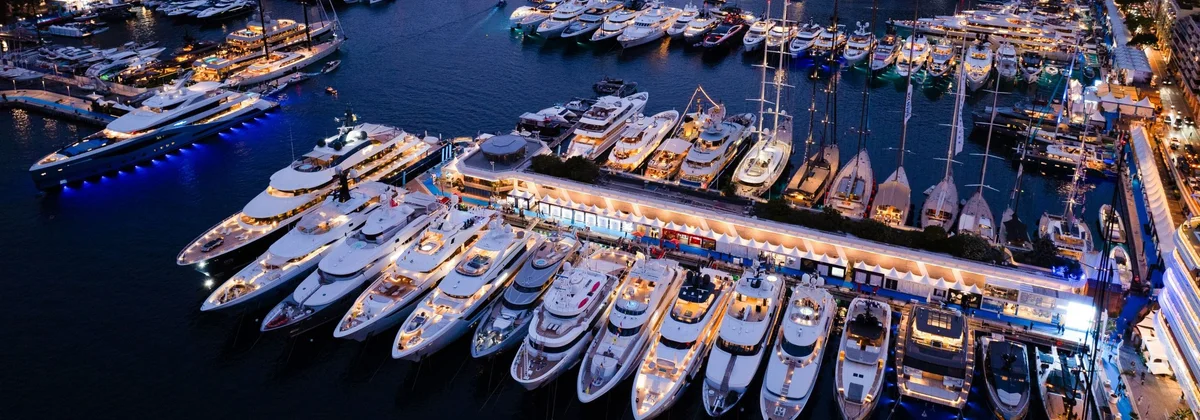
Quick answer: The boat show year has a shape. January and February are indoor shows and new-model launches, when manufacturers show next season’s boats and dealers clear last season’s. Late September through early November is the in-water brokerage season, when Newport, Annapolis, Cannes, Southampton, Monaco and Fort Lauderdale put real inventory on real docks. If you intend to buy rather than browse, the autumn in-water shows are where the boats you can board and negotiate on actually are.
Which Boat Shows Are Worth a Buyer’s Time?
There are hundreds of boat shows a year in the United States alone, and most of them are regional retail events: a marina, a dealer group, a weekend. They are useful if you want to see what is sold locally and meet the people who will service the boat. They are not where a serious purchase usually starts.
The shows that matter to a buyer fall into four groups, and the grouping tells you more than the size ranking does.
| Show type | What it is for | Typical months | What you can judge |
|---|---|---|---|
| Indoor winter show | Seeing many models fast, new-season launches, trailerable boats | January to March | Layout, finish, price positioning, dealer terms |
| In-water production show | Boarding new boats afloat, first sea trials of the season | May to September | How the hull sits, deck ergonomics, systems noise |
| In-water brokerage show | Used inventory concentrated in one place | September to November | Real condition, real asking prices, seller motivation |
| Superyacht show | Above roughly 24 metres, mostly by appointment | September | Build quality, yard reputation, management contacts |
A buyer walking into an indoor January show expecting to negotiate on a three-year-old cruiser is in the wrong building. A buyer arriving at a brokerage show in November hoping to see the newest model year will find last year’s boats and this year’s discounts. Both are good shows. They answer different questions.
When Is Each Major Show?
Show organisers confirm exact dates roughly a year out and move them for venue and calendar reasons, so the useful thing to hold in your head is the month and the character, not the date. Confirm the date with the organiser before you book anything.
| Show | City | Usual month | Format |
|---|---|---|---|
| Düsseldorf boot | Düsseldorf, Germany | January | Indoor, very large, European launches |
| Chicago Boat Show | Chicago, Illinois | January | Indoor, Great Lakes retail |
| Seattle Boat Show | Seattle, Washington | January to February | Indoor plus in-water, Pacific Northwest |
| Miami International Boat Show | Miami Beach, Florida | February | Indoor plus in-water, largest US winter show |
| Dubai International Boat Show | Dubai, UAE | February to March | In-water, Gulf market |
| Palm Beach International Boat Show | West Palm Beach, Florida | March | In-water, brokerage heavy |
| Sydney International Boat Show | Sydney, Australia | July to August | Indoor plus in-water, southern winter |
| Newport International Boat Show | Newport, Rhode Island | September | In-water, New England, end of season |
| Cannes Yachting Festival | Cannes, France | September | In-water, European production and superyacht |
| Southampton International Boat Show | Southampton, UK | September | In-water, UK market |
| Monaco Yacht Show | Monaco | September | Superyacht, largely by appointment |
| Annapolis Sailboat Show | Annapolis, Maryland | October | In-water, the US sailboat show |
| Annapolis Powerboat Show | Annapolis, Maryland | October | In-water, immediately after the sailboat show |
| Fort Lauderdale International Boat Show | Fort Lauderdale, Florida | Late October to November | In-water, largest brokerage concentration |
Insider tip: the two weeks after a major in-water show are frequently a better buying window than the show itself. A dealer who trucked six boats to a dock and sold four now has two boats to move and a storage bill starting. Brokers know this and it is why so many accepted offers on show boats carry a date in the fortnight after the doors close.
Which Shows Are In-Water and Why It Matters
An in-water show floats the boats at a dock. That sounds like a detail and it is not. A boat sitting in a cradle under exhibition lighting is telling you about its interior and nothing else. The same boat afloat tells you how it trims with tanks part-full, whether the swim platform sits where the brochure implies, how loud the air conditioning is in the aft cabin, and whether the companionway steps work at the angle they will actually be at.
The trade is comfort and speed. An indoor show is warm, dry, and lets you walk through twenty boats in an afternoon. An in-water show is a dock in September or November weather, the queues are longer because boarding is one party at a time, and you will see fewer boats. If you are still narrowing a shortlist, indoor is efficient. If you have three candidates and want to know which one you actually want, in-water is the only useful format.
| Judgement | Indoor show | In-water show |
|---|---|---|
| Interior finish and layout | Good | Good |
| Boats seen per day | High | Low |
| How the hull sits with load | Not possible | Yes |
| Systems noise under power | Not possible | Sometimes at the dock |
| Deck work at real freeboard | Not possible | Yes |
| Sea trial access | Rare | Sometimes, pre-booked |
| Weather dependence | None | Significant |
Which Show Suits Which Buyer?
The shows sort cleanly by what you are buying, and the sorting is more useful than any size ranking.
Someone buying a first trailerable boat under about 26 feet is best served by a large indoor winter show. The inventory is there, the dealers who will service the boat are there, and comparing eight centre consoles from 20 feet to 26 feet in one hall in a single afternoon is genuinely hard to do any other way.
Someone buying a cruising sailboat in the 35 feet to 50 feet band should be in Annapolis in October. The United States Sailboat Show is the deepest concentration of sail inventory in the country, it is in the water, and the Chesapeake fleet that surrounds it means the brokers and riggers you need are all local.
Someone buying a brokerage motor yacht above about 40 feet should be at Fort Lauderdale. It is the largest in-water show in the world by displayed value, and more importantly it is where the brokerage inventory physically is for the rest of the year anyway.
Someone buying in Europe has Cannes in September for production boats and Southampton for the UK market, with Düsseldorf in January as the indoor equivalent of Miami.
Going to a show with a budget and no shortlist?
Tell us the length, the water you will use it on and the ceiling. We will come back with the models worth your dock time and what to check on each.
Is Show Pricing Real?
Partly, and not where most buyers look for it.
Manufacturers rarely discount the hull price at a show, because a public price cut at a show damages every dealer holding the same model. What moves instead is content. A show offer is usually built from electronics packages, canvas and covers, a generator, a trailer, first-service credits, extended warranty terms or freight and rigging absorbed by the dealer. Those are real money, and on a production boat they are commonly worth 2% to 5% of the purchase price.
The larger discounts sit on last season’s stock. A dealer holding two of last year’s model year at the start of winter is paying floor plan interest and storage on both for 5 to 6 months, and that is the boat with room in it.
| Where the money actually is | Typical form | Who offers it |
|---|---|---|
| Prior model year stock | Direct price reduction | Dealer clearing inventory |
| Current model year | Package content, not price | Manufacturer through dealer |
| Brokerage boat at a show | Seller motivation, not show pricing | Listing broker |
| Show-only finance rate | Subvented rate for a limited term | Manufacturer finance arm |
| Post-show fortnight, 2 weeks | The best of both, quietly | Dealer with unsold show stock |
Treat a “show only, today only” price as a negotiating tactic rather than a deadline. A boat that is right for you is still right for you in November, and a dealer who will not repeat an offer three days later was not offering much.
What Should You Arrange Before You Go?
Show weeks compress a whole local industry into a few days. In Fort Lauderdale and Annapolis this is not a metaphor: hotel rates multiply, surveyors are booked out, and the yards that would normally haul a boat for inspection have no slots. Everything you might need afterwards should be arranged before you arrive.
| Item | When to arrange | Why show week breaks it |
|---|---|---|
| Show registration | 2 to 4 weeks ahead | Gate queues and higher door pricing |
| Sea trial slot | 3 to 6 weeks ahead | Slots fill on the models people already want |
| Accommodation | 8 to 12 weeks ahead | Show week fills Fort Lauderdale and Annapolis |
| Surveyor availability | Before the show | Local surveyors book out around show weeks |
| Finance pre-approval | Before the show | Lets you sign subject to survey with confidence |
| Insurance indication | Before the show | Hull value and cruising area drive the quote |
If you may sign, know your ceiling before you walk in, and know what your contract must contain. A deposit into escrow subject to survey and sea trial is a normal thing to do at a show. Read the escrow and closing costs page before you go, and take the first-time buyer’s route through the process with you.
Red Flags on a Show Floor
Insider tip: ask a dealer what happens to the boat if you sign today and the survey finds a problem. The answer separates a normal show contract from a bad one in about ten seconds. A dealer who says the deposit is refundable on a failed survey is describing standard practice. A dealer who says show orders are non-refundable is telling you to walk.
- A price that exists only today, with no written offer that survives the weekend.
- A contract without survey and sea trial conditions on a used boat.
- A trade-in valuation given verbally, on the floor, without an inspection.
- A finance rate quoted without the term, the deposit and the balloon stated together.
- A boat presented as “in stock” that is a hull number on an order sheet with a delivery estimate.
- Any pressure to sign before you have seen the boat in the water.
Buyer Scenarios for the Show Calendar
First boat, under 26ft, trailerable. Go to a large indoor winter show in your own region: Chicago, Seattle, or a state show. You are choosing a dealer as much as a boat, and the dealer needs to be within an hour of where the boat will live.
Cruising sailboat, 35ft to 45ft. Annapolis in October, and plan for 2 days. Board everything on the shortlist, then spend the second day on the rigging, the tankage and the systems rather than the accommodation.
Brokerage motor yacht, 45ft to 70ft. Fort Lauderdale in late autumn, with a broker engaged beforehand and a surveyor on standby for the following fortnight. Expect to make the decision after the show, not during it.
Second boat, trading up. Any in-water show, and start with your own trade. Get a written valuation before you fall for something on the dock, because the trade number decides the deal more often than the new boat’s price does.
European buyer. Cannes in September for production and Düsseldorf in January for breadth. Southampton if the boat will be UK-based, where the UK buying route and VAT status matter more than the show itself.
Pros and cons of buying at a boat show
| Advantages | Disadvantages |
|---|---|
| Inventory from many builders in one place, boardable in an afternoon | Crowds and queues make careful inspection difficult |
| Dealers and manufacturer staff are present together, so questions get answered | Show conditions favour the seller’s timeline, not yours |
| Package content and prior-year stock genuinely move at show time | Hull prices rarely fall, and “today only” is usually a tactic |
| In-water format shows trim, freeboard and systems as they really are | Surveyors and yards are fully booked around show weeks |
| Post-show fortnight often produces the best terms of the year | Travel, accommodation and time off are a real cost to weigh |
How to Use the Rest of This Section
Every show below has its own page here, written from the buyer’s side rather than the visitor’s: what the show is for, what you can and cannot inspect, and what show week does to the local market around it.
In-water shows, where the boats are afloat and the judgement is real:
- Miami International Boat Show, February, the largest winter show
- Palm Beach International Boat Show, March, brokerage heavy and walkable in a day
- Fort Lauderdale International Boat Show, late autumn, the brokerage show
- Annapolis Boat Shows, October, sail then power
- Newport International Boat Show, September, end of the New England season
- San Diego, Pacific swell, sportfishing and the Mexico question
- Seattle, January, indoor and in-water across two sites
Indoor winter shows, where you compare dealers, packages and interiors rather than hulls:
- Chicago, January, Great Lakes retail
- Detroit, February, run by the state trade association
- Minneapolis, January, pontoons and fishing boats
- New York, January, where the berth decides the boat
- Atlanta, January, a drive-to-the-water trailer market
- Houston, January, Galveston Bay and hurricane exposure
- Tampa, September, a shallow bay and a year-round season
European shows, which work differently again:
- Cannes Yachting Festival, September, Europe’s production week and the one show where sea trials happen during it
- Monaco Yacht Show, late September, superyacht brokerage and charter by appointment
If you are earlier than that and still deciding what to look for, start with how to buy a boat and the best time of year to buy, then come back to the calendar with a shortlist.
Buying at a show this season?
We can tell you what the show is realistically worth for your budget and length, and what to line up before you fly in.
Frequently Asked Questions
Fort Lauderdale in late autumn and Miami in February carry the deepest brokerage and new-boat inventory in one place, and both are in-water, so you can board what you are considering. Annapolis in October is the strongest sailboat show in the United States, and Newport in September suits a New England buyer working to the end of the season.
Sometimes, and rarely on the boat itself. Manufacturers hold list price and discount through package content: electronics, canvas, a trailer, a first-service credit or extended warranty. The real saving is usually on last season's stock a dealer does not want to store over winter, and that offer is often better in the two weeks after the show than on the show floor.
At in-water shows, sometimes, and almost never on demand. Sea trial slots are booked before the show opens and fill first for the models people already intend to buy. Ask your dealer or broker to reserve a slot several weeks out, and expect the trial itself to happen in the days either side of the show rather than during it.
An in-water show floats the boats at a dock, so you can see how the hull sits, board with the boat trimmed as it will run, and hear the systems. An indoor show puts hulls on cradles under lights, which is better for comparing many models quickly and for smaller trailerable boats, and worse for judging anything that matters when the boat is loaded.
Register in advance, book any sea trial through a dealer or broker 3 to 6 weeks ahead, arrange accommodation 8 to 12 weeks out in Fort Lauderdale and Annapolis where show week fills the town, and decide your budget ceiling before you walk in. If you may sign, have your surveyor's availability and your lender's pre-approval in hand, because both tighten around show weeks.
You can sign at a show if the contract is subject to survey and sea trial, which is the normal protection and should not be waived for a show incentive. If the offer depends on signing that day with no conditions, that is a reason to walk. A deposit into escrow with a survey contingency is a decision you can make at a show; an unconditional purchase is not.
Organisers usually confirm the following year's dates within a few weeks of the current show closing, and dates move for venue and calendar reasons. Treat any date you see republished on a third-party site as indicative and confirm it with the organiser before booking travel.
Request a yacht buyer consultation
Share your budget, target LOA, and use case. We reply within one business day with matched brokers or surveyors.