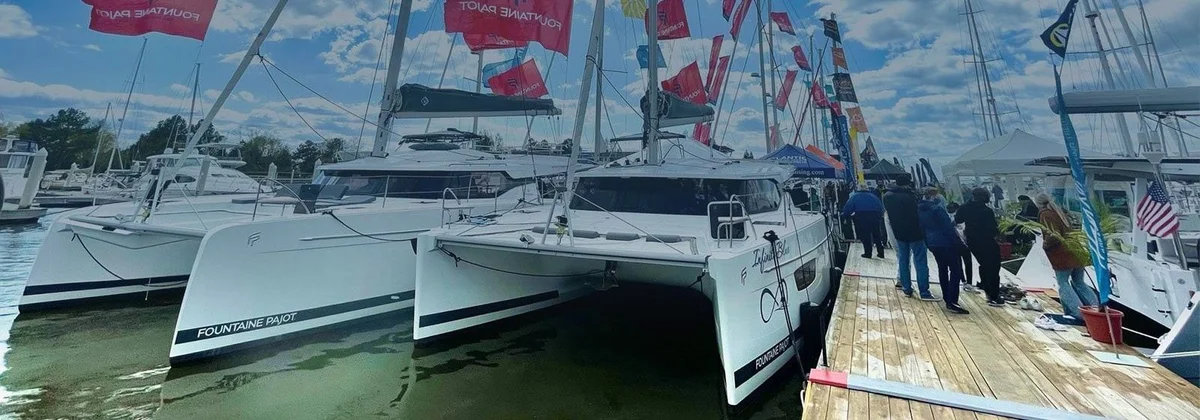
Quick answer: Annapolis runs two separate shows in October, both in the water at City Dock: the United States Sailboat Show first, then the United States Powerboat Show about a week later. The sailboat show is the deepest concentration of sail inventory in the United States, and the in-water format is the reason to go. A sailboat on a cradle tells you about its joinery. The same boat afloat tells you whether you can actually work its side decks, sheet its headsail and live in its cockpit.
What Are the Annapolis Boat Shows?
Annapolis has run in-water shows at City Dock since the 1970s, and the format has barely changed because it works. The harbour is filled with boats on temporary docks, you walk out along the finger piers, and you board one boat at a time. There is no convention hall component. Everything on display is floating. The boat show calendar sets Annapolis against the rest of the year.
The shows split into two events roughly a week apart in October.
| Show | Usual timing | What is there |
|---|---|---|
| United States Sailboat Show | Early October, 4 to 5 days | Monohulls, catamarans, rigging, sails, cruising gear |
| United States Powerboat Show | Mid October, 4 days | Cruisers, centre consoles, trawlers, outboard packages |
The reason for the split is space rather than politics. City Dock holds a finite number of boats. Running one combined show would halve each fleet; running two lets the sailboat show fill the harbour with sail and the powerboat show fill it with power. That is why Annapolis carries more sail inventory in one week than any general show in the country.
Is Annapolis the Right Show for a Sailboat Buyer?
For a US buyer, yes, and by a distance. The major production builders time their American model-year introductions to it. The multihull presence has grown substantially and cruising catamarans are well represented. The sail lofts, rigging shops, electronics installers and short-handed sailing equipment suppliers are all there, which matters because a cruising sailboat purchase is really a purchase plus a specification list.
The show also concentrates the people. A buyer looking at a 42-foot cruiser can, in one afternoon, board the boat, talk to the builder’s US importer, price a furling upgrade with the loft that would do it, and ask a rigger what that mast section costs to re-tune. That combination is genuinely hard to assemble any other way.
| Buyer | Annapolis suits you if | Consider elsewhere if |
|---|---|---|
| Coastal cruising monohull, 32 to 45 feet | Yes, this is the show | Nothing better in the US |
| Cruising catamaran, 38 to 50 feet | Strong presence, good comparisons | Also see the Caribbean charter shows |
| Bluewater passage-maker | Some presence, mostly production | Specialist brokers, see the offshore guide |
| Powerboat, 25 to 45 feet | The powerboat show a week later | Miami in February for breadth |
| Trawler or long-range cruiser | Reasonable, Chesapeake is trawler country | Seattle in winter for the Pacific fleet |
What the In-Water Format Actually Lets You Check
This is where an Annapolis day earns its cost, and most visitors waste it by walking through interiors.
| Check | Why it needs water |
|---|---|
| Side deck width at real freeboard | Cradle height flatters every boat |
| Companionway angle and step depth | You cannot judge it on a hull tilted in a cradle |
| Cockpit geometry under way loads | Seat height against coaming only makes sense afloat |
| Winch positions and sheet leads | Reach and angle change with the boat’s real attitude |
| Boarding from a dinghy or dock | The transom step height is a daily quality-of-life fact |
| Waterline against loaded trim | Tells you what the boat looks like with tanks and gear |
| Systems noise with hatches shut | Pumps, fans and fridges at rest, not on a demo stand |
Insider tip: go aboard and sit down. Sit at the helm, sit in the cockpit where you would sit on passage, sit at the nav station and at the saloon table. A boat that photographs beautifully and does not fit you is the most expensive mistake at any show, and standing in the middle of the saloon will never reveal it.
Shortlisting a cruising boat for Annapolis?
Send us the length, the water you sail and how you will use it. We will tell you what is worth boarding and what to check on each.
How Chesapeake Conditions Shape What You See
The Chesapeake is shallow, protected and frequently light. That has a real effect on which boats sell well in Annapolis, and a buyer should read the fleet with that in mind.
Boats optimised for the Bay tend toward shoal draft, often with a wing or shallow keel option, generous sail area for the displacement so they move in 8 to 10 knots of breeze, and interiors laid out for weekend and coastal use rather than long passages. That is exactly right if you are buying for the Bay, for Long Island Sound, or for similar sheltered water.
If your water is different, note the mismatch rather than being talked out of it. A boat that is delightful on the Chesapeake at 8 knots of true wind may be under-canvassed nowhere and over-canvassed on a windy coast, and a shoal keel that opens up the Bay costs you upwind performance you will want elsewhere.
| If you sail | Read the Annapolis fleet as |
|---|---|
| Chesapeake, Long Island Sound | Directly representative, buy with confidence |
| New England coast | Broadly right, check draft and reefing |
| Pacific Northwest | Different priorities: heating, draft, motoring range |
| Great Lakes | Close fit, check winter storage implications |
| Offshore or Caribbean | Read carefully; see the offshore buying guide |
For the offshore case specifically, the structural, rig and tankage questions are different enough to deserve their own treatment: the bluewater sailboat buying guide covers what changes when a coastal boat is asked to cross an ocean.
What to Arrange Before Show Week
| Item | Lead time | Why |
|---|---|---|
| Accommodation | 8 to 12 weeks | Both shows fill Annapolis and the surrounding towns |
| Show tickets | 2 to 4 weeks | Advance pricing and shorter gate queues |
| Shortlist of boats to board | 2 weeks | Boarding queues limit you to a handful per day |
| Surveyor placeholder | Before the show | Chesapeake surveyors book out around both shows |
| Broker contact | 3 to 4 weeks | Some builders run appointment slots for serious buyers |
| Parking or transport plan | 1 week | City Dock parking is limited during show weeks |
Two days is the realistic minimum if you have a genuine shortlist. The constraint is not the walking, it is the queue for each boat: on a popular new model the wait to board can be substantial at midday, and the sensible pattern is popular boats early, quieter docks in the afternoon.
Red Flags and Practical Cautions
Insider tip: ask the builder’s representative what the boat weighs as displayed versus the published displacement, and what the show boat’s option list cost. The gap between the base price on the placard and the boat you actually walked through is routinely 15% to 30%, and it is entirely legitimate. It is also the single most common budgeting surprise a first-time sailboat buyer runs into.
- A base price on the placard that does not match the boat you boarded.
- Delivery estimates for a build slot given verbally rather than in the contract.
- Any pressure to place a build deposit before you have read the build contract.
- A used boat offered without survey and sea trial conditions.
- Rig age not disclosed on a brokerage boat, where standing rigging replacement is a known cyclical cost.
- Sail inventory described as “good” without age or hours.
Buyer Scenarios for Annapolis
First cruising sailboat, 32 to 40 feet. Two days, six boats maximum. Spend the second day on rigging, tankage and systems rather than accommodation, because those are what you will live with.
Trading up to 45 feet plus. Draft is your first filter, not layout. Decide what you can accept before you board anything, because a deep keel and a shoal keel version of the same boat sail differently enough to be different purchases.
Catamaran buyer. Annapolis is a good comparison week, and the catamaran buying guide sets out what changes against a monohull. Check bridgedeck clearance and the helm sightlines specifically; both are hard to judge from photographs.
Powerboat buyer. Come back a week later for the powerboat show rather than trying to do both in one trip. The Chesapeake trawler and cruiser fleet is well represented and the format is the same, and the sailing yacht type page is the wrong place to start if power is the decision.
Offshore-minded buyer. Use Annapolis to narrow builders, then take the shortlist to a survey-led process described in the pre-purchase survey guide. A production coastal boat can be prepared for offshore work, but the preparation is a project with its own budget.
Pros and cons of buying at Annapolis
| Advantages | Disadvantages |
|---|---|
| Deepest sail inventory in the United States in one week | Two separate shows means two trips for a mixed shortlist |
| Everything is afloat, so the real ergonomics are visible | October weather on open docks can be genuinely unpleasant |
| Sailmakers, riggers and electronics installers all present | Boarding queues limit you to a handful of boats a day |
| Chesapeake fleet is representative for sheltered-water buyers | The same fleet is skewed if you sail windier or deeper water |
| Strong builder presence for model-year comparison | Show-boat option lists inflate the price you actually pay |
Buying a cruising boat this season?
We can help you read the Annapolis fleet against the water you actually sail, and line up the survey that follows.
Frequently Asked Questions
Because sail and power buyers want different docks and different conversations. The United States Sailboat Show runs first, in early October, and the United States Powerboat Show follows within about a week at the same City Dock site. Splitting them lets each show fill the harbour with its own boats instead of dividing the space, which is why Annapolis carries more sail inventory than any general show can.
It is the strongest sailboat show in the United States. Production builders launch their US model year here, the multihull presence is significant, and the boats are afloat, so rig, freeboard, cockpit ergonomics and companionway geometry can all be judged properly rather than guessed from a cradle.
How the boat sits with tanks part-full, whether the side decks work at real freeboard, how the companionway angle feels, how loud systems are with the doors shut, and whether the cockpit geometry suits how you will actually sail. A hull on a cradle under lights tells you about joinery and nothing about any of that.
The Bay is shallow, sheltered and often light-air, so the local fleet skews toward shoal draft, larger sail area for the displacement, and boats that are pleasant at 8 knots of breeze. If you are buying for the Chesapeake this is exactly right. If you are buying for offshore or for a windier coast, note that the boats being sold well here are optimised for different water.
Arrange it before, not during. Chesapeake surveyors and the local haul-out yards fill around both shows and stay busy afterwards. Hold a tentative slot for the fortnight after the show and tell the surveyor you may or may not use it.
It fills the town. Accommodation should be booked 8 to 12 weeks out, parking near City Dock is limited during both shows, and local berth availability tightens. Plan on 2 days if you are serious about a shortlist, because the boarding queues on popular models are the real constraint on how much you see.
Commonly 15% to 30% over the base price on the placard, and occasionally more on a heavily specified display boat. Ask the representative what the boat as displayed would cost delivered, and ask for that in writing, because the placard number is the stripped hull and almost nobody buys it that way.
Request a yacht buyer consultation
Share your budget, target LOA, and use case. We reply within one business day with matched brokers or surveyors.