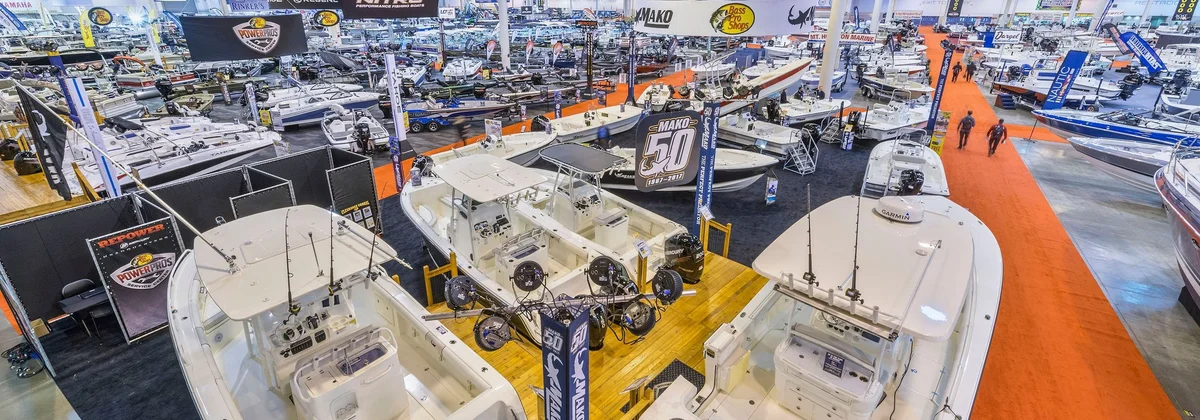
Quick answer: Houston is an indoor January retail show serving one of the largest concentrations of recreational boating in the United States. Two facts shape the buying decision here and neither will be on a brochure: Galveston Bay is large, shallow and gets choppy fast, which points at bay boats and mid-size centre consoles rather than at either extreme; and hurricane exposure sets the insurance terms, including a named-storm deductible that is a percentage of hull value rather than a flat figure.
What Galveston Bay Asks For
The bay system is the reason the local fleet looks the way it does, and buyers who arrive with an inland-lake mental model buy the wrong boat.
| Condition | What it implies for the hull |
|---|---|
| Large, shallow, wind-exposed | Shallow draft, but not a flat bottom |
| Chop builds fast and stays short | Moderate deadrise, enough freeboard to stay dry |
| Long runs across open bay | Range, and a boat you can stand behind a screen in |
| Passes out to the Gulf | Real deadrise if you intend to use them |
| Brackish water | Anodes, bonding and a flushing habit |
| Oyster reefs and shoals | Draft and a chart plotter you trust |
That combination is precisely the design brief of a bay boat: shallow enough for the flats and the back lakes, capable enough to cross open bay, and laid out to fish. Above that, mid-size centre consoles take over for anyone genuinely running out of the passes, and a flat-bottomed jon boat belongs on the bayous and back lakes rather than on the bay itself.
Insider tip: ask every dealer for transom deadrise, not just length. Two 22 ft boats with, say, 12 degrees and 18 degrees at the transom are different machines on this water: the flatter one runs shallower and fishes better at anchor, the deeper one is dry and comfortable when the afternoon wind gets up. Builders publish the number and buyers ignore it.
Hurricane Exposure Is a Purchase Decision
This is the part that separates a Gulf Coast purchase from an inland one, and it is much easier to sort out in January than in August.
| Item | What to establish before you buy |
|---|---|
| Named-storm deductible | Usually a percentage of hull value, not a flat sum |
| Standard deductible | Separate, and much smaller |
| Hurricane plan requirement | Many policies require a written, agreed plan |
| Haul-out obligations | Some policies require removal at a named trigger |
| Lay-up or navigation warranties | Can restrict where the boat may be in season |
| Storage location | Underwriters price wet slip and dry stack differently |
A named-storm deductible expressed as a percentage is the item that surprises people. On a boat worth a few hundred thousand dollars, a percentage-based deductible is a materially different exposure from the flat figure most owners picture. The mechanics are set out in the named storm deductible guide and the wider question in hurricane zone yacht insurance, with premium drivers generally in the boat insurance cost guide.
The practical corollary: a trailerable boat can leave. That is a real argument for staying under roughly 26 ft on this coast, and the towing arithmetic is in the boat trailer guide.
Where the Boat Will Live
| Option | Practical note |
|---|---|
| Wet slip on the bay | Convenient, most exposed, bottom paint required |
| Dry stack | Popular here, limits size and beam |
| Trailer at home | Cheapest, and it can be moved before a storm |
| Inland lake berth | Different market, no storm exposure, no Gulf access |
| Covered slip | Premium, and demand exceeds supply in most basins |
Storage decides the annual budget more than the purchase price does, and on this coast it also decides your storm exposure. The comparison is in cost to dock a boat and the wider budget in the ownership cost guide.
Brackish Water Is Its Own Maintenance Regime
Owners moving from an inland lake underestimate this, and owners moving from the open coast overestimate it. Brackish water sits in between and has its own habits.
| Item | Fresh water | Brackish bay | Open ocean |
|---|---|---|---|
| Anode consumption | Slow | Moderate to fast | Fast |
| Bonding system attention | Occasional | Annual | Annual |
| Engine flushing after use | Optional | Advisable | Essential |
| Bottom paint if wet-slipped | Sometimes | Yes | Yes |
| Growth rate on the hull | Slow | Fast in summer | Fast |
| Electrical corrosion at connections | Rare | Common | Common |
The item that catches people is anode consumption, because it varies with salinity, with the marina’s stray current, and with the boat next to yours. Check them at least twice a season rather than annually, and treat a fast-eroding anode as information rather than a nuisance: it usually means something electrical needs attention. The general schedule is in the boat maintenance checklist.
What the Week Costs
| Line | Typical range | Note |
|---|---|---|
| Show admission, per day | $15 to $30 | Multi-day tickets usual |
| Parking, per day | $15 to $30 | Large venue lots |
| Survey, if buying used | $20 to $30 per ft | Book ahead of the spring rush |
| Short haul-out for that survey | $300 to $900 | Depends on yard and size |
| Dry stack, per month | $200 to $600 | Size dependent |
| Wet slip, per month | $250 to $900 | Location dependent |
| Bottom paint, per haul | $25 to $50 per ft | Not required if trailered |
Because the season runs all year here, the cost per usable day is far better than in a northern market, which is genuinely the strongest argument for boating on this coast. What offsets it is insurance and corrosion, both of which are higher than inland.
Comparing Dealers Rather Than Boats
An indoor show’s real value is that eight dealers who normally sit an hour apart are in one hall. Use that.
| What varies between stands | Why it matters |
|---|---|
| Options included at the quoted price | The largest source of apparent price difference |
| Commissioning and first service | Frequently four figures, rarely compared |
| Trailer included or extra | On a trailerable boat, a substantial line |
| Electronics package | The easiest thing to over-buy at a show |
| Warranty term and what voids it | Read it rather than being told about it |
| Where the service department is | You will visit it far more than the showroom |
Ask each stand the same three questions and write the answers down: what is included at this number, what does commissioning cost, and where does the boat go for warranty work. On this coast add a fourth, because it is specific to the market: does the dealer offer or arrange storm haul-out, and on what notice.
Pros and cons of buying at the Houston show
| Advantages | Disadvantages |
|---|---|
| Serves one of the largest boating populations in the US | Almost entirely new-boat retail |
| January timing beats the spring rush at every yard | Nothing about ride quality is answerable indoors |
| Dealers, finance and insurance in one hall | Package pricing is easy to mistake for a discount |
| Year-round season, so the boat is used from day one | Hurricane exposure raises the cost of ownership |
| Strong bay boat and centre console selection | Thin above roughly 45 ft |
| Trailer boats are genuinely practical here | Brackish water is harder on a boat than fresh |
Which Buyer Should Go
| Buyer | Is Houston the right show? |
|---|---|
| Bay and inshore fishing | Yes, this is the core of the floor |
| Family day boat on the bay | Yes |
| Offshore fishing out of the passes | Yes for shortlisting, then see it afloat |
| Trailer boat for lakes and bay | Yes |
| Brokerage yacht over 45 ft | No, the Florida shows serve you better |
| Sailboat buyer | Limited |
Earlier in the process, read how to buy a boat and buying a yacht at a boat show, and use the show calendar to see where the January date sits. If you are buying used, run the used boat inspection checklist, paying particular attention to corrosion and bonding, which brackish water punishes.
Buying on the Texas coast?
Tell us where you would keep it and whether you plan to run the passes, and we will tell you what hull and what insurance structure that actually implies.
Frequently Asked Questions
The main winter show usually runs in January over about nine days, indoors, with a separate in-water show on the coast later in the year. Confirm dates with the organiser. January is the practical time to buy in a year-round market, because it puts you ahead of the spring rush at every yard and surveyor on the coast.
Bay boats and mid-size centre consoles dominate for good reason. The bay is large, shallow and gets choppy fast in wind, so you want shallow draft with enough deadrise to handle a short steep chop. It is not the water for a flat-bottomed hull, and it does not require an offshore boat unless you are actually running out of the passes.
It changes what it costs to insure and where you can keep it, which amounts to the same thing. Upper Texas coast policies commonly carry a separate named-storm deductible expressed as a percentage of hull value rather than a flat dollar figure, and many require a written hurricane plan. Settle this before you commit, not after.
For many owners, yes. A trailered boat can be moved inland ahead of a storm, avoids the wet-slip premium, and opens up lakes as well as the bay. The practical ceiling is roughly 26 ft and what your vehicle can legally pull, and above that a slip or a dry stack becomes the realistic answer.
Brackish, and it varies with rainfall and where you are in the bay system. That is harder on a boat than fresh water and gentler than open ocean, but it is emphatically not fresh: anodes, bonding and flushing matter, and a boat kept in a wet slip needs bottom paint and a maintenance regime accordingly.
The show is a new-boat retail event, so use it to compare packages, dealers and interiors. If used is the plan, the show is still worth attending as research, then shop afterwards with a clear idea of layouts and a surveyor booked. In a year-round market the used inventory does not disappear in winter the way it does up north.
Transom deadrise. It separates two boats of identical length into a shallow-running fishing platform and a drier, deeper-drafting boat that handles the afternoon chop, and on a wind-exposed bay that difference decides how often you actually go out. Builders publish it and almost no buyer compares it.
Request a yacht buyer consultation
Share your budget, target LOA, and use case. We reply within one business day with matched brokers or surveyors.