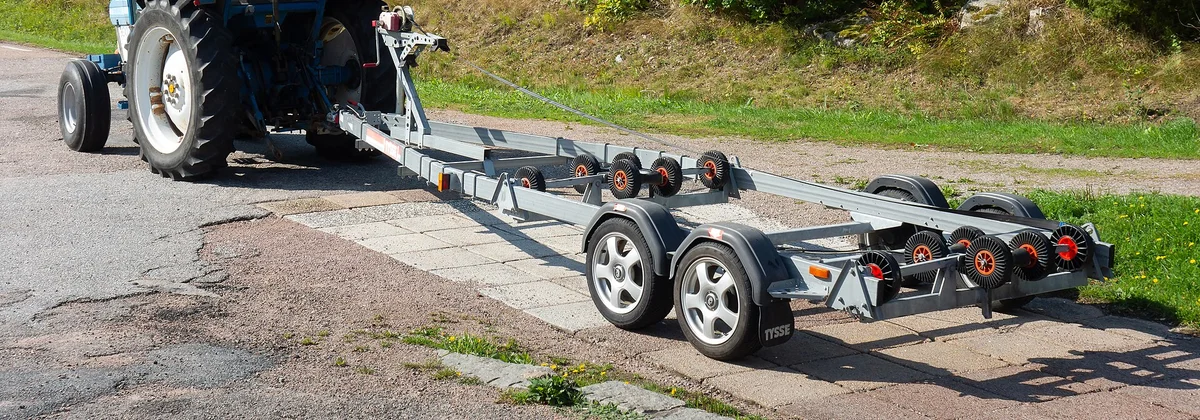
Quick answer: A trailer is sized on loaded weight, not on the boat’s advertised length, and the calculation that actually decides whether a purchase works is boat plus engine plus fuel plus gear plus trailer against what the tow vehicle is rated for. Fuel alone adds about 6 lb a gallon and water about 8 lb, which on a 60-gallon tank is over 350 lb nobody counted. The wider purchase sequence is in how to buy a boat. Get that arithmetic wrong and the boat is unusable from the day you buy it.
The Weight Calculation Nobody Does Before Buying
This is the single most useful thing on this page, and most first-time buyers do it after the purchase rather than before.
| Component | How to get it | Typical order of magnitude |
|---|---|---|
| Hull dry weight | Manufacturer specification | The published number, stripped |
| Engine, if quoted separately | Engine manufacturer | 300 to 600 lb for a mid outboard |
| Fuel | About 6 lb per gallon | 60 gallons is roughly 360 lb |
| Fresh water | About 8 lb per gallon | 20 gallons is roughly 165 lb |
| Batteries | About 40 to 70 lb each | Two is common |
| Gear, safety kit, anchor, cooler | Weigh it or estimate high | 150 to 400 lb in practice |
| Trailer itself | Trailer specification plate | 400 to 1,800 lb by type |
| Gross combined | Add all of the above | The number that matters |
The published dry weight is a stripped boat with no fuel, no battery and no gear. The gap between it and a loaded rig is commonly 20% to 35%, and it is precisely the gap that turns a boat that “fits the tow rating” into one that does not.
Insider tip: take the loaded rig to a public weighbridge once, in the state you actually tow it in, and keep the ticket. It costs a few dollars, it settles every argument about whether you are legal, and it is the only number in this whole subject that is not an estimate.
Three Vehicle Numbers, Not One
Manufacturers advertise towing capacity. Three numbers actually govern.
| Rating | What it caps | Where to find it |
|---|---|---|
| Maximum towing capacity | What the vehicle may pull | Handbook, often optimistic in real conditions |
| Maximum tongue or hitch weight | Downward load on the hitch | Handbook and the hitch itself |
| Gross combined weight rating | Vehicle and trailer together, loaded | Door plate or handbook |
| Gross vehicle weight rating | The tow vehicle alone, loaded | Door plate |
| Payload | People and cargo in the vehicle | Door plate, and tongue weight counts against it |
The one that catches people is gross combined rating. A vehicle rated to tow 5,000 lb with a 1,500 lb payload does not tow 5,000 lb with five passengers and a full boot: the tongue weight comes out of the payload, and the combined figure caps everything.
Tongue weight should sit at roughly 10% to 15% of the loaded trailer weight. Too little and the trailer sways at speed, which is the most dangerous failure mode in towing. Too much and the tow vehicle’s steering goes light. Adjust it by moving the boat forward or back on the trailer, not by adding ballast.
Single Axle or Tandem
| Single axle | Tandem axle | |
|---|---|---|
| Typical capacity | Up to roughly 3,500 lb loaded | 3,500 lb and well above |
| Stability at highway speed | Adequate, less forgiving | Better |
| If a tire fails | Trailer is down | Often can be moved carefully |
| Manoeuvring by hand | Easy | Hard |
| Tire and brake cost | Two tires | Four tires, more brakes |
| Ramp behaviour | Nimble | Longer, needs more depth |
| Best for | Small runabouts, jon boats, small pontoons | Cruisers, bass boats, larger pontoons, long tows |
The honest crossover is not only weight. A boat that lives on the trailer and is moved by hand in a garage wants single axle. A boat towed 300 miles twice a year wants tandem regardless of what the weight table says.
Buying a trailerable boat and unsure it will tow?
Send us the boat, the engine and your vehicle. We will run the loaded weight against your three ratings before you commit to anything.
Bunks or Rollers
| Bunk trailer | Roller trailer | |
|---|---|---|
| Hull support | Continuous along carpeted timbers | Point loads at each roller |
| Launch | Needs the boat to float off, deeper ramp | Boat rolls off, shallow ramp works |
| Recovery | Winch the boat up, drive on with care | Easier on shallow ramps |
| Trailer immersion | More | Less, which helps bearings and brakes |
| Maintenance | Carpet and timber, occasional | Rollers, brackets and bearings, more |
| Cost | Lower | Higher |
| Suits | Deep ramps, fibreglass hulls | Shallow ramps, tidal ramps, aluminium hulls |
The ramp you actually use should decide this. A roller trailer on a deep ramp is money spent on a problem you do not have; a bunk trailer on a shallow tidal ramp means either a very wet tow vehicle or a boat you cannot recover at low water.
Loading, Launching and Reversing
The mechanics are simple and the practice is what people lack.
| Step | What matters |
|---|---|
| Before the ramp | Straps off, plug in, gear stowed, engine trimmed up |
| Approach | Stop in the staging area, not on the ramp |
| Reversing | Hand at the bottom of the wheel, move it the way the trailer should go |
| Depth | Enough to float or roll, not enough to submerge hubs if avoidable |
| Launch | Bow line held before the last strap comes off |
| Recovery | Drive on or winch on, then pull clear before securing |
| After the ramp | Secure straps, plug out, lights checked, then leave |
Two habits separate people who look competent at a ramp from people who do not. First, everything that can be done in the staging area is done there, so the ramp itself is occupied for two minutes rather than fifteen. Second, small corrections early: a trailer responds slowly and then all at once, and the fix for a jackknife starting to form is to pull forward and start again, not to keep correcting.
Insider tip: practise in an empty supermarket car park with two cones before the first real launch. Twenty minutes there is worth more than a season of learning on a busy ramp with a queue watching, and it is the single most common piece of advice experienced owners give that new owners skip.
Launching Alone
It is entirely doable and it needs a plan rather than strength.
- Rig a long bow line and secure it to a cleat on the trailer or your wrist before releasing the boat.
- Use the staging area to fit fenders and lines so the boat is ready to tie up the moment it floats.
- Back down, stop, release, let the boat float off on its line, walk it to the dock.
- Park the vehicle, then return to the boat rather than trying to do both at once.
- On recovery, reverse the order and never leave the boat unattended on a line at a busy ramp.
Red Flags When a Trailer Comes With the Boat
- Rated capacity that sits at or below the loaded weight rather than comfortably above.
- Bunks or rollers that do not match the hull shape, which damages the boat rather than the trailer.
- No visible capacity plate, which makes the legal position unknowable.
- Tires with good tread and an old date code, covered in the trailer maintenance guide.
- A single axle under a boat that clearly needs tandem.
- Rust bubbling at the welds, which is corrosion working from inside the frame.
- A tongue weight that is obviously wrong, visible as a tow vehicle sitting nose-up or tail-down.
Buyer Scenarios
First trailerable boat, under 20 feet. Single axle is fine. Spend the attention on the weight arithmetic and on practising the reverse, not on trailer specification.
Pontoon boat. The pontoon type page covers the boats themselves. Pontoons need a trailer built for pontoons, with bunks that support the tubes rather than a hull, and they are wider than their length suggests. Check width against your garage and against any state escort rules before you buy.
Bass boat towed long distances. Tandem axle, brakes, an in-date spare and a bearing service before each season. This is the profile that racks up highway miles, and highway miles are where trailers fail.
Saltwater launching. Storage out of the water is covered in the boat storage cost page. Specify galvanised or aluminium, and read the maintenance guide before you choose, because the specification decision cannot be corrected later.
Buying a boat far from home. Weigh the rig before the long tow home, not after. A one-way trip at the limit of your ratings, on unfamiliar roads, with a new-to-you trailer, is how first days go wrong.
Pros and cons of a trailerable boat over a berth
| Advantages | Disadvantages |
|---|---|
| No slip rent, which is the largest fixed line in most budgets | The tow vehicle becomes part of the purchase decision |
| The boat can follow you to different water each season | Launching and recovery add time to every outing |
| Storage at home is often free or close to it | Garage width and driveway length become real constraints |
| Out of the water means less growth and less corrosion | The trailer is a second machine that needs its own servicing |
| Easier and cheaper to sell into a national market | Size is capped by what your vehicle can legally pull |
Deciding between a trailer and a slip?
We can set the towing arithmetic against local slip rates so the comparison is on real numbers rather than assumptions.
Frequently Asked Questions
Size it on loaded weight and hull shape rather than on the boat's advertised length. Take the dry weight from the manufacturer, add fuel at about 6 lb a gallon, water at about 8 lb a gallon, the engine if it is quoted separately, batteries, and every piece of gear that lives aboard. The trailer's rated capacity should sit comfortably above that total, not level with it.
A single-axle trailer for a small runabout commonly runs 400 to 800 lb empty, a tandem axle for a 24 to 28 foot boat 1,000 to 1,800 lb, and a heavy tandem or triple for larger hulls well beyond that. The number that matters for towing is the gross combined figure: boat, engine, fuel, gear and trailer together.
Check three numbers on the vehicle, not one. Maximum towing capacity, maximum tongue or hitch weight, and gross combined weight rating, which caps the vehicle and trailer together. The towing capacity headline is the one manufacturers advertise and the gross combined rating is the one people exceed without realising.
Single axle is lighter, cheaper, easier to manoeuvre by hand and fine for smaller boats. Tandem axle carries more, tows more stably at speed, and keeps you moving if one tire fails, which on a single axle means the trailer is down. The crossover is usually somewhere around 3,000 to 3,500 lb loaded, and long tows push the decision toward tandem earlier.
Bunks support the hull along carpeted timbers and suit deeper ramps where the boat can float off. Rollers let a boat be launched and recovered on a shallow ramp with less immersion, which is easier on the trailer, and they cost more and need more maintenance. Ramp depth where you actually launch is what should decide it.
Hold the bottom of the wheel and move your hand the way you want the trailer to go, go slowly, and make small corrections early rather than large ones late. Get out and look rather than guessing. Practise in an empty car park before the first ramp, because a ramp with a queue behind you is the worst classroom in boating.
Roughly 10% to 15% of the loaded trailer weight. Below that the trailer becomes prone to sway at highway speed, which is the most dangerous towing failure there is; above it the tow vehicle's front end goes light and steering suffers. Adjust it by moving the boat forward or aft on the trailer rather than by adding weight anywhere.
Request a yacht buyer consultation
Share your budget, target LOA, and use case. We reply within one business day with matched brokers or surveyors.