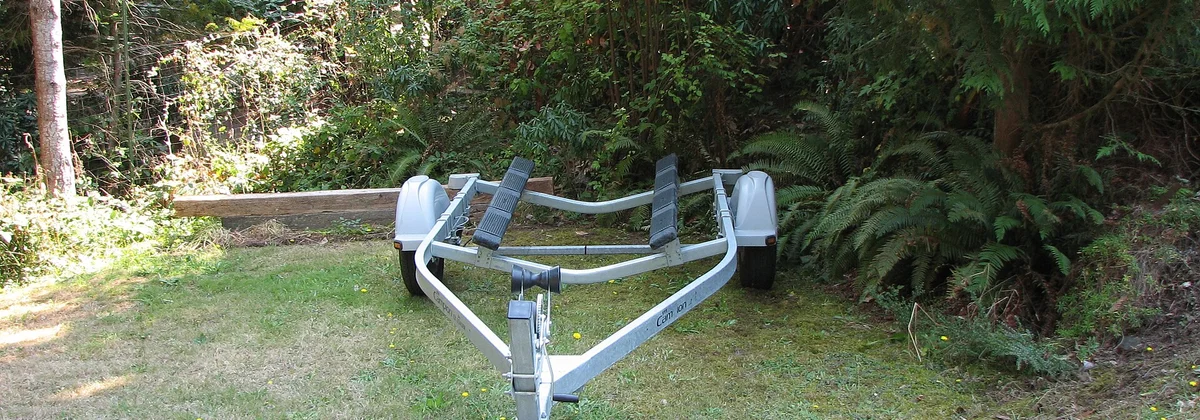
Quick answer: Boat trailer failures follow a predictable order and almost all of them are about age and water rather than mileage. Trailer tires age out in 3 to 5 years regardless of tread. Bearings fail when a hot hub is backed into cool water and draws moisture past the seal, which is why they want repacking annually, and more often in salt. Brakes and lights fail from corrosion at connections nobody inspects. None of it is expensive to prevent, and all of it strands you on the hard shoulder with a boat behind you.
Why Trailer Tires Are Not Car Tires
This is the single most misunderstood item on a boat trailer, and the misunderstanding puts people on the hard shoulder every summer.
A trailer tire is built for a different job. It carries a heavy vertical load with very little suspension travel above it, it takes lateral scrub every time the trailer is manoeuvred, and it spends the overwhelming majority of its life stationary and loaded in sunlight. It is marked ST on the sidewall, for Special Trailer, and it is not interchangeable with a passenger car tire.
| Special Trailer (ST) tire | Passenger car (P) tire | |
|---|---|---|
| Sidewall | Stiffer, built for vertical load | Softer, built for ride and grip |
| Speed rating | Lower, commonly limited | Higher |
| Designed for | Being towed and parked loaded | Being driven and steered |
| Failure mode | Age degradation, sidewall | Tread wear |
| Fitting a car tire instead | Overloads the sidewall | Not applicable |
Insider tip: find the four-digit DOT date code on the sidewall and read it before you read the tread. The first two digits are the week, the last two the year, so 2823 means the twenty-eighth week of 2023. A tire with 90% tread and a 2019 date code is finished, and it is exactly the tire that looks fine in the driveway and lets go at 65 mph in August.
The Tire Replacement Interval
| Age of tire | Condition, typical | What to do |
|---|---|---|
| Under 3 years | Sound if stored well | Inspect, check pressure monthly |
| 3 to 5 years | Degrading internally | Plan replacement, inspect closely |
| Over 5 years | Unreliable regardless of tread | Replace |
| Over 7 years | Should not be on the road | Replace immediately |
| Any age, sidewall cracking | Failed | Replace immediately |
| Any age, uneven wear | Alignment or load problem | Replace and investigate cause |
Trailer tires are one of the running costs nobody budgets for when they price a boat, alongside the items in the cost to dock a boat breakdown. Pressure matters more on a trailer than on a car, because an under-inflated trailer tire flexes, heats and fails rather than simply wearing. Check cold pressure against the sidewall maximum rather than against a car-style recommendation, and check it before every long tow.
Two more habits that pay for themselves. Cover the tires when the trailer is parked outdoors for long periods, because ultraviolet degradation is a large part of the ageing. And carry a spare that is itself in date, along with a jack that will actually lift a loaded trailer, which a car jack usually will not.
Bearings: Why They Fail and How Often to Service
Bearings do not fail from load. They fail from water, and the mechanism is worth understanding because it explains the service interval.
Towing heats the hub. Backing the trailer into cool water cools the hub rapidly, the air inside contracts, and that contraction pulls water past the seal into the grease. Water plus hot grease plus steel produces rust, rust produces play, play produces heat, and a bearing that has been quietly rusting for two seasons seizes on a highway in the third.
| Condition | Repack interval | Notes |
|---|---|---|
| Fresh water, occasional use | Every 12 months | Or 2,000 miles, whichever comes first |
| Fresh water, frequent launching | Every 12 months | Inspect mid-season |
| Salt water, any frequency | Every 6 to 12 months | Rinse hubs after every launch |
| Trailer stored outdoors | Annually, inspect seals | Seals perish in sunlight |
| After any immersion above the hub | Inspect immediately | Water crosses the seal easily |
| Bearing buddies fitted | Still annually | They reduce risk, not the interval |
The sizing and towing side is covered in the boat trailer guide. Bearing protectors, sold under several brand names, keep the hub under slight positive grease pressure so water is pushed out rather than drawn in. They help and they are cheap. They are not a substitute for opening the hub once a year and looking at what is inside.
Insider tip: put your hand on each hub at every fuel stop on a long tow. Warm is normal, hot enough that you cannot hold your palm there is a bearing telling you it has perhaps twenty miles left. That thirty-second check has saved more trailers than any product sold for the purpose.
Buying a boat that comes with a trailer?
Tell us the boat, the trailer and where it will be launched. We will tell you what to inspect before you take it and what the first year of trailer work is likely to cost.
Brakes: What the Law Requires and What Fails
Trailer brake requirements are set by state, not by the trailer manufacturer, and the rule that binds you is the rule of the state you are driving through.
| Item | What to establish |
|---|---|
| Gross trailer weight | Boat, trailer, fuel, water, gear, all of it |
| Your state’s brake threshold | Commonly around 3,000 lb, but it varies |
| Every state on your route | Rules differ and the strictest applies |
| Brake type fitted | Surge, electric, or electric over hydraulic |
| Breakaway system | Required in many states above the threshold |
| Last brake service | Corrosion after a season of disuse is normal |
| Brake type | How it works | Suits |
|---|---|---|
| Surge | Trailer pushes a master cylinder under deceleration | Simple, no tow-vehicle wiring, common on boats |
| Electric drum | Controller in the tow vehicle applies the brakes | Cheaper, poor tolerance of immersion |
| Electric over hydraulic | Controller drives a hydraulic pump | Heavier trailers, best control, dearest |
| Disc, in any of the above | Better heat and water tolerance | Saltwater use, heavier boats |
Whatever is fitted, the failure mode is corrosion during disuse rather than wear. A trailer that sat all winter with damp brake components can have a seized caliper or a rusted drum by spring, and the first indication is often a pull to one side under braking with a loaded boat behind you. Test the brakes in a quiet place before the first long tow of the season, not on the way to the ramp.
Lights, Wiring and the Earth Connection
Trailer lighting failures are almost always earth failures, and almost always corrosion.
- Check the earth connection at the coupler and at each light body, which is where corrosion concentrates.
- Use dielectric grease in every connector, including the plug to the tow vehicle.
- Submersible LED units tolerate immersion far better than filament bulbs, which crack when a hot bulb is dunked.
- Run the wiring inside the frame where possible, and inspect where it passes through the frame for chafe.
- Test lights with the boat loaded, because the loom is under tension then and a marginal connection shows up.
Saltwater Changes the Interval, Not the List
| Item | Fresh water | Salt water |
|---|---|---|
| Rinse after launch | Occasionally | Every single time, hubs and frame |
| Bearing service | Annual | Every 6 to 12 months |
| Brake inspection | Annual | Twice a year |
| Wiring and connectors | Annual | Every few months |
| Frame and weld inspection | Every 2 years | Annual |
| Spring and shackle check | Every 2 years | Annual |
| Realistic trailer life | 15 to 20 years | 8 to 12 years |
Galvanised trailers last longer in salt than painted steel and cost more up front; aluminium trailers avoid the rust question and bring their own galvanic considerations at the fasteners. If the boat will be launched in salt more than a handful of times a year, the specification decision is made at purchase and cannot be corrected afterwards.
Insider tip: rinse the hubs and the brake components specifically, not just the visible frame. A hose over the top of the trailer washes the paintwork and leaves salt sitting exactly where it does the damage. Two minutes with the hose aimed at each wheel is worth more than ten minutes on the frame.
Red Flags on a Used Trailer
- Tires with good tread and a date code more than 5 years old.
- Grease weeping from a hub, which means the seal has already failed.
- Rust streaks running down from the wheel bearings.
- Lights that work on the driveway and fail when the boat is loaded.
- A frame with bubbling paint at the welds, which is rust working from inside.
- Rollers or bunks that do not match the hull, which damages the boat rather than the trailer; the maintenance schedule covers what the boat itself needs.
- A trailer whose capacity is close to the loaded weight rather than comfortably above it.
Buyer Scenarios
Buying a used boat with a trailer included. Price the trailer separately in your head, alongside the checks in how to buy a boat. Tires, a bearing service and a light repair on a neglected trailer is a real sum, and a trailer at the end of its life on a saltwater coast can be most of the cost of a new one.
First season with a new trailer. Do the first bearing inspection at the end of that season even though nothing feels wrong. It establishes what good looks like and catches a seal that was marginal from the factory.
Saltwater launching more than a few times a year. Specify galvanised or aluminium, fit disc brakes if the weight requires brakes at all, and build the post-launch rinse into the routine from day one.
Long tows between states. Check the brake threshold for every state on the route, carry an in-date spare and a jack that lifts a loaded trailer, and check hub temperature at every fuel stop.
Storing over winter. The boat storage cost page covers where the rig should sit. Take the weight off the tires or move the trailer periodically, cover the tires, grease the hubs before storage rather than after, and disconnect and protect the wiring plug.
Pros and cons of servicing the trailer yourself
| Advantages | Disadvantages |
|---|---|
| Bearings, lights and tires are genuinely owner-serviceable | A brake fault on a loaded trailer is a serious safety matter |
| You learn what your trailer sounds and feels like when right | Bearing races need the right tools to seat correctly |
| Annual cost drops to parts and an afternoon | A missed seal problem shows up as a seized hub on a highway |
| You inspect the frame regularly rather than never | Some warranty terms require documented professional service |
| Records of your own work still count at resale | Undocumented DIY history reads as no history to a buyer |
Working out what a trailered boat really costs to keep?
We can model the trailer, the launching pattern and the storage alongside the boat itself, so the annual figure is the real one.
Frequently Asked Questions
Because they age out rather than wear out. A trailer tire spends most of its life parked, loaded, in sunlight, and the rubber degrades from the inside while the tread still looks new. Most manufacturers treat 3 to 5 years as the replacement window regardless of mileage, and a tire with full tread and a six-year-old date code is the classic roadside blowout.
Special Trailer rating, marked ST on the sidewall, not a passenger car tire. ST tires carry stiffer sidewalls for the vertical load and the lateral forces a trailer sees, and they are speed rated lower than car tires. Check the load rating against the loaded trailer weight per tire with a real margin, not against the empty trailer.
Annually for most trailers, and more often if the trailer is regularly dunked in salt water. Bearings fail when water gets past the seal into hot grease, and a trailer backed into cool water with hot hubs draws water in as the hub contracts. Repacking is cheap; a seized bearing on a highway is not.
Above a weight threshold, yes, and the threshold is set by state law rather than by the trailer. Many states require brakes above roughly 3,000 lb gross trailer weight, some lower, and the rule follows the state you are driving through rather than the one you registered in. Check the states on your route, not just your own.
It attacks everything the fresh-water owner never thinks about: bearings through the seals, brake components, wiring connectors, spring shackles and the frame itself from the inside where galvanising is thinnest. A saltwater trailer needs rinsing after every launch, more frequent bearing service, and annual inspection of the frame at the welds.
Tires, then bearings, then lights, then brakes, roughly in that order. Tires fail on age, bearings on water ingress, lights on corroded earth connections, brakes on seized components after a season of disuse. All four are cheap to prevent and all four strand you on the hard shoulder with a boat behind you.
Commonly 15 to 20 years in fresh water with annual servicing, and 8 to 12 in salt, with galvanised and aluminium frames at the long end of each range and painted steel at the short end. The decision that sets that life is made at purchase: a painted steel trailer bought for a saltwater coast is on a shorter clock from the first launch.
Request a yacht buyer consultation
Share your budget, target LOA, and use case. We reply within one business day with matched brokers or surveyors.