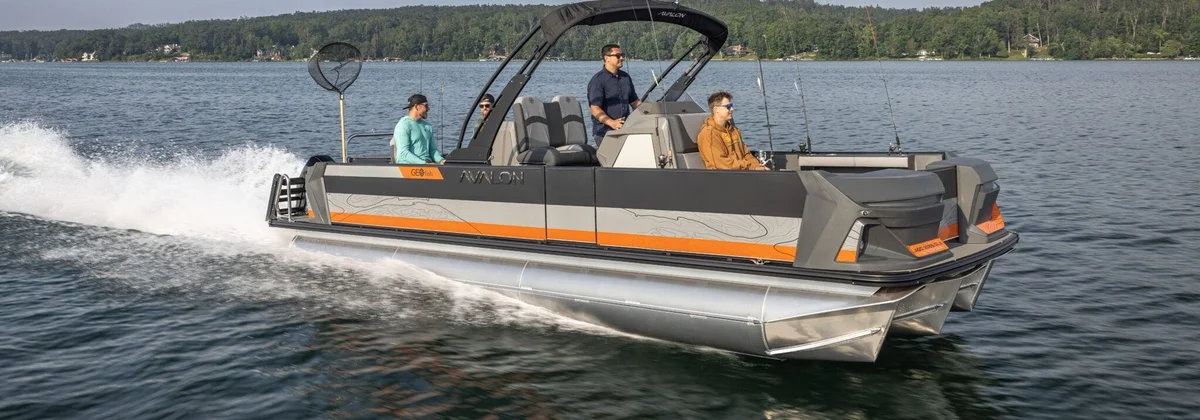
Quick answer: Pontoon boats are flat-decked vessels supported on two or three aluminum tubes, offering maximum deck space, high stability, and passenger capacity on calm water. They are the dominant freshwater leisure boat in the United States, the top-selling powerboat segment by unit volume in many consecutive years according to NMMA data. Prices start at $25,000 for an entry-level model and reach $200,000+ for performance tritoon packages.
What Is a Pontoon Boat and Why Is It So Popular?
A pontoon boat is a flat-decked leisure vessel supported on two hollow aluminum tubes, the pontoons, rather than a traditional V-hull or flat-bottom hull. The tubes displace enough water to float the deck, which sits 18-24 inches above the waterline. The result is a stable, spacious, and remarkably functional platform that maximises living and recreational space relative to the boat’s overall length.
The key advantages are immediately obvious:
Stability: The wide tube spacing (typically 8-10 ft on a 22 ft pontoon) creates a far more stable platform than a conventional single-hull boat of equivalent length. Passengers can move around freely, stand at the rail, and board from the water ladder without the vessel rocking significantly.
Deck space: A 24 ft pontoon boat offers more usable seating, cooler space, and walking room than a 24 ft V-hull runabout or cabin cruiser. The flat deck extends the full length of the vessel between the pontoons with no intrusions from a hull below.
Passenger capacity: Most 22-25 ft pontoons are certified for 10-14 passengers, a capacity that makes them uniquely suited for family gatherings, entertaining, and group recreation.
Low entry threshold: Pontoon boats are among the most forgiving vessels to operate for new boaters. The wide beam provides stability; the outboard engine is simple to maintain; and the shallow draft (typically 12-18 inches) reduces grounding risk in unfamiliar waters.
These characteristics explain why pontoon boats consistently rank as the top-selling or second-selling powerboat category in the US by unit volume. The broader US recreational marine market recorded 238,117 new boat sales and 858,798 pre-owned transactions in 2024 (NMMA), with pontoons representing one of the largest individual segments by unit count.
For a complete walkthrough of the boat-buying process, see the guide to buying a boat.
Pontoon vs Tritoon: Two Tubes or Three?
The third tube does not create speed, it removes the ceiling. A two-tube pontoon is typically capped somewhere around 60-200 hp; a tritoon is commonly rated to 250-400 hp, and the handling, chop and water-sports differences all follow from being allowed to carry that power.
| Feature | Standard Pontoon (2 tubes) | Tritoon (3 tubes) |
|---|---|---|
| Max engine size (typical) | 60-200 hp | 150-400+ hp |
| Top speed (typical) | 20-30 mph | 35-50+ mph |
| Rough water handling | Adequate in calm to light chop | Noticeably better |
| Load capacity | Standard | Higher (3rd tube adds buoyancy) |
| Price premium | Baseline | $10,000-$25,000 more |
Buy the two-tube boat for calm water and a modest motor, and the tritoon for water sports, chop, big crowds or long runs. Tube diameter, lifting strakes, the underskin and the full cost of the package including the engine and the trailer are set out in pontoon vs tritoon.
Pontoon Boat Sizes and Engine Configurations
The pontoon boat market centres on a practical size range with clear performance implications at each tier:
| Size | Engine Range | Top Speed | Typical Use | New Price Range |
|---|---|---|---|---|
| 18-20 ft | 40-90 hp single | 16-24 mph | Small lakes; 2-6 persons | $20,000-$45,000 |
| 21-23 ft | 90-175 hp single | 20-30 mph | Lakes; 8-12 persons | $35,000-$75,000 |
| 24-26 ft | 150-250 hp single/twin | 25-40 mph | Lakes; rivers; 10-14 persons | $55,000-$130,000 |
| 25-27 ft tritoon | 200-350 hp single/twin | 35-50 mph | Performance cruising | $85,000-$175,000 |
| 28-30 ft | 250-400 hp twin | 40-55 mph | Large lakes; semi-coastal | $130,000-$220,000+ |
The 24-26 ft range is the practical sweet spot for most families. It offers comfortable capacity for 10-12 people, accepts a 150-200 hp outboard for comfortable lake cruising speeds, and fits within the slip dimensions of most freshwater marinas and some covered boathouses.
How Much Does a Pontoon Boat Cost?
Pontoon boats span a wide price spectrum depending on length, tube configuration, engine size, and brand positioning:
New boat market pricing (2026 approximate):
| Brand | Tier | Representative Model | Price |
|---|---|---|---|
| SunTracker | Entry | Party Barge 22 | $25,000-$40,000 |
| Lowe | Entry-Mid | SS210 | $28,000-$50,000 |
| Harris | Mid-Market | Cruiser 210 | $45,000-$80,000 |
| SunChaser | Mid-Market | Geneva Cruise 22 | $45,000-$75,000 |
| Bennington | Premium | 22 SSFB | $60,000-$95,000 |
| Manitou | Performance | XT 25 Oasis | $80,000-$130,000 |
| Bennington | Performance Tritoon | 25 QXFBA | $120,000-$175,000+ |
Used market: A 5-7 year old Bennington or Manitou in good condition typically sells for 55-70% of its original retail price. Entry-level brands depreciate more aggressively. The used pontoon market is extensive and well-documented through platforms like Boats.com and BoatTrader.
For detailed annual cost modelling, see the boat ownership cost guide.
Best Pontoon Boat Brands
Bennington Marine: Based in Elkhart, Indiana, Bennington is widely regarded as the premium production pontoon boat builder in the US. Their fit, finish, and upholstery quality are consistently above the market average, and the breadth of configuration options, hull colour, furniture package, engine, tube diameter, is exceptional. Bennington’s Q-Series performance tritoons command strong demand and premium resale values. A well-maintained used Bennington typically holds value better than most competitors.
Manitou Pontoon Boats: Based in Bremen, Indiana, Manitou is particularly focused on the performance end of the pontoon market. Their V-Toon hull technology uses a V-shaped keel section between the tubes to improve handling at speed and reduce porpoising. Manitou is a strong choice for buyers who want pontoon stability with sportboat performance characteristics.
Harris Boats: Based in Fort Wayne, Indiana, Harris offers a mid-market range of pontoons with a reputation for quality and durability. Their Crowne and Solstice series are practical mid-range options for families looking for a quality pontoon without premium-brand pricing.
SunTracker (Bass Pro Shops): The volume brand of the pontoon market, distributed through Bass Pro Shops and Cabela’s retail locations. SunTracker boats offer the lowest entry prices in the category and are appropriate for buyers who prioritise value over premium fit and finish. Their Party Barge series is one of the best-selling pontoon boats in the US by unit volume.
Lowe Boats: Part of the Platinum Equity portfolio, Lowe builds both aluminum fishing boats and pontoons across a mid-range price spectrum. Practical and functional without the premium branding of Bennington.
See the brands directory for full independent builder profiles across the recreational marine market.
What You Can (and Cannot) Do on a Pontoon Boat
Know the limitations before you buy, not after your first windy day on a big lake.
Winter storage tip: If your lake freezes, pull the boat by October and store it in a covered boathouse or under a fitted cover. UV destroys vinyl upholstery faster than anything else, a $3,000 re-upholstery job at year 5 is almost always caused by inadequate winter storage, not use.
Trailering tip: Pontoon boats up to about 24 feet can be trailered with a standard half-ton truck, but the width (8.5 ft beam is common) means you need to check your state’s oversize-load rules. Some states require flags, lights, or even a permit for beams over 8.5 ft on a trailer.
Best applications:
- Family day cruising and socialising on lakes, rivers, and protected bays
- Fishing in calm freshwater (pontoons accept rod holders, livewells, and trolling motors readily)
- Tubing and casual water sports at moderate speeds (30 mph and under for most tubing setups)
- Wakeboarding with a performance tritoon over 250 hp
- Swimming, anchoring, and entertaining with large groups
- Sunset cruises and waterfront restaurant access
Limitations:
- Open coastal or offshore use: not appropriate. Pontoon boats are not designed for waves exceeding 2-3 ft, and their flat-bottom profile offers poor seakeeping in chop. For saltwater bay fishing, a center console boat or bay boat is better suited.
- High-speed performance: even a performance tritoon at 50 mph is not a ski boat or runabout. If watersports performance is the primary goal, a dedicated ski/wake boat is more capable.
- Long-distance cruising: limited range, typically 60-120 nm on a tank. Not practical for extended overnight coastal passages.
- Shallow-draft exploration without grounding concern: although pontoons have shallow draft (12-18 inches), the tubes can catch on submerged objects in very shallow or rocky water.
If a V-hull would suit your water better, the deck boat page covers the family boat that carries a similar crowd and handles chop, and the bowrider page covers the better-riding alternative with fewer seats.
Pontoon Boat Ownership Costs
Annual running costs for a pontoon boat are among the lowest in the recreational powerboat category, which is part of their broad appeal for first-time boat owners:
| Expense | 22 ft (90 hp) | 26 ft Tritoon (250 hp) |
|---|---|---|
| Storage (marina slip or boathouse) | $2,500-$8,000 | $4,000-$10,000 |
| Insurance | $500-$1,200 | $900-$2,000 |
| Fuel (80 annual hours) | $800-$2,000 | $2,000-$5,000 |
| Annual engine service | $400-$800 | $700-$1,500 |
| Dock lines, covers, safety gear | $300-$600 | $400-$800 |
| Total annual estimate | $4,500-$12,600 | $8,000-$19,300 |
Pontoon boats are also well-suited to long-term storage in covered boathouses on freshwater lakes, a lower-cost alternative to wet-slip marina storage that also protects the upholstery and furniture from sun fading.
For financing a purchase above $40,000, see the yacht financing guide for marine loan structures available from banks and specialty lenders.
Buying a Used Pontoon Boat: What to Check
The used pontoon market offers strong value, particularly for buyers targeting 5-10 year old models from premium builders. Key inspection points:
Pontoon tube condition: Check for dents, corrosion (especially in saltwater-used or poorly maintained vessels), and any repair patches or foam-fill evidence that suggests a previous flooding incident. Check the strakes (longitudinal ribs on the underside of the tubes) for bending or missing sections on performance models.
Deck and furniture: Pontoon boat decks are typically aluminum with marine carpet or vinyl flooring. Check the floor for soft spots or delamination, carpet for mold or water retention (lift corner sections if accessible), and vinyl upholstery for cracking, UV fading, and mold in the seams.
Engine condition: Outboard engines on pontoon boats are typically lower-hours than comparable fishing or sportboat engines because pontoons are used at moderate speeds for social rather than performance purposes. Request maintenance logs, check for corrosion on the cowling and lower unit, and do a water test to verify smooth operation across the throttle range.
Electrical systems: Check all navigation lights, bilge pump operation (pontoons have a bilge space in the tubes on some models), horn, and accessories (stereo, livewell pump, dock lights if installed). Electrical issues on older pontoons are common and can be time-consuming to diagnose.
Looking for a pontoon boat?
Tell us your lake or river, typical group size, and budget. We'll connect you with dealers who specialise in pontoon and tritoon boats for your region.
Frequently Asked Questions
A pontoon boat is a flat-decked vessel supported on two (or three, in a tritoon) hollow aluminum tubes. The tubes provide buoyancy and stability; the flat deck above maximises usable passenger space. Pontoons are the dominant freshwater leisure boat in the US, consistently the top-selling powerboat segment by unit volume, valued for stability, capacity, and ease of operation.
Choose a standard two-tube pontoon if your water is calm, your top speed goal is under 28 mph, and you are budget-conscious. Choose a tritoon if you want to run a 200-350 hp engine for higher performance and speeds of 35-50 mph, you carry heavy loads regularly, or you want better rough-water handling. Tritoons cost $10,000-$25,000 more than comparable two-tube models.
Entry-level 20-22 ft pontoons from SunTracker or Lowe start at $25,000-$40,000 new. Mid-market 24 ft models from Harris and SunChaser run $45,000-$80,000. Premium Bennington models in the 24-26 ft range cost $60,000-$130,000. High-performance tritoon packages with 250+ hp engines and luxury furniture from Bennington or Manitou reach $150,000-$200,000+.
Pontoon boats can operate in calm saltwater environments, protected bays, estuaries, and tidal rivers, but are not designed for open coastal or offshore use. Saltwater accelerates corrosion of aluminum tubes, requiring more frequent maintenance and marine-grade aluminum alloy construction. Open coastal use in waves over 2-3 ft is not appropriate for a standard pontoon boat.
Most 22-25 ft pontoons are certified for 10-14 persons by the capacity plate. A 25-28 ft model commonly rates 12-16 persons. For comfortable real-world use with coolers, gear, and free movement, subtract 2-4 persons from the maximum capacity plate figure to estimate a practical comfortable capacity.
For a mid-size 24 ft pontoon on a freshwater lake, expect $4,500-$13,000 per year including marina or boathouse storage, insurance, fuel, and annual engine service. Pontoon boats have among the lowest annual operating costs in the recreational powerboat category, which is part of their broad appeal for budget-conscious or first-time boat owners.
Request a yacht buyer consultation
Share your budget, target LOA, and use case. We reply within one business day with matched brokers or surveyors.