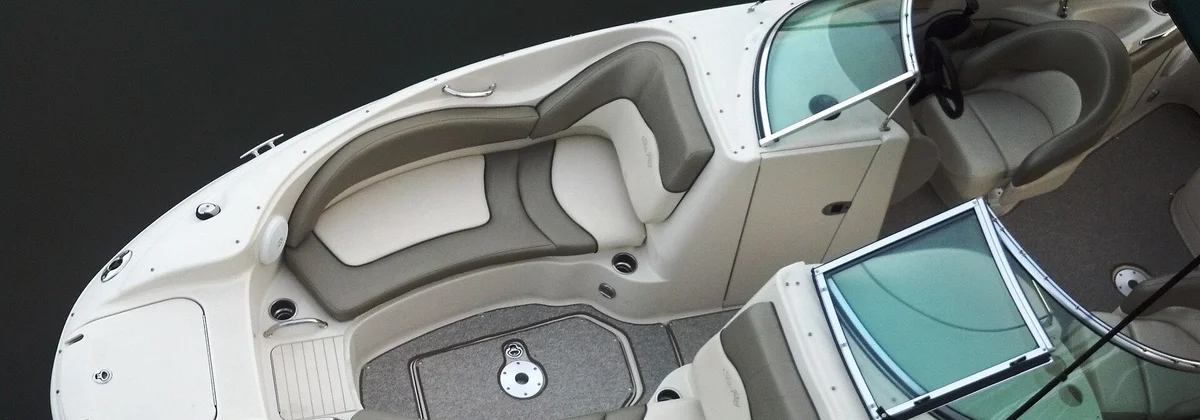
Quick answer: A bowrider is an open-bow V-hull runabout, and it is the default first boat almost everywhere because it is competent at day cruising, swimming, towing and family outings without being built for any one of them. The two decisions that matter are size and outboard against sterndrive, and both are decided by the water you use rather than by the brochure.
Why the Type Dominates
The bowrider wins on breadth rather than on excellence. It tows a skier, carries a family for a day on the water, anchors off a beach, and fits on a trailer in a normal driveway. Nothing else in its price band does all four.
| Use | How a bowrider handles it |
|---|---|
| Day cruising | Its core competence |
| Swimming and beach stops | Swim platform and ladder as standard |
| Towing skiers and tubes | Perfectly capable, quick with modern power |
| Fishing | Possible, awkward: no rod storage, no livewell |
| Overnighting | No |
| Rough open water | Within limits, better than deck boats and pontoons |
That profile is also why resale is strong. A bowrider suits the largest pool of buyers in the market, which matters more to the true cost of ownership than most first-time buyers expect. The depreciation mechanics are set out in the yacht depreciation guide.
Sizing It Honestly
| Length | Realistic crew | Where it belongs | Trailering |
|---|---|---|---|
| 16 to 17 ft | 3 to 4 | Small lakes, sheltered rivers | Easy, small vehicle |
| 18 to 19 ft | 4 to 6 | Lakes, calm coastal days | Straightforward |
| 20 to 21 ft | 6 to 8 | The volume of the market | Needs a proper tow vehicle |
| 22 to 23 ft | 8 to 10 | Coastal, bigger lakes, chop | Serious tow rating needed |
| 24 to 26 ft | 10 to 12 | Coastal cruising, longer runs | Often lives in a slip instead |
Insider tip: the bow seats are the first thing buyers fall in love with and the first thing that becomes unusable. At anything above a gentle chop the bow is wet and uncomfortable, and everyone moves aft. Judge a bowrider by its cockpit, which is where people actually spend the day, and treat the bow as a bonus for calm water.
The towing decision travels with the size decision. Once the loaded rig passes what your vehicle is rated for, the boat stops being trailerable in practice; the arithmetic is in the boat trailer guide.
Outboard Against Sterndrive
The market has moved decisively toward outboards over the last decade, and the reasons are practical rather than fashionable.
| Outboard | Sterndrive | |
|---|---|---|
| Transom and swim platform | Engine sits aft, platform split around it | Clean transom, full-width platform |
| Service access | Everything reachable | Engine boxed under the sun pad |
| Known wear items | Lower unit, trim system | Bellows, gimbal bearing, transom assembly |
| Weight | Lighter | Heavier, lower centre of gravity |
| Winterisation | Simple | More involved |
| Resale, current market | Stronger | Weaker on newer boats |
The general comparison across boat types is in outboard versus inboard. For a bowrider specifically, the decisive point is that sterndrive maintenance items are predictable, expensive and invisible until they fail, which is exactly the profile that catches first-time owners.
Pros and cons of a bowrider
| Advantages | Disadvantages |
|---|---|
| Does more different things well than anything at the price | Master of none of them |
| The broadest resale market of any small boat type | Bow seating is unusable in chop |
| Trailerable at most useful sizes | Larger sizes quietly stop being trailerable |
| Simple, well-understood systems | Sterndrive models carry known expensive wear items |
| Strong dealer and parts support everywhere | No fishing features, no accommodation |
| Good ride for the length | Upholstery is the dominant long-term cost |
Buying One Well
Bowriders are mass-produced and the used market is deep, which means condition matters more than model. Three things separate a good used boat from a cheap one.
The deck and stringers. Walk every square foot of the cockpit sole in bare feet. Any softness, any flex, any hollow sound means water has been in the structure. That is the difference between a boat worth buying and one worth walking away from.
The upholstery. It is most of the boat’s visible surface, it fails in sun, and replacing it is a genuinely large bill relative to the boat’s value. Look under the seat bases rather than at the vinyl on top, because the plywood the base is built on is what actually rots, and a re-covered seat on a wet base is a cosmetic repair over a structural problem.
The paperwork. Title, registration and lien status, covered in the title transfer guide and the bill of sale guide.
Run the used boat inspection checklist before you commit, and read how to buy a boat for the sequence around it. If a family boat that carries more people is closer to the brief, the deck boat page covers that side and the pontoon guide covers the calm-water alternative.
Running costs sit mostly in insurance, storage and upholstery renewal; the insurance drivers are in the boat insurance cost guide and the storage comparison in cost to dock a boat.
First family boat?
We can match size, power and storage to how your family will really use the boat, before a dealer matches it to their stock.
Frequently Asked Questions
An open-bow runabout: a V-hulled powerboat with a windscreen, a cockpit aft and seating forward of it in the bow, reached through a walk-through in the screen. It is the default recreational boat in most markets because it does day cruising, swimming, towing and family use adequately without being specialised for any of them.
For a family of four on a lake, 18 to 21 feet is usually enough boat and easily towed. For coastal water, more people, or any real chop, 22 to 25 feet buys a dry ride and a boat that does not feel small when the wind gets up. Below 18 feet the bow seating becomes decorative rather than usable.
A deck boat carries its beam forward, so its bow is a real seating area for several people and it carries 8 to 12 aboard. A bowrider narrows at the bow, seats two comfortably up front, and rides better for it. Choose the deck boat if the bow is where people will sit; choose the bowrider if you want the better-handling, more resaleable boat.
Outboards have taken most of the market: they free up the transom, weigh less, are far easier to service and no longer look out of place. Sterndrives keep the engine under the sun pad, give a cleaner transom and a slightly different ride, and carry the bellows, gimbal bearing and transom assembly as known maintenance items. For most buyers today the outboard is the lower-risk choice.
Not properly. A bowrider is an open day boat; some larger ones have a small head compartment under the console and none has real accommodation. If overnighting matters, the cuddy cabin is the type that adds a berth without moving up to a full cruiser.
Upholstery and the deck beneath it, then water in the stringers, then, on sterndrive boats, the bellows and gimbal bearing. Engine hours are usually low and engine problems are usually not the issue. Soft spots underfoot and a musty bilge tell you more about the boat's future than the hour meter does.
Better than a pontoon or a deck boat of the same length, and clearly worse than a deep-V offshore hull. The V-hull and windscreen handle a moderate chop; what fails first is comfort in the bow, which becomes wet and unpleasant long before the boat itself is troubled.
Request a yacht buyer consultation
Share your budget, target LOA, and use case. We reply within one business day with matched brokers or surveyors.