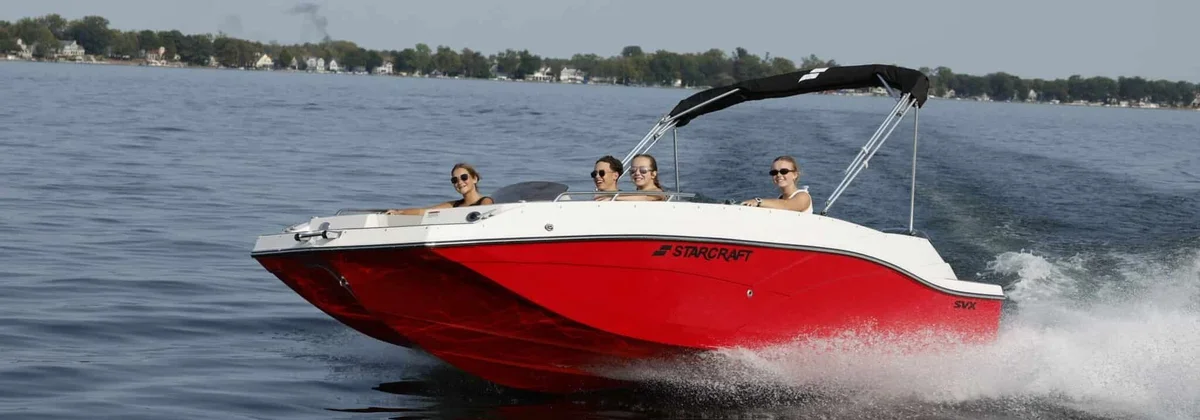
Quick answer: A deck boat is a V-hull that carries its beam almost to the bow, which turns the forward third of the boat from a two-seat cockpit into a real seating area. It exists to solve one specific problem: wanting a pontoon’s space and passenger count without giving up a hull that handles chop and tows water sports. The trade is ride quality against deck area, and the wide bow that creates the space is the same surface that slaps in a head sea.
What Makes It a Deck Boat
Ignore the marketing and look at one line: the plan view.
On a conventional runabout the hull narrows steadily toward the stem, so by the time you reach the forward seats there is room for two people with their knees together. On a deck boat the maximum beam is held forward and the bow is squared or bluntly rounded, so the same 24 feet of boat contains a bow lounge several people can actually use.
| Feature | Deck boat | Conventional runabout |
|---|---|---|
| Beam at the bow | Carried nearly full width | Narrows to a fine entry |
| Usable bow seating | Genuine lounge, several people | Two seats, knees together |
| Total capacity, 24 ft hull | Commonly 10 to 12 | Commonly 7 to 9 |
| Ride in a head sea | Firmer, more slap | Softer, finer entry |
| Stability at rest | Higher | Lower |
| Storage volume | Substantially more | Less |
Insider tip: at a boat show, ignore the brochure capacity and count the seat bases in the bow with an adult sitting in each. Rated capacity is a weight and volume calculation, not a comfort measurement, and deck boats are where the gap between the two is widest. The wider approach to show buying is in the boat show buyer’s guide.
Deck Boat Against Bowrider
This is the comparison most buyers are actually making, and the honest answer depends on how the boat gets used rather than on which is better.
| Deck boat | Bowrider | |
|---|---|---|
| Bow area | Large, social, useable underway at rest | Small, two people |
| People carried | 8 to 12 typical | 6 to 9 typical |
| Ride quality | Firmer, more bow slap | Finer entry, softer |
| Handling feel | Steadier, less agile | Sportier, more responsive |
| Water sports | Perfectly capable | Perfectly capable, often quicker |
| Storage | More, and better placed | Less |
| Resale market | Narrower, family buyers | Very broad |
The decision rule that actually works: if the bow is where your people will sit, buy the deck boat; if the bow is where you occasionally put a cooler, buy the bowrider. The type itself is covered in more depth on the bowrider page.
Deck Boat Against Pontoon
The other comparison, and here the water decides.
| Deck boat | Pontoon | |
|---|---|---|
| Calm-water space per dollar | Good | Better |
| Behaviour in chop | Handles it | Slams, wets everyone |
| Turning and handling | Proper V-hull turns | Flat, skates |
| Water sports | Strong | Adequate at best on most models |
| Trailering | Straightforward, single trailer | Needs a pontoon-specific trailer |
| Stability at rest | High | Highest |
| Shallow water | Sterndrive limits it | Very shallow |
If you are weighing the two seriously, the pontoon boat guide covers the other side of that choice, including where a third tube changes the answer.
Sizes, Power and Layout
| Length | Typical beam | Capacity | Common power |
|---|---|---|---|
| 20 to 21 ft | 8 ft to 8 ft 4 in | 8 to 10 | Single sterndrive or 150 hp outboard |
| 22 to 23 ft | 8 ft 4 in to 8 ft 6 in | 10 to 12 | 200 to 250 hp |
| 24 to 26 ft | 8 ft 6 in | 12 | 250 to 350 hp, sometimes twin outboards |
Two layout decisions matter more than the rest. Outboard or sterndrive changes the whole stern: an outboard frees the transom for a swim platform and is easier to service, a sterndrive keeps the engine under the sun pad and gives a cleaner transom. The trade is set out in outboard versus inboard. And beam against 8 ft 6 in decides whether the boat trailers freely; over that width most jurisdictions want a wide-load permit, which quietly ends the idea of towing it to a different lake each summer. The towing arithmetic is in the boat trailer guide.
What They Cost to Own
The purchase price is the visible number and the running costs are where deck boats sit awkwardly between two worlds. They are heavier and thirstier than a bowrider of the same length, and lighter and cheaper to run than a cruiser.
- Fuel scales with weight and with how much of that wide bow is out of the water at cruise. Trimmed badly, a deck boat burns noticeably more than it should.
- Insurance follows value, hull type and where the boat sits; the drivers are in the boat insurance cost guide.
- Storage is the fork: trailer-and-driveway or a slip. The comparison is in cost to dock a boat.
- Upholstery is the type’s biggest long-term expense. A deck boat is mostly seating, and seating is what fails first in sun.
For the wider sequence from shortlist to survey to closing, see how to buy a boat, and for a used purchase run the used boat inspection checklist.
Pros and cons of a deck boat
| Advantages | Disadvantages |
|---|---|
| Seats a pontoon’s crowd on a hull that turns and tows | Bow slap in a head sea is the price of the wide bow |
| Far more usable bow area than a bowrider of the same length | Narrower resale market than a mainstream bowrider |
| Trailers on a standard single trailer, unlike a pontoon | Heavier and thirstier than a bowrider of equal length |
| Genuinely capable at water sports | Not an offshore hull, whatever the length suggests |
| Large storage volume under the seating | Upholstery area is the biggest long-term cost |
| Stable at rest for swimming and lunch stops | Sterndrive models limit how shallow you can go |
Deck boat, bowrider or pontoon?
We can set the three against your actual water, crew and towing situation rather than against a brochure.
Frequently Asked Questions
A V-hulled powerboat whose beam is carried much further forward than on a conventional runabout, giving a wide, usable bow area and far more deck space for the same length. The point of the type is to combine a pontoon's carrying capacity and open layout with a fibreglass V-hull that can handle chop and pull water sports.
Both have an open bow, but the hull shape differs. A bowrider narrows to a fine entry at the bow, so the forward seats are a small cockpit for two. A deck boat keeps its beam almost to the stem, so the bow becomes a genuine seating area for several people. The deck boat carries more and is more stable at rest; the bowrider is usually the better-riding, sportier boat.
It depends entirely on the water. A pontoon carries more people for the money, is more stable at rest and is unbeatable on calm lakes. A deck boat handles chop, turns properly, tows skiers better and is easier to trailer. If your water is flat and social, buy the pontoon; if it gets rough or you want water sports, buy the deck boat.
The mainstream sits between about 20 and 26 feet, with beams typically 8 to 8 feet 6 inches so the boat stays trailerable without permits in most jurisdictions. Capacity commonly runs 8 to 12 people, which is where the type's appeal comes from: it seats a pontoon's crowd on a hull that behaves like a runabout.
Better than a pontoon and generally not as good as a deep-V of the same length. The wide bow that creates the deck space also creates more flat surface to slap in a head sea. A deck boat is a competent coastal and big-lake boat within sensible limits, and it is not an offshore hull.
Yes, and towing is one of the main reasons people buy them. A deck boat with a sterndrive or a large outboard will pull skiers, wakeboarders and tubes perfectly well. It will not throw the shaped, weighted wake that a dedicated inboard wake boat produces, which matters only if wake surfing is the point of the purchase.
Upholstery and the deck under it, because a deck boat is mostly seating and water gets under seat bases and into the stringers. Check the bow area particularly hard: it is walked on, sat on and rarely inspected. Then the usual sterndrive items, bellows, gimbal bearing and transom assembly, which are the expensive surprises on this type.
Request a yacht buyer consultation
Share your budget, target LOA, and use case. We reply within one business day with matched brokers or surveyors.