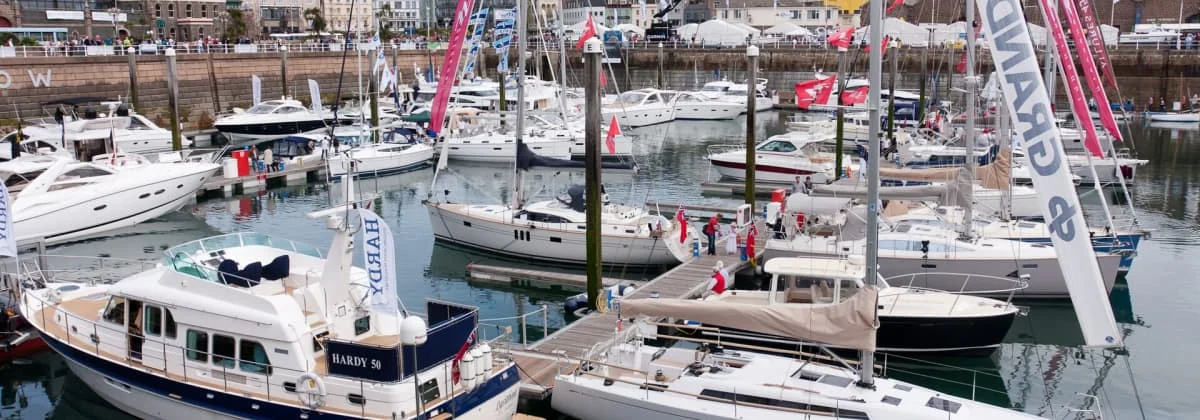
Quick answer: Buying a boat at a boat show means using the show for what it is genuinely good at, comparing 700-1,000 boats in 4-5 days, locking show incentives of 5-10% on new builds, and signing a contract with survey and escrow contingencies, while refusing the one thing shows push hardest: an unconditional same-day commitment. The deal you sign at FLIBS or Miami still runs through the same 2-6 week survey, sea trial and closing path as any other purchase.
What Actually Happens When You Buy a Yacht at a Boat Show?
A boat show purchase is a contract signed under show conditions, not a boat carried home: the signature starts a 2-6 week diligence sequence identical to any brokerage deal. What the show changes is the front of the process: 700-1,000 boats in one place turn months of viewings into 4-5 days of comparison.
The sequence, in the order it should happen:
| Phase | When | What is decided |
|---|---|---|
| Shortlisting and walkthroughs | Days 1-2 of the show | Which 3-5 boats merit serious time |
| Sea-trial requests and broker talks | Days 2-3 | Real availability, seller posture, comparables |
| Offer and contract | Final 48 hours | Price, contingencies, deposit terms |
| Survey, sea trial, financing | 2-6 weeks after the show | Whether the deal survives diligence |
| Closing, tax and registration | On acceptance | Ownership transfers |
Two rules keep the sequence honest, and both belong on the buyer’s checklist:
- The contract is conditional or it is wrong. Survey, sea trial and (where relevant) financing contingencies belong in writing before any deposit moves, the deposit and escrow guide covers the exact wording that protects the money.
- The show deadline is theirs, not yours. Incentives are real, but a “today only” price on a boat that has sat unsold for 200 days is a negotiating posture, not a market fact.
The broader decision framework, new against brokerage, size against budget, total cost against purchase price, sits in the yacht buying guide; this page covers what changes when the venue is a show dock.
Which Boat Shows Matter for a Buyer in 2026?
The buying calendar is anchored by 6 shows that each run 4-9 days, and for US purchase intent two dominate: Fort Lauderdale (FLIBS) in late October, the largest in-water boat show in the world, and Miami in February. Each show has a distinct buyer profile, and matching the show to the mission saves a season.
| Show | Timing | Runs | Scale and character | Best for |
|---|---|---|---|---|
| FLIBS, Fort Lauderdale | Late October | 5 days | ~1,000 boats in water, 6-7 sites | Widest US selection, new and brokerage |
| Discover Boating Miami | February | 5 days | ~1,000 boats, strong outboard and mid-size | New models, US East Coast delivery |
| Palm Beach International | Late March | 4 days | Smaller, higher average size | Focused shopping, 60ft+ |
| Cannes Yachting Festival | September | 6 days | ~600 boats, European debuts | New European builds, EU delivery |
| Monaco Yacht Show | Late September | 4 days | ~120 superyachts | 30m+ market, brokerage and charter |
| boot Düsseldorf | January | 9 days | ~1,500 boats indoors | Sail, catamarans, European season start |
Season logic matters as much as the venue, treat the calendar as a planning checklist:
- FLIBS starts the US buying season, a deal signed there typically closes in December-January, in time for the winter Bahamas and Caribbean season; the Fort Lauderdale market page covers the inventory that sits there year-round.
- Miami is the pricing checkpoint: new-model-year boats debut with fresh price lists, which is exactly when the outgoing model year gets quietly cheaper.
- European shows fit US buyers planning EU delivery or a Mediterranean season before shipping home, a path with its own tax mechanics covered in the buying process library.
Show weeks also distort the local market around them. Brokerage boats near the venue get priced for show traffic in the weeks before, and unsold show inventory softens in the weeks after, a rhythm the Florida buying guide maps across the whole state calendar.
Each of the four US shows that matters most to a buyer now has its own page. The boat show calendar sorts the year by what a buyer is trying to do rather than by show size, and Miami, Fort Lauderdale, Annapolis and Newport are covered one by one.
How Do Show Prices and Discounts Really Work?
Show pricing on new boats typically means 5-10% off list or an equivalent package, electronics, extended warranty, options credits, funded by the builder’s show program and the dealer’s need to not ship the display boat home. On brokerage boats the show changes the audience, not the price logic: the discount still comes from time on market and condition.
Where the money actually sits, line by line:
| Lever | Typical value | Who funds it |
|---|---|---|
| New-build show incentive | 5-10% of list | Builder program + dealer margin |
| Options and electronics package | 3-6% equivalent | Builder, as margin-cheap goods |
| Outgoing model year at debut shows | 8-15% below new list | Dealer clearing stock |
| Last-48-hours terms softening | 1-3% + terms | Dealer’s sunk display cost |
| Brokerage “show special” | Usually 0% | Nobody: it is a banner |
A worked example shows why the package needs pricing, not admiring. A dealer offers a $1,200,000 new flybridge at “show price” $1,110,000, a 7.5% headline cut, or at $1,150,000 with an electronics and options package “worth $95,000”. The package’s parts cost the dealer far less than retail, and 3 of its items were boats-standard equipment repackaged as extras; priced at what the buyer could order independently, the package clears about $52,000. The cash discount wins by roughly $12,000, but only a line-by-line comparison at retail-you-can-actually-buy prices reveals it. The same test applies to every warranty extension and berth-credit sweetener on the dock: convert it to cash at your prices, not theirs, then compare offers on one number.
Insider tip: ask the dealer what happens to the show incentive if you sign 10 days after the show closes. In our experience the honest answer is usually “most of it survives”, builder programs run to a quarter’s end, not to the show’s last horn. A buyer who knows that can take the contract home, have counsel read it, and still catch the incentive; the urgency is real only in the final days of the builder’s quarter.
What Deposit and Contract Terms Should You Sign at a Show?
Show contracts require the same three protections as any yacht purchase, an escrowed deposit, a survey and sea-trial contingency, and defined return conditions, and the show floor is where those protections most often get skipped. The standard brokerage deposit is 10% of the agreed price; new-build slot-holders typically run $5,000-$25,000.
The non-negotiables, as a checklist:
- Deposit held by a neutral escrow agent or the broker’s regulated escrow account, never the seller directly
- Survey and sea-trial contingency with a defined acceptance window, commonly 14-30 days
- Financing contingency where a loan is planned, with its own deadline
- Written list of included equipment: show boats carry demo electronics that have a habit of leaving before delivery
- For new builds: staged payment schedule tied to build milestones, with refund guarantees or escrow on each stage
| Deal type | Customary deposit | Where it should sit |
|---|---|---|
| Brokerage purchase | 10% of agreed price | Neutral escrow account |
| New-build show slot | $5,000-$25,000 | Escrow, or builder account with refund terms |
| Staged build payments | 3-5 instalments over 12-24 months | Escrow or bank refund guarantee per stage |
Deposit mechanics decide who holds the leverage for the next 6 weeks, and the arithmetic deserves respect before the pen moves. On a $900,000 brokerage sportfish, the standard 10% deposit is $90,000: money that sits in escrow through survey and sea trial and comes back only on the terms the contract actually states. A contingency worded “subject to survey acceptable to buyer” returns the full $90,000 on any material finding; a receipt worded “deposit applied to purchase” with no contingency can convert the same $90,000 into a negotiation about how much the buyer loses for walking. The 30 minutes spent on that wording is worth more than any show discount on the dock, and the deposit and escrow guide sets out clause-by-clause language that US brokers recognise and accept without friction.
New-build slots add a time dimension: builders typically raise price lists 3-5% each year, so a slot signed at a show locks current pricing for a delivery 12-24 months out. The exposure is the builder’s balance sheet across that period: staged payments without refund security have turned into unsecured-creditor claims in every downturn the industry has had.
How Do You Run Survey and Sea Trial After a Show Deal?
The post-show diligence phase typically runs 2-6 weeks and follows the standard brokerage sequence: haul-out and marine survey at roughly $20-$35 per foot, sea trial with the surveyor aboard, engine surveys on larger boats, then acceptance, renegotiation or withdrawal on the findings. A show signature compresses none of this: it only starts the clock.
The scheduling reality after a big show, in numbers:
| Diligence item | 2026 band |
|---|---|
| Marine survey report, 55ft boat | $1,100-$1,900 |
| Haul-out for the survey | $400-$900 |
| Engine survey, twin diesel | $1,500-$3,500 |
| Acceptance window in the contract | 14-30 days |
Three scheduling rules protect the window:
- Reserve the surveyor before signing, calendars around Fort Lauderdale book out 2-4 weeks after FLIBS
- Budget the all-in survey figure, not the per-foot quote; the survey cost guide breaks it down
- Get acceptance-window extensions in writing from the seller before the deadline, not after it passes
Findings drive money, and the pattern is stable across the market. Surveys on show-purchased boats produce the same distribution as any other brokerage deal: small punch lists on most boats, and on a meaningful minority a finding, moisture in a deck core, an osmosis field, a generator at end of life, that reprices the deal by 5-15%. A buyer holding a properly worded contingency converts that finding into a price adjustment or a clean exit with the full deposit back; a buyer without one absorbs it. The pre-purchase survey guide covers how to convert findings into renegotiation without collapsing the contract, and the sea trial checklist covers the on-water hour. What matters at the show is only this: nothing signed on the dock should make those findings irrelevant.
Heading to FLIBS or Miami with a budget?
Tell us your LOA band, budget and timeline. We connect show-season buyers with vetted brokers, surveyors and escrow-literate closing help, independent and free.
What Are the Red Flags in a Boat Show Purchase?
Boat show red flags are procedural, not criminal: the venue is legitimate and the inventory is real, but manufactured urgency and skipped paperwork cost real money, typically the 10% deposit, or the gap between a package’s quoted value and its true price. Five patterns account for most losses, and every one is visible before signing.
| Red flag | Why it costs money |
|---|---|
| ”Today only” pricing with no builder program behind it | Real incentives run to the builder’s quarter, not the show’s last day |
| Deposit paid to the seller or dealer directly | Recovery after a failed deal depends on goodwill, not escrow |
| Contract with no survey or sea-trial contingency | The deposit converts to leverage against the buyer |
| Package “value” quoted at retail nobody pays | Inflates the discount; price the parts independently |
| Show-boat equipment not listed in the contract | Demo electronics and loose gear leave before delivery |
The countermeasures fit on an index card:
- Price every package line at retail you could actually order, quoted values routinely shrink 40-50% under that test
- Route the deposit, commonly 10%, through named escrow, with the account written into the contract
- Reserve the surveyor before the final handshake; post-show calendars book out 2-4 weeks
None of this requires walking away from show deals, it requires signing them the way the closing process guide describes: conditions first, money second, urgency last.
What Does a Show Actually Change for a Buyer?
A boat show compresses comparison. Ten builders that would otherwise take a month of travel sit on one dock for four days, and that is genuinely valuable. The risk is that the same compression gets applied to diligence, which is where show purchases go wrong.
- Arrive with a shortlist, not with a question. A buyer who already knows the three or four boats worth seeing uses the show to compare them properly. A buyer arriving open-ended uses it for a first impression, which is exactly what a display is built to produce.
- The late-show concession usually sits in the terms. Included equipment, delivery, commissioning and warranty move more readily than the headline number. Ask for the specification rather than for the discount.
- A dock-signed receipt is not a contract. Deposit wording written to hold a hull for an hour rarely carries the contingencies a purchase needs. Nothing gets signed without survey and financing conditions inside it.
Let the show compress the shortlist and nothing else. The advantages of a show are comparison and access on one dock; the disadvantages are time pressure and a sales environment designed to use it.
What Should You Verify Before Relying on These Numbers?
GlobalYachtGuide publishes show-season figures as 2026 planning bands, and the specifics here are seasonal rather than statutory, which means they drift every year: FLIBS dates shift within late October, builder incentive programs typically reset each quarter, the customary 10% deposit varies by state and broker, and escrow practice is contract, not law. Verify as a minimum checklist:
- Current show dates and venues on the organiser’s official calendar before booking travel
- The builder’s actual incentive program and its expiry date, in writing from the dealer
- Escrow arrangements and contingency wording against the deposit and escrow guide before any money moves
- Surveyor availability and haul-out slots for the 2-4 weeks after the show
Nothing here is legal advice. A show deal that survives this checklist is simply a good brokerage deal with better comparison shopping behind it, which is exactly what a boat show, used correctly, is for.
Frequently Asked Questions
Sometimes, but rarely by the headline amount. Genuine show incentives on new builds typically run 5-10% off list, or come as equipment packages, electronics upgrades and extended warranties worth a similar band. On brokerage boats the show itself changes little: the discount still comes from negotiation, condition and time on market, not from a banner. The real value of a show is comparison: 700-1,000 boats in one place in 4-5 days.
Only under a written contract with survey, sea trial and financing contingencies and the deposit held in escrow, typically 10% of the purchase price on brokerage deals, or a $5,000-$25,000 slot-holder on new builds. A properly worded contingency makes the deposit refundable if the boat fails survey; a show-floor receipt without those words can make it very hard to recover.
For US buyers the calendar runs Fort Lauderdale (FLIBS, late October, roughly 1,000 boats, the largest in-water show in the world), Miami in February, and Palm Beach in late March. In Europe, Cannes and Monaco in September and Düsseldorf in January cover new builds and superyachts. FLIBS and Miami are where most US purchase decisions actually start, because inventory depth makes same-day comparison possible.
Yes, and the show calendar helps. Dealers pay heavily for display space and want boats sold rather than shipped back, so the final 1-2 days of a 5-day show are measurably softer on price and terms. On new builds, negotiation moves through options, electronics and warranty terms more readily than the base number; on brokerage boats it works the same as any other week, informed by comparables.
The signed contract starts a 2-6 week diligence phase, not ownership. The deposit goes to escrow, the boat is hauled for a marine survey costing roughly $20-$35 per foot plus haul-out, the sea trial is run, and the price is confirmed or renegotiated on findings. Closing paperwork, tax filing and registration follow acceptance, the same path as any brokerage purchase.
They can. Builders typically raise list prices 3-5% annually, and a slot ordered at a show locks the current price list plus show incentives for a delivery 12-24 months out. The risk sits in the deposit schedule: staged builder payments need refund guarantees or escrow, because a builder insolvency mid-build is a real, recurring loss scenario.
For terms, usually yes: display costs are sunk, sales targets are due, and boats not sold must be shipped home. Selection argues the other way: the specific boat you want may go under contract on day 2. The working compromise is to shortlist and sea-trial early, then close the negotiation in the final 48 hours of the show.
Request a yacht buyer consultation
Share your budget, target LOA, and use case. We reply within one business day with matched brokers or surveyors.