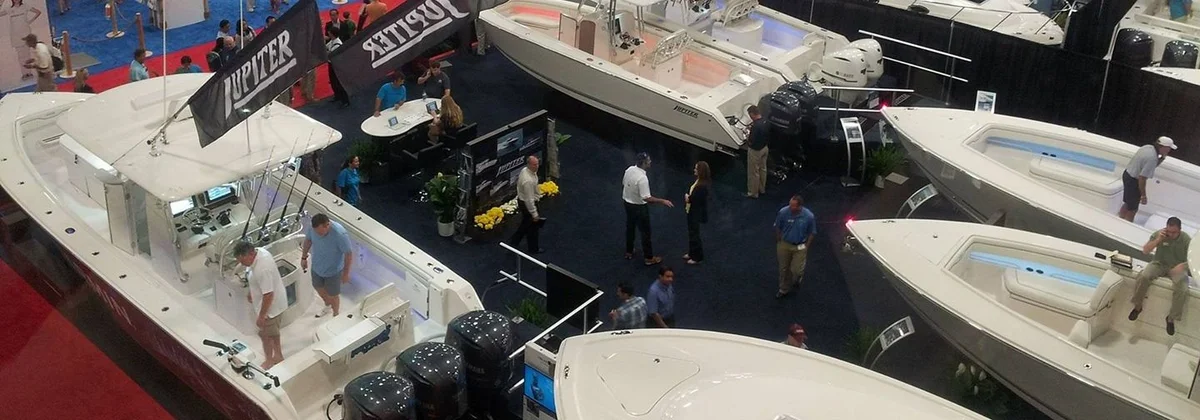
Quick answer: The Miami International Boat Show, held every February, is the largest winter boat show in the United States and the point in the calendar where the new model year arrives. It is a new-boat show first: manufacturers launch here and dealers write orders here. If you are buying a used boat above 40 feet, the inventory you want is at Fort Lauderdale in the autumn. Come to Miami to see what is new, to compare builders side by side, and to start a relationship with the dealer who will service the boat.
What Is the Miami International Boat Show?
Miami runs in February, over the Presidents Day weekend, and it is the first major show of the American calendar year. That timing is the whole point of it. Builders time model-year announcements to it, engine manufacturers show new outboard and diesel packages, and the electronics companies release the season’s software at it. What you see in Miami in February is what dealers will be selling for the next 12 months.
The show has grown across multiple sites rather than a single hall, mixing a convention-centre component with in-water displays at marina sites. Practically, that means two different experiences on the same ticket. The indoor part is efficient: dozens of centre consoles, bowriders and small cruisers under one roof, with dealers ready to quote. The in-water part is where the larger boats are, boarding is slower, and what you learn is different.
| Component | What is there | Best for |
|---|---|---|
| Convention hall | Trailerable boats, engines, electronics, gear | Comparing many models fast, dealer terms |
| In-water displays | Cruisers, sportfish, motor yachts afloat | Judging trim, freeboard, deck work, systems |
| Manufacturer stands | Launches and model-year changes | Understanding what changed and why |
| Brokerage presence | Present but not the focus | Meeting brokers, not finding stock |
Is Miami a Buying Show or a Looking Show?
Both, and it depends entirely on whether you are buying new or used.
For a new boat, Miami is one of the two best days of the year to be in a room. Every builder in your length band is within a few hundred metres of every other, the specification sheets are open, and the people who can tell you what changed since last year are standing next to the boat. You can compare hull, layout and price positioning in a single afternoon in a way that is otherwise impossible without months of dealer visits.
For a used boat above 40 feet, Miami is thinner. Brokerage inventory concentrates at Fort Lauderdale in late autumn, where the in-water format and the local brokerage industry put hundreds of listed boats on one set of docks. Coming to Miami hoping to walk a used 55-footer you saw online is usually a wasted trip.
| If you are buying | Go to Miami for | Go elsewhere for |
|---|---|---|
| New production boat, any size | Model comparison, ordering, dealer terms | Nothing, this is the show |
| Used boat under 30 feet | Dealer trade-in stock, local market read | Regional shows and dealer lots |
| Used boat 40 feet and up | Broker relationships, market temperature | Fort Lauderdale, late autumn |
| Sailboat | Some presence, limited depth | Annapolis in October |
| Superyacht above 24 metres | Yard and management contacts | Monaco or Fort Lauderdale |
Insider tip: in February a dealer’s inventory position is the opposite of what it is in November. Miami sits at the start of the selling season, so the pressure to move stock is low and the pressure to take orders is high. That is why Miami incentives arrive as content and finance rates rather than price cuts, and why the same dealer will be far more flexible on a physical boat eight months later.
What Can You Actually Inspect at a Show?
A show is not a survey and no show boat is presented the way a used boat is. Everything is clean, the batteries are charged, the bilge is dry and nothing has been run hard. Knowing what the format can and cannot tell you keeps the day useful.
| What you can judge | What you cannot |
|---|---|
| Layout, headroom, sightlines from the helm | Engine condition or hours under load |
| Build finish, locker access, hatch quality | How the hull behaves in a seaway |
| How the boat sits afloat with tanks part-full | Osmosis, structural repairs, past damage |
| Deck ergonomics at real freeboard | Corrosion history, wiring behind panels |
| Noise at the dock with systems running | Fuel burn, real cruise speed, range |
| Whether the space works for your use | Anything a surveyor is paid to find |
That list is the argument for the in-water component. A cruiser on a cradle under lights tells you about joinery. The same boat afloat tells you whether the swim platform is at the height the brochure implies, whether the side decks work when you are actually at that freeboard, and how loud the air handler is in the aft cabin with the doors shut.
Going to Miami with a budget and no shortlist?
Send us the length, the water you will run it on and your ceiling. We will come back with the models worth your dock time and what to check on each one.
What Does Show Pricing Mean in Miami?
Very little on the hull, and a real amount on everything around it.
A public price cut at a February show would undercut every dealer holding the same model for the rest of the year, so builders do not make one. What they authorise instead is content and terms: an electronics package, a generator, canvas and covers, upgraded upholstery, freight and rigging absorbed, a first-service credit, or a subvented finance rate for a limited period. On a production boat those together commonly amount to 2% to 5% of the purchase price, which is real money and which most buyers undervalue because it does not appear as a discount.
| What moves at Miami | What does not |
|---|---|
| Electronics and canvas packages | Base hull price on current model year |
| Freight, rigging and commissioning | Brokerage asking prices |
| Manufacturer finance rate for a set term | Trade-in valuations given verbally on the floor |
| Extended warranty terms | Delivery slots on a sold-out model |
| Prior model year stock a dealer still holds | Anything described as today-only with no written offer |
Get every element of an offer in writing before you leave the stand, including what is included at that price, the delivery estimate, the deposit terms and what happens to the deposit if survey or sea trial goes badly. An offer that will not survive being written down was not an offer.
What Should You Arrange Before You Fly In?
February in Miami is a busy week for the city as well as the show. The things you will need after the show are the things to book before it.
| Item | Lead time | Why |
|---|---|---|
| Show registration | 2 to 4 weeks | Door pricing and gate queues |
| Accommodation | 8 to 12 weeks | Show week and the holiday weekend together |
| Sea trial slot | 3 to 6 weeks | Slots go to buyers the dealer already knows |
| Surveyor availability | Before the show | Florida surveyors book out around show weeks |
| Finance pre-approval | Before the show | Lets you sign subject to survey with confidence |
| Insurance indication | Before the show | Hull value and cruising area drive the quote |
| Trade-in appraisal | Before the show | A verbal floor valuation is not a number |
If the boat will be kept in Florida, read the Florida vessel sales tax cap before you sign anything, and the wider Florida market page for how the local supply chain shapes running cost. If this is a first purchase, walk the process once in how to buy a boat so you know which step the show is. The wider boat show calendar sets Miami against the other shows in the year, and the sea trial checklist is what to run when your slot comes up.
Red Flags on the Miami Floor
Insider tip: ask what the delivery date is, in writing, and what happens if the yard misses it. On a February show order for a boat that has not been built yet, the delivery estimate is the single most consequential number in the contract and the one most often given verbally. A dealer who will commit it to paper with a remedy attached is a dealer worth buying from.
- A “show only” price with no written offer that survives past the weekend.
- A used boat contract without survey and sea trial conditions.
- A trade-in number given on the floor without an inspection.
- A finance rate quoted without term, deposit and any balloon stated together.
- An order for a boat presented as in stock that is a hull number and an estimate.
- A delivery date given verbally when the boat has not started production.
Buyer Scenarios for the Miami Show
First boat, 20 feet to 26 feet. The convention hall is your show. Compare eight to twelve models in one afternoon, then pick the dealer as carefully as the boat, because the service relationship will matter more than a 3% price difference over the first three years.
Trading up to a 30 feet to 40 feet cruiser. Split the day: hall in the morning for the shortlist, in-water in the afternoon to check the two you actually like afloat. Get the trade-in appraised before you go, because that number decides the deal more often than the new boat’s price does.
Buying a used 45 feet to 70 feet motor yacht. Use Miami to meet brokers and read the market, not to find the boat. Book the real work for Fort Lauderdale in the autumn, where the brokerage inventory concentrates.
Ordering a semi-custom build. February is the right month, because yard slots for the year are being allocated now. Focus on the build contract and the delivery remedy rather than the specification, which you can adjust later and the slot you cannot.
Overseas buyer. Miami is the most accessible US show for international travel, and the one where export and documentation questions are best answered in person. Bring the flag and registration question with you rather than solving it afterwards.
Pros and cons of buying at the Miami show
| Advantages | Disadvantages |
|---|---|
| Every builder in your length band within walking distance in February | New-boat weighted, so used inventory above 40 feet is thin |
| Model-year changes explained by the people who made them | Dealers are taking orders, not clearing stock, so price flexibility is low |
| Indoor and in-water components on one ticket | Two formats across sites means a lot of walking and time |
| Best show of the year for ordering a build slot | Delivery dates on unbuilt boats are estimates, not commitments |
| Strong dealer and finance presence in one place | Show week raises accommodation cost and books out local surveyors |
Buying in Florida this season?
We can map what Miami is realistically worth for your budget and length, and what to line up before you fly in.
Frequently Asked Questions
It runs in February, over the Presidents Day weekend, across several days. Exact dates and venues move between years, so confirm them with the organiser before booking travel. February placement matters more than the precise date: it is the first major US show of the calendar year and the point at which new model-year boats appear.
It is primarily a new-boat and new-model show. Manufacturers launch here, dealers write orders here, and the display is weighted toward current model year rather than brokerage stock. If you are buying used above 40 feet, Fort Lauderdale in the autumn will show you far more of what is actually for sale.
Miami is February, new-boat led and split between an indoor convention component and in-water displays. Fort Lauderdale is late autumn, in-water throughout, and carries the deepest brokerage inventory in the world. Miami answers what is new; Fort Lauderdale answers what is available.
Sometimes, and only if it was booked well in advance. Trials run from the in-water sites and slots go first to buyers a dealer already knows. Ask your dealer or broker to reserve one 3 to 6 weeks out, and expect it to happen in the days either side of the show rather than in the middle of it.
Florida caps the total state sales, use and discretionary surtax on a single vessel, which makes tax a fixed amount rather than a percentage above a certain price. Whether it applies to your purchase depends on where the boat will be kept and registered, not on where the show was. Read the Florida vessel sales tax cap page and confirm your own position with a Florida tax professional.
Your budget ceiling written down, lender pre-approval if you are financing, your surveyor's contact and availability for the following fortnight, an insurance indication for the hull value and cruising area you have in mind, and the trade-in details if you have a boat to move. Signing subject to survey and sea trial is normal. Signing without those conditions is not.
The travel cost rarely pays for itself on price alone, because February incentives arrive as package content worth roughly 2% to 5% rather than as a hull discount. The trip pays for itself in comparison: seeing every builder in your band in one afternoon shortens a decision that otherwise takes months of separate dealer visits.
Request a yacht buyer consultation
Share your budget, target LOA, and use case. We reply within one business day with matched brokers or surveyors.