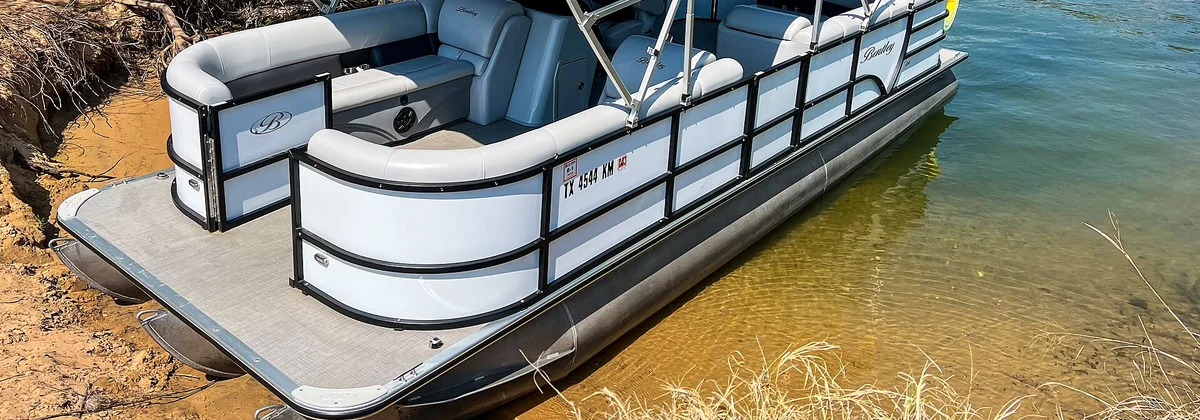
Quick answer: The third tube does not make a pontoon fast. It removes the ceiling that was keeping it slow. A two-tube pontoon is typically capped somewhere around 90 to 150 hp; a tritoon is commonly rated to 250 or 300 hp and above. Everything people say about tritoons, that they turn better, run drier, handle chop and pull skiers, follows from being allowed to carry that power on a hull with enough buoyancy to use it.
What Actually Changes
| Two-tube pontoon | Tritoon | |
|---|---|---|
| Typical hp ceiling | 90 to 150 hp | 250 to 400 hp |
| Realistic top speed, well powered | Often low to mid 20s mph | Commonly 35 to 45 mph |
| Behaviour in a turn | Leans out, wants to skate | Banks in, holds the line |
| Chop | Slaps, wets the bow, slows down | Flatter, drier, keeps its speed |
| Water sports | Marginal on most models | Genuinely capable |
| Load carrying | Good | Better, and less affected by where people sit |
| Price, like for like | Lower | Several thousand dollars more |
| Trailer | Two-tube pontoon trailer | Three-tube trailer, heavier |
| Fuel burn | Lower | Higher, in proportion to the power |
The pattern to notice is that every difference in the table traces back to buoyancy and running surface on the centreline. That is the whole engineering argument, and everything else is a consequence.
Insider tip: the third tube is not the only variable, and builders blur this deliberately. Ask about tube diameter and whether the boat has lifting strakes and an underskin. A 25 inch three-tube package without strakes can be slower and wetter than a well-specified 27 inch package with them. Two boats both described as tritoons can be very different machines.
Who Should Buy Which
Buy the two-tube pontoon if the water is calm, the crowd is modest, the boat will cruise and swim rather than tow, and the budget matters. It is the correct answer for a large share of lake owners and the money saved buys a better layout, better upholstery or a bigger boat.
Buy the tritoon if any of these apply: you want to pull a skier, wakeboarder or tube; the lake builds real chop by afternoon; you regularly carry ten or more people; the runs are long enough that 15 mph is tedious; or you want the option to add power later. The extra tube is the difference between a boat that does those things badly and one that does them properly.
The type as a whole, including layouts, brands and running costs, is covered on the pontoon boat page.
Pros and cons of the third tube
| Advantages | Disadvantages |
|---|---|
| Raises the horsepower ceiling from about 150 hp to 250 hp and beyond | Several thousand dollars more for an otherwise identical boat |
| Banks into turns instead of skating out | Higher fuel burn, in proportion to the power fitted |
| Runs flatter and drier in chop | Still a flat-decked pontoon, not a V-hull |
| Makes water sports genuinely viable | Heavier, so the tow rating requirement rises |
| Less sensitive to where the crowd stands | Needs a three-tube trailer, itself more expensive |
| Stronger resale in performance-minded markets | Wasted capability on a calm-water cruising boat |
The Costs the Comparison Hides
The sticker difference between the two boats is the smallest part of the decision.
| Line | Two-tube | Tritoon |
|---|---|---|
| Boat, like for like | Baseline | Several thousand more |
| Engine, to use the hull | 90 to 150 hp | 200 to 300 hp, a large step |
| Trailer | Two-tube | Three-tube, heavier and dearer |
| Tow vehicle | Often a mid-size SUV | Frequently a truck |
| Fuel, per season | Lower | Higher |
| Insurance | Lower, follows value and speed | Higher, follows both |
That third row down is where people are caught. The engine is where the real money goes, and buying a tritoon and then under-powering it produces a heavier, slower, more expensive version of the boat you did not buy. If the budget will not carry the engine, buy the two-tube boat.
The towing arithmetic, which is the other place this decision goes wrong, is set out in the boat trailer guide; saltwater or lake-launch servicing is in the trailer maintenance guide. Insurance drivers are in the boat insurance cost guide, and the storage fork between driveway and slip is in cost to dock a boat.
Reading a Specification Sheet
Two boats can both be called tritoons and behave completely differently, so the sheet is worth reading rather than skimming.
| Specification | What to look for | Why it matters |
|---|---|---|
| Tube diameter | Commonly 23, 25 or 27 in | Larger tubes carry more weight and lift sooner |
| Lifting strakes | Fitted or not, and how many | They are what make the boat plane and turn |
| Underskin | Present on performance packages | Smooths the underside, worth several mph |
| Centre tube depth | Level with or lower than the outers | A lowered centre tube adds bite in turns |
| Maximum rated hp | On the capacity plate | The definitive statement of what the hull is |
| Deck length against overall length | Often differs by 2 ft or more | Marketing quotes the larger of the two |
That last row catches people constantly. A boat advertised as 24 ft frequently has a 22 ft deck, and it is the deck that holds the furniture you are buying. Measure the thing you will actually use.
Where Both Types Stop
Neither boat is a V-hull, and no amount of tubes changes that. A flat deck on cylinders is superb at carrying people on flat water and progressively less good as the water gets rougher. In a metre of short chop even a well-specified tritoon is slow, wet and unpleasant, and the honest advice at that point is a different hull entirely: the deck boat for a family that wants space and a V-hull, or the bowrider for a better ride with fewer seats.
For coastal and saltwater use, look at the bay boat or the hulls in the fishing boat guide instead. Pontoons and tritoons are freshwater and sheltered-water boats, and buying one for open coastal water is the single most common mismatch in this category.
Buying Either One Used
The used market is where the tube count matters most, because it is easy to buy a tritoon badly.
- Check the capacity plate, not the seller’s description. It states the maximum horsepower and it is the definitive answer to what the hull is.
- Look inside the tubes’ end caps for water. A tube that has taken on water sits low and the boat lists at rest.
- Inspect the deck where it meets the tubes, and every fastener through it. Pontoon decks are plywood on aluminium cross members and they rot from the fastener holes outward.
- Check the strakes and underskin if the boat is sold as a performance package, because they are frequently absent.
- Look at the transom and the motor mount, which take the whole load on a high-horsepower boat.
The general purchase sequence is in how to buy a boat and the point-by-point walk is in the used boat inspection checklist.
Two tubes or three?
We can price the whole package, boat, engine, trailer and tow vehicle, so the comparison is on the real number rather than the sticker.
Frequently Asked Questions
A pontoon boat with three tubes instead of two. The extra centre tube adds buoyancy and running surface, which raises the horsepower the hull can safely carry, improves handling in a turn, and lets the boat run faster and drier. Everything else about the boat, the flat deck, the railings, the layout, stays the same.
If you want to pull water sports, run in chop, carry a heavy crowd, or use anything above roughly 115 to 150 hp, yes. If the boat will potter on a calm lake with a modest motor, the third tube is money spent on capability you will not use. The premium is typically several thousand dollars on an otherwise identical boat.
The tube count itself does not create speed, it removes the ceiling. A two-tube pontoon is usually limited to around 90 to 150 hp depending on the builder, while tritoons are commonly rated to 250, 300 hp and beyond. In practice a well-powered tritoon runs in the 35 to 45 mph range where a two-tube boat is often capped in the 20s.
Meaningfully, yes. The third tube adds buoyancy on the centreline and reduces the tendency to dig and slap, so the boat stays flatter and drier in chop. It is still a flat-decked pontoon rather than a V-hull, so there is a limit, and neither type belongs in genuinely rough open water.
Slightly more when at rest, because the centre tube usually hangs a little lower than the outer two on performance packages, and noticeably less when running, because the boat lifts. For most lake use the difference is small enough not to drive the decision.
It needs a pontoon-specific trailer built for three tubes, which is heavier and usually more expensive than a two-tube version. Combined with the boat's own extra weight, that pushes the loaded rig into a higher tow rating than many owners expect, so check the tow vehicle before committing to the boat.
The capacity plate for the real horsepower rating, the tube end caps for water inside, the deck around every fastener for rot, and whether the performance package actually includes lifting strakes and an underskin. Many boats sold as tritoons are three-tube hulls without the parts that make a tritoon behave like one.
Request a yacht buyer consultation
Share your budget, target LOA, and use case. We reply within one business day with matched brokers or surveyors.