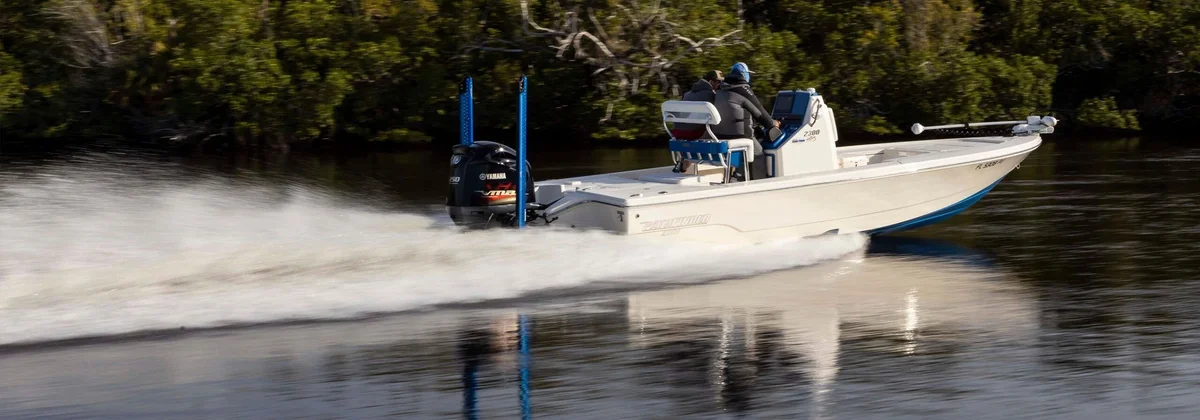
Quick answer: A bay boat is a deliberate compromise between a flats skiff and an offshore center console. It draws roughly 12 to 20 inches so it can work bays and the edges of flats, and it carries enough deadrise and freeboard to cross open water when the weather allows. Buying one well means being honest about which half of that compromise your water actually needs, because a bay boat is second best at both extremes and clearly first at everything in between.
The Type Defined by What It Gives Up
Three inshore hull types are routinely confused, and the differences are all in the running surface rather than in the deck layout.
| Flats skiff | Bay boat | Offshore center console | |
|---|---|---|---|
| Typical length | 16 to 18 ft | 18 to 24 ft | 24 ft and up |
| Draft, engine up | Under a foot | Roughly 12 to 20 in | 18 in to well over 2 ft |
| Deadrise at transom | Very low | Moderate | Deep |
| Freeboard | Minimal | Moderate | High |
| Ride in 2 ft chop | Punishing | Acceptable | Comfortable |
| Poling a flat | Designed for it | Possible, awkward | No |
| Running 20 miles offshore | No | Settled weather only | Yes |
| Fishability at rest | Excellent | Excellent | Good |
Read that table as one continuous line rather than three categories. The bay boat is not a distinct invention, it is the middle of a spectrum, and every specification on it was chosen by giving something up at one end or the other.
Insider tip: compare boats on deadrise at the transom, not on hull length. Two 22 foot bay boats with, say, 12 degrees and 18 degrees of transom deadrise are different boats: the flatter one runs shallower and fishes better at anchor, the deeper one is dry and comfortable in the chop and needs more water. Builders publish the number and buyers ignore it.
How Much Draft You Actually Need
The published draft figure is measured in the kindest possible way: light boat, no fuel, no crew, engine trimmed up. Load it properly and the real number grows.
| Load state | Effect on draft |
|---|---|
| Published specification | Empty tanks, no crew, engine up |
| Full fuel | Meaningfully deeper on a small hull |
| Four adults and gear | Deeper again, and trim changes |
| Engine down and running | The trim position sets the true minimum |
| Full livewells | Often overlooked, and it is hundreds of pounds |
A jack plate is the standard answer to this, letting the engine sit higher when you are idling into shallow water. It is one of the few options on a bay boat that changes what the boat can do rather than how comfortable it is.
Where the Type Runs Out
The honest limits are worth stating plainly, because both are routinely ignored.
Too shallow. If the fishing you actually love is poling a flat in a foot of water, a bay boat will get you close and then stop. The people who buy one for that and end up frustrated are the ones who bought on flexibility rather than on the fishing they do most weeks.
Too far out. Lower freeboard and less deadrise are the whole reason a bay boat drafts shallow, and they are also why it becomes unsafe sooner than an offshore hull. Crossing to a reef on a settled morning is normal use. Being caught out there when it builds is not something the boat forgives. If most of your fishing is offshore, the center console page and the wider fishing boat guide cover the hulls built for it.
For truly sheltered inland water, where none of this matters, an aluminium hull is the cheaper answer; the jon boat page covers that end.
Layout and Options That Matter
| Feature | Why it matters |
|---|---|
| Livewell capacity and plumbing | The single most-used system on the boat, and the most commonly badly built |
| Raised casting decks fore and aft | The reason to buy the type, and where water gets into the deck |
| Jack plate | Changes real minimum depth, not just comfort |
| Trolling motor and battery placement | Weight in the bow changes how the boat rides and drafts |
| Rod storage, in-gunwale or locker | Decides whether the deck stays clear |
| Hardtop or T-top | Shade against windage; on a light hull windage is a real handicap |
| Self-bailing cockpit | Non-negotiable on a saltwater fishing boat |
Power on a bay boat is almost universally a single outboard, which keeps the transom clear, the weight aft where it helps shallow draft, and servicing simple. The general case for outboards is set out in outboard versus inboard.
Pros and cons of a bay boat
| Advantages | Disadvantages |
|---|---|
| Works water that neither a skiff nor an offshore hull can cover | Second best at both ends of that range |
| Shallow enough for bays, flats edges and back country | Not a skinny-water poling skiff |
| Fishes superbly at rest, decks fore and aft | Low freeboard limits offshore use |
| Trailerable on a single trailer, easy to launch | Salt water is hard on every system aboard |
| Single outboard keeps running costs sane | Livewells and casting decks are where rot starts |
| Strong resale in coastal markets | Weak resale away from them |
Buying and Owning
Bay boats live in salt water and are used hard, which puts the emphasis on inspection rather than on brand. Water intrusion into cored decks is the failure that turns a cheap boat into an expensive one, and it hides under exactly the casting decks that sold you the boat.
The general purchase sequence is in how to buy a boat, the point-by-point inspection in the used boat inspection checklist, and the paperwork in the boat title transfer guide. Because these boats almost always live on a trailer rather than in a slip, the boat trailer guide is part of the purchase decision, not an afterthought, and saltwater launching makes the trailer maintenance guide genuinely load-bearing.
Running costs are dominated by insurance in coastal states and by corrosion everywhere; the drivers are in the boat insurance cost guide.
Bay boat or center console?
We can weigh draft, deadrise and how you actually fish before you commit to one end of the compromise.
Frequently Asked Questions
An inshore fishing hull that sits deliberately between a flats skiff and an offshore center console. It draws little enough to work shallow bays and flats, carries enough freeboard and deadrise to cross open water in reasonable conditions, and is laid out for fishing with raised casting decks fore and aft. It is a compromise by design, and that is the whole point of the type.
Most bay boats are center consoles; the difference is what the hull underneath is doing. An offshore center console carries deep deadrise, high freeboard and a deep-V that eats chop but needs water under it. A bay boat trades some of that deadrise and freeboard for shallow draft and a lower, more fishable platform. Same console, different mission.
Typically somewhere between about 12 and 20 inches with the engine up and a normal load, which is shallow enough for most bays and the edges of flats but not shallow enough for true skinny water. A dedicated flats skiff will run in a fraction of that. If poling a foot of water is the goal, a bay boat is the wrong tool.
Short distances in settled conditions, yes, and that flexibility is why people buy them. What you cannot do is treat one as an offshore boat. Lower freeboard, less deadrise and a fishing-first layout mean a bay boat gets uncomfortable and then unsafe in conditions a true offshore hull shrugs off. Watch the forecast rather than the length.
The mainstream runs about 18 to 24 feet. Under 20 feet is nimble, cheap to run and gets pushed around by wind and chop. Over 22 feet the boat rides better, carries more and starts drawing more water, which erodes the reason to buy the type. Most buyers who fish mixed water end up around 21 to 22 feet.
Wet foam and soft decks first, because a fishing boat lives with water on it and the casting decks are where it gets in. Then the transom and jack plate mounting, the livewell plumbing, and every through-hull. Bay boats work hard in salt water and the failures are almost always about water where it should not be rather than about the engine.
For how the boat rides and how shallow it runs, yes. Transom deadrise is the number that separates two bay boats of identical length into a shallow, flat-running fishing platform and a drier, deeper-drafting boat that handles chop. Builders publish it and most buyers never compare it.
Request a yacht buyer consultation
Share your budget, target LOA, and use case. We reply within one business day with matched brokers or surveyors.