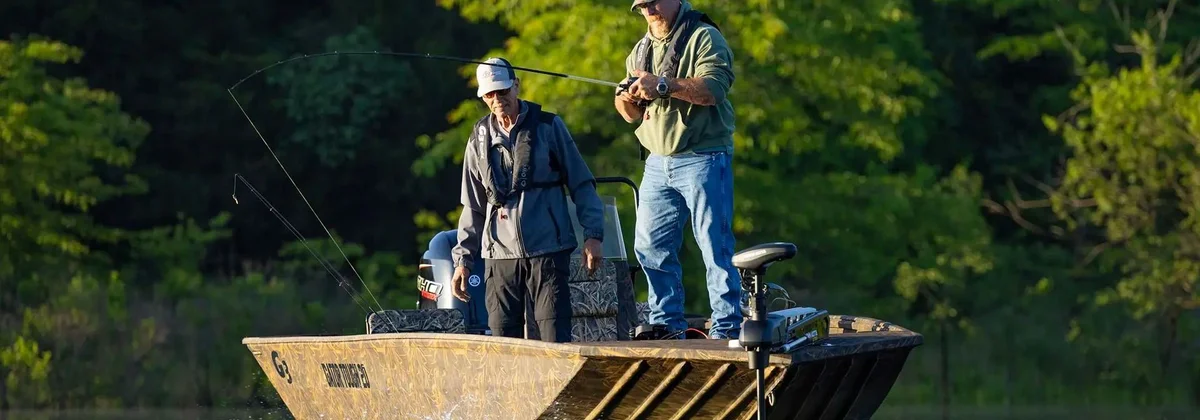
Quick answer: A jon boat is a flat-bottomed aluminium utility hull with a squared bow, and the single most useful thing to understand about buying one is the size code. 1436 means 14 feet long by a 36 inch bottom; 1448 means 14 feet by 48 inches. Two boats the same length can carry wildly different loads because of that second number, and the people who buy on length alone are the ones who end up with a boat that will not take the family and the gear.
Reading the Size Code
Almost every jon boat on the market is named by a four-digit number, and almost every first-time buyer ignores it.
| Code | Length | Bottom width | Realistic use |
|---|---|---|---|
| 1032 | 10 ft | 32 in | One person, carried in a truck bed, pond fishing |
| 1236 | 12 ft | 36 in | One to two people, small outboard or electric |
| 1436 | 14 ft | 36 in | Two people, narrow, tippy when standing |
| 1448 | 14 ft | 48 in | Two to three people, the volume seller for a reason |
| 1648 | 16 ft | 48 in | Three people plus gear, tiller outboard territory |
| 1860 | 18 ft | 60 in | Serious river boat, casting decks, larger outboards |
The lesson in that table is the 1436 against the 1448. Same length, same trailer, same storage footprint, and a completely different boat to stand up in. The extra 12 inches of bottom is where the stability lives.
Insider tip: measure the transom height as well, because it must match the outboard shaft. A 15 inch transom takes a short shaft, a 20 inch transom a long shaft. Buying a used hull and a used motor separately and discovering they do not match is one of the most common and most avoidable mistakes in cheap boat buying.
Riveted Against Welded
This is the real fork in the road, and the marketing on both sides overstates its case.
| Riveted | Welded | |
|---|---|---|
| Aluminium gauge | Thinner, typically 0.050 to 0.072 in | Thicker, typically 0.100 in and up |
| Weight | Noticeably lighter | Heavier, needs more motor for the same speed |
| Price new | Lower | Substantially higher |
| Damage tolerance | Dents; rivets can weep with age | Takes impacts, repairs by welding |
| Repairability at home | Rivets can be re-set | Needs an aluminium welder |
| Best for | Ponds, easy launching, carrying in a truck | Rocks, gravel bars, hard commercial use |
A leaking rivet line is the classic ageing failure and it is not automatically fatal. What matters when you look at an old riveted boat is whether the leak is a single rivet or a pattern along a chine, because a pattern means the hull has been flexing for years.
Where Jon Boats Stop
Every boat type has an honest limit and this one is unusually sharp.
A flat bottom has effectively zero deadrise. It does not part a wave, it hits it. In flat water that same geometry gives you a boat you can stand and cast from all day, which is exactly the appeal. In a short chop it gives you a boat that pounds your spine, throws spray back over the bow and loses lateral grip in a beam wind.
That means jon boats are excellent on rivers, backwaters, farm ponds, marshes, flooded timber and sheltered lakes, and a bad idea on open bays, tidal inlets, large lakes with fetch, and anywhere the wind can build a metre of chop. If your water is bigger than that, look at the bay boat or the deeper hulls covered in the fishing boat guide instead.
Power, Capacity and the Plate
| Hull size | Common hp rating | Typical crew | Notes |
|---|---|---|---|
| 10 to 12 ft | 3 to 10 hp | 1 to 2 | Electric trolling motor is often enough |
| 14 ft, 36 in | 10 to 20 hp | 2 | Watch the standing stability |
| 14 to 16 ft, 48 in | 20 to 40 hp | 2 to 3 | The mainstream of the market |
| 18 ft, 60 in and up | 40 to 90 hp | 3 to 4 | Console or tiller, real river boats |
The capacity plate is a legal limit and, on a flat bottom, also a physical one. There is no reserve buoyancy in the topsides the way there is in a deep V, and the boat’s behaviour changes abruptly rather than gradually as it is loaded. Whether an outboard or an inboard suits the rest of your boating life is covered in outboard versus inboard.
Buying Used
The used jon boat market is the least formal part of boating, which cuts both ways. Prices are low, paperwork is thin, and the same hull can be an honest twenty-year-old workhorse or a corroded liability.
- Look along every rivet line in strong light, from inside and outside, for weeping stains rather than for holes.
- Check the transom where the outboard clamps. Aluminium work-hardens and cracks radiate from the transom corners.
- Look for electrolysis where dissimilar metals meet, particularly around cheap aftermarket fittings.
- Sit in it on the trailer and shift your weight. A hull that has lost its shape telegraphs it immediately.
- Get the title and registration sorted before money changes hands. The rules are in the boat title transfer guide and the paperwork itself in the bill of sale guide.
The full sequence for a used purchase of any size is in the used boat inspection checklist, and the wider process in how to buy a boat.
The Costs Nobody Quotes
The hull price is the smallest number in the project.
| Item | Why it surprises people |
|---|---|
| Outboard | Frequently costs more than the hull, new or used |
| Trailer | A rig needs one, and it needs its own servicing |
| Battery, charger, trolling motor | A common second-year addition |
| Seats, casting deck, flooring | Where a bare hull becomes a fishing boat |
| Registration and insurance | Small, but not zero, and mandatory in most states |
Because a jon boat lives on a trailer rather than in a slip, the running costs sit almost entirely in the trailer rather than in marina rent. That is the real economic argument for the type, and it is worth reading the boat trailer guide and the trailer maintenance guide before you buy, because the trailer will strand you long before the boat does.
Moving up from a jon boat?
We can map what your water actually demands against the hull types that suit it, before you spend on the wrong boat twice.
Frequently Asked Questions
A flat-bottomed utility boat with a squared-off bow, almost always aluminium, built for shallow calm water. The flat bottom gives enormous initial stability and very shallow draft, which is why it dominates rivers, farm ponds and marshes, and it is also why the same hull slams and takes spray in any real chop.
The first two digits are the length in feet, the last two the bottom width in inches. A 1436 is 14 feet long with a 36 inch bottom, a 1448 is 14 feet with a 48 inch bottom, and a 1648 is 16 feet with a 48 inch bottom. Two boats of the same length can differ enormously in capacity and stability because of that second number, which is why quoting length alone tells you almost nothing.
Riveted hulls are lighter and cheaper and use thinner gauge aluminium; welded hulls are heavier, more expensive and take abuse better. If the boat will be dragged over gravel bars, launched off banks and used hard, welded pays for itself. If it is carried in a truck bed and used on ponds, riveted is the sensible buy and the weight saving is real.
Whatever is on the capacity plate and not one horsepower more. Small jon boats are commonly rated for 5 to 25 hp, larger 16 to 18 foot hulls for 25 to 60 hp. Overpowering a flat-bottomed hull is genuinely dangerous rather than merely illegal, because the hull has no deadrise to bite when it starts to skate.
No, and this is the honest limit of the type. A flat bottom has no V to cut a wave, so it pounds, throws spray and loses grip in a beam sea. Jon boats belong on rivers, ponds, backwaters and sheltered lakes. Open water, tidal inlets and anywhere that builds a short steep chop call for a different hull.
A bare 10 to 12 foot riveted hull is one of the cheapest ways into boat ownership, a mid-size 1448 with a small outboard and a trailer sits in the low thousands used, and a welded 18 foot boat with a tiller, casting deck and a modern four stroke can run past what many people pay for a first fibreglass boat. The hull is rarely the expensive part.
Count the people and the gear, then pick the bottom width first and the length second. Two adults who want to stand and fish want a 48 inch bottom, not a 36. Length adds carrying capacity and softens the ride slightly, but width is what stops the boat feeling precarious when somebody moves.
Request a yacht buyer consultation
Share your budget, target LOA, and use case. We reply within one business day with matched brokers or surveyors.