Quick answer: Fishing boats are the largest single segment of the US recreational boating market by unit volume. NMMA data shows 238,117 new boats sold in 2024 and 858,798 pre-owned transactions, fishing-oriented vessels (bass, walleye, aluminum, and bay boats) account for the majority of those numbers. Prices range from $8,000 for an entry-level aluminum jon boat to $80,000+ for a tournament-grade bass boat.
The US Fishing Boat Market: Size and Scope
Fishing is the single most popular recreational use of recreational boats in the United States. According to NMMA (National Marine Manufacturers Association) data, fishing-related vessels consistently represent the largest share of new powerboat sales by unit count, significantly larger than water sports boats, pontoons (which are closing the gap), or cruising boats.
The category is broad. “Fishing boat” encompasses everything from a $8,000 aluminum jon boat used on a farm pond to a $500,000 quad-outboard offshore center console targeting blue marlin in the Gulf Stream. Most US fishing boat buyers are in the $15,000-$60,000 range, fishing freshwater lakes and rivers within a few hours of home.
The US recreational boating market recorded 238,117 new boat sales and 858,798 pre-owned boat transactions in 2024 (NMMA), with total recreational marine spending of $55.6B. The majority of new boat units sold were fishing-oriented vessels in the sub-$60,000 range. This reflects the broad demographic base of freshwater fishing in the US, an activity participated in by over 35 million Americans annually.
For the complete boat-buying process, see the guide to buying a boat.
The Five Main Types of Fishing Boats
The most common first-time buyer mistake: choosing a boat optimised for a different style of fishing than what you actually do. A guy who fishes crappie on a 200-acre lake doesn’t need a $65,000 bass boat, and a serious tournament angler can’t compete from a $15,000 aluminum jon boat.
Winter storage tip: If you’re in a freeze state, budget $400-$1,000 for winterisation, engine fogging, water system drain, battery tender. Skipping this on a $30,000 bass boat to save $500 is how you end up with a cracked block in March.
Dealer vs private tip: For fishing boats under $40,000, check Facebook Marketplace and local fishing forums before walking into a dealer. The secondary market is enormous, 78% of US boat transactions are pre-owned, and a 4-year-old aluminum boat with a maintained engine is functionally identical to new.
| Type | Water | Species | Size Range | Price Range |
|---|---|---|---|---|
| Bass boat | Freshwater lakes | Largemouth/smallmouth bass | 16-22 ft | $20,000-$80,000 |
| Aluminum multi-species | Freshwater lakes/rivers | Walleye, pike, panfish | 14-20 ft | $10,000-$40,000 |
| Jon boat | Shallow water, rivers | Multi-species, catfish | 10-18 ft | $3,000-$20,000 |
| Bay boat | Saltwater flats/bays | Redfish, snook, flounder | 18-24 ft | $30,000-$90,000 |
| Center console | Coastal/offshore | Multi-species | 18-44 ft | $25,000-$700,000 |
Each type has a distinct design logic. A bass boat is low and fast, optimised for covering large tournament-circuit lakes in minimal time. An aluminum multi-species boat prioritises stability, durability in shallow rocky rivers, and affordability for the family angler who fishes several different species across the season. A bay boat is designed for minimal draft to access shallow saltwater flats without grounding. For offshore fishing specifically, see the center console boat guide for a full breakdown.
Bass Boats: Tournament-Grade Freshwater Fishing
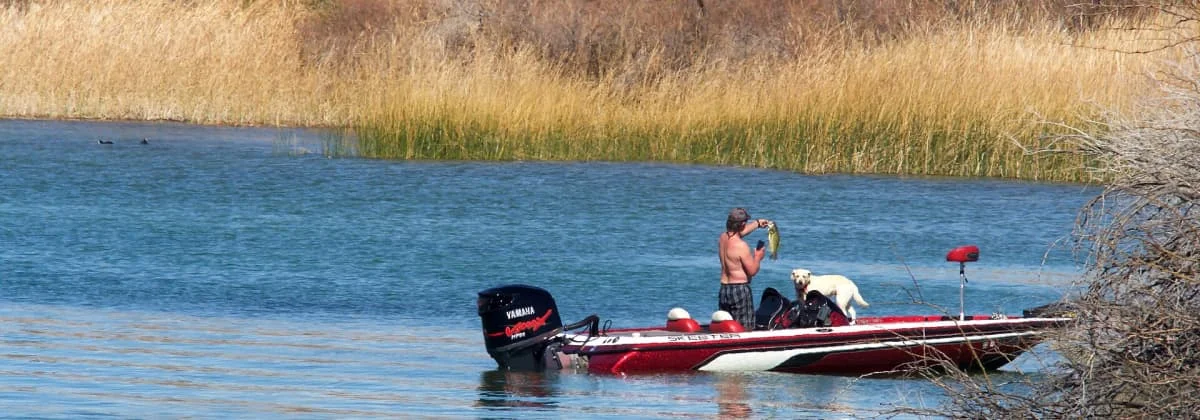
The bass boat is the most specialised, and among the most recognisable, fishing boat designs in the US market. Low-profile fiberglass hulls, large bow and stern casting decks (to fish from a standing position with minimal obstruction), a high-powered bow-mount electric trolling motor for silent position control, twin livewells to keep tournament-caught bass alive, and a powerful outboard engine (150-300+ hp) for fast transit between fishing spots: every design element reflects tournament bass fishing requirements.
Key tournament bass boat builders:
| Builder | Reputation | Representative Models | Price Range |
|---|---|---|---|
| Ranger Boats | Heritage US builder; strong tournament presence | Z518, Z520 | $45,000-$75,000 |
| Skeeter Boats | Performance-oriented; popular tournament circuit | ZX150, FX21 | $40,000-$70,000 |
| Nitro Boats (White River Marine) | Value-oriented with tournament features | Z20 Pro | $35,000-$55,000 |
| Bass Cat Boats | Premium; popular on Major League Fishing circuit | Puma FTD | $55,000-$80,000 |
| Phoenix Bass Boats | Fast-growing performance brand | 921 Elite | $40,000-$65,000 |
Bass boats are not practical general-purpose fishing boats. Their low freeboard makes them uncomfortable in wind chop. Their forward casting decks eliminate the seating and stability features that matter to family anglers. And their high-performance outboards optimised for tournament-speed transit are overkill for the casual angler making short runs between trolling spots.
Buy a bass boat if you actively tournament fish, or if bass fishing with maximum casting deck space and boat control is your primary and consistent activity. Buy an aluminum multi-species boat if you want a more versatile, practical, and less expensive platform for varied freshwater fishing.
Best Aluminum Fishing Boats
Aluminum fishing boats, typically 14-20 ft, with moderate-V or modified-flat hulls and single outboard power, are the most practical and widely owned category of fishing boat in the US. They dominate the walleye, northern pike, panfish, and multi-species markets, and are the standard tool for guide services on inland lakes from Minnesota to the Carolinas.
Why aluminum dominates the practical fishing market:
- Impact resistance: Aluminum hulls are more tolerant of minor grounding in rocky rivers and lake shallows than fiberglass, which can crack or delaminate under similar impacts.
- Light weight: A 17 ft aluminum boat with a 90 hp outboard can be towed with a standard pickup truck, stored in a garage on a trailer, and launched at any two-lane ramp.
- Low cost: Quality aluminum fishing boats from Lund, Alumacraft, Crestliner, or Princecraft in the 16-19 ft range cost $18,000-$35,000 new, significantly below equivalent fiberglass models.
- Versatility: A 17 ft aluminum boat with a 60-115 hp outboard can fish walleye on Lake Erie, troll for salmon on Lake Michigan, bass fish on a local reservoir, and catfish on a river in the same season without any modification.
Best aluminum fishing boats by use
| Use | What to look for | Typical size |
|---|---|---|
| Walleye and multi-species | Deep-V, high freeboard, livewells | 16-20 ft |
| Bass on smaller water | Modified-V, casting decks, trolling motor | 16-18 ft |
| Rivers and rocky shallows | Welded hull, heavier gauge, skid plate | 14-18 ft |
| Duck hunting and utility | Flat bottom, low profile, camouflage | 12-16 ft |
| Big-water trolling | Deep-V, 20 ft and up, kicker bracket | 18-22 ft |
Leading aluminum fishing boat builders:
Lund Boats (based in New York Mills, Minnesota): The most respected name in aluminum walleye and multi-species boats. Lund’s Pro-V and Pro-Guide series are the standard tool for professional walleye guides across the northern US and Canada. Their reputation for hull rigidity and quality is unmatched in aluminum.
Alumacraft (based in St. Peter, Minnesota): A heritage builder with over 75 years of production. Alumacraft builds a broad range from basic jon boats through serious walleye rigs. Widely distributed through dealer networks across the Midwest and South.
Crestliner (based in Little Falls, Minnesota): Part of Brunswick Corporation. Crestliner builds a mid-market range of aluminum fishing and multi-purpose boats with solid quality and broad dealer support.
Tracker Boats (Bass Pro Shops brand): The volume leader in entry-level aluminum fishing and pontoon boats. Sold primarily through Bass Pro Shops and Cabela’s. Tracker boats offer the lowest entry prices in the category and are appropriate for casual anglers who prioritise cost over premium features.
Jon Boats: Simple, Affordable, and Effective
A jon boat is the simplest fishing boat in existence: a flat-bottom, low-freeboard aluminum hull, typically 10-18 ft, powered by a small outboard or an electric trolling motor. It is the standard tool for river and shallow-water fishing across the southern US, from catfish on the Tennessee River to duck hunting in Louisiana marshes.
Entry-level models start at $3,000-$8,000 for a 12-14 ft hull with a small outboard, and a fully rigged 16-18 ft boat with a 40-60 hp outboard, trolling motor and basic electronics runs $12,000-$22,000 new. They are not appropriate for lakes with consistent wind chop or any water where waves exceed 1-2 ft.
Sizes, the four-digit size codes, riveted against welded construction and what to check on a used hull are covered in full on the jon boat page.
Bay Boats: The Saltwater Flats Specialist
Bay boats are built for inshore saltwater fishing in shallow flats, estuaries and tidal creeks, the habitat of redfish, snook, speckled trout, flounder and tarpon through the Gulf Coast and South Atlantic. They are typically 18-24 ft, powered by a single 115-250 hp outboard, and draw little enough to work water an offshore hull cannot reach.
They are not offshore boats. Low freeboard and moderate deadrise make them unsuitable above roughly 2-3 ft of wave height, which is the trade that buys the shallow draft.
Draft, deadrise, layout and what to check on a used hull are covered in full on the bay boat page. Key builders include Maverick Boat Group, Hell’s Bay Boatworks, Ranger, Action Craft, NauticStar and Sportsman; see the brands directory for an overview.
How Much Does a Fishing Boat Cost to Own Per Year?
Good news: fishing boats are among the cheapest recreational vessels to own annually. You fish a defined season, trailer the boat home, and run a single efficient outboard. No marina slip fees eating your wallet every month.
| Boat Type | Storage | Insurance | Fuel (50-80 hrs) | Maintenance | Annual Total |
|---|---|---|---|---|---|
| 16 ft aluminum / 75 hp | Trailer: $500-$1,500 | $400-$900 | $600-$1,500 | $600-$1,200 | $2,100-$5,100 |
| 19 ft bass boat / 200 hp | Trailer: $500-$1,500 | $700-$1,500 | $1,500-$3,000 | $1,000-$2,000 | $3,700-$8,000 |
| 22 ft bay boat / 200 hp | Slip: $4,000-$8,000 | $800-$1,800 | $1,500-$3,500 | $1,500-$3,000 | $7,800-$16,300 |
Detailed annual cost breakdowns including storage options, insurance factors, and regional variation are available in the boat ownership cost guide. For financing boats over $20,000, see the yacht financing guide.
What to Look for When Buying a Used Fishing Boat
The used fishing boat market is large and offers strong value, but fishing-specific use patterns create inspection priorities that differ from other boat types.
Transom condition: The transom bears the weight of the outboard and the stress of engine torque. On older fiberglass bass boats and aluminum boats, check the transom for soft spots (fiberglass delamination) or cracks (aluminum fatigue) around the engine mount points. A compromised transom is a safety issue and a significant repair.
Hull bottom: On aluminum boats, check for dents from grounding (some are cosmetic; major deformation suggests structural stress). On fiberglass bass boats, check for cracks in the hull gelcoat around the keel and bow, stress points from trailer contact and launching.
Livewells: Test both livewells for pump operation, water supply, and drain function. Malfunctioning livewells are a common issue on tournament bass boats and represent a competitive and practical problem.
Electronics: Check each unit individually, fish finder/sonar, chart plotter, trolling motor (bow mount and foot pedal), VHF radio. Electronics are often customised or upgraded and replacement costs can be substantial.
Engine hours and maintenance: A well-maintained outboard with complete service logs is the most important single factor in used boat value. Request oil change records, impeller replacement history, and any warranty claim documentation.
Looking for a fishing boat?
Tell us your water type, target species, and budget. We'll connect you with dealers and brokers who specialise in freshwater and saltwater fishing boats.
Red Flags and Buyer Checklist
Run this list before the survey, since a fishing layout carries more penetrations and harder-worked systems than a cruiser of the same length.
- Red flag specific to fishing boats: tower, outrigger and hardtop mounts with hairline gelcoat cracks around the bolts, which indicate stress the seller has been running through rather than repairing.
- Confirm the survey covers livewell, baitwell and washdown plumbing, a fishing boat has far more through-hulls than a cruiser.
- Verify generator and refrigeration hours against the stated fishing pattern, tournament use runs both hard.
- Ask whether the boat has been fished competitively and request the maintenance file that goes with those seasons.
- Check rod-holder and deck-hardware backing plates for crushed core around the fasteners.
- Request the last two haul-out reports, including bottom paint and zinc cycles.
Frequently Asked Questions
The main types are: bass boats (fiberglass, fast, tournament-oriented for freshwater), aluminum fishing boats (practical all-rounders for walleye, pike, and multi-species), jon boats (flat-bottom aluminum for shallow rivers and creeks), bay boats (shallow-draft for saltwater flats and estuary fishing), and offshore fishing platforms including center consoles for coastal and bluewater fishing.
Jon boats and basic aluminum fishing boats start at $8,000-$20,000 new. Entry-level fiberglass bass boats run $20,000-$40,000. Tournament-grade bass boats from Ranger or Skeeter commonly cost $40,000-$80,000. Bay boats for saltwater fishing start at $30,000-$50,000. Offshore center consoles for fishing start at $50,000 and reach $500,000+ for the largest dedicated platforms.
Aluminum is lighter, more durable against minor impacts, less expensive, and lower-maintenance. It is the practical choice for small lakes, rivers, and casual fishing. Fiberglass offers smoother ride quality, better offshore performance, and typically better resale value in premium tournament segments. For most casual freshwater anglers, aluminum is the economical and practical choice.
For most first-time freshwater anglers, a 16-18 ft aluminum fishing boat with a 75-115 hp outboard is the practical starting point. It is trailerable, low-maintenance, versatile across multiple species, and priced at $18,000-$35,000 new or $10,000-$22,000 used. For saltwater fishing, a 20-24 ft center console with a 150-200 hp outboard is the equivalent entry point.
The standard walleye fishing platform is a 18-20 ft aluminum or fiberglass multi-species boat with a 115-175 hp outboard. Lund's Pro-V series and Alumacraft's Trophy series are benchmark models. Deeper-V hulls handle the wind chop on large walleye lakes like Erie, Mille Lacs, and Lake of the Woods more comfortably than flat-bottom aluminum models.
For a 16-18 ft aluminum fishing boat trailered rather than marina-stored, annual costs commonly run $2,000-$5,000, among the lowest in recreational boating. A 19-21 ft tournament bass boat with a 200 hp outboard adds fuel and maintenance costs, running $3,500-$8,000 per year. The biggest cost variable is storage: trailer storage is far cheaper than marina wet-slip storage.
Request a yacht buyer consultation
Share your budget, target LOA, and use case. We reply within one business day with matched brokers or surveyors.