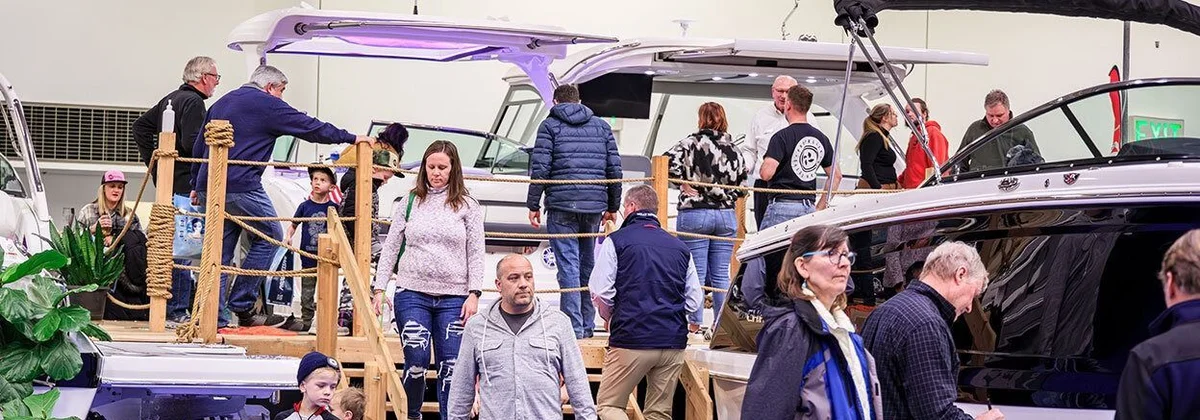
Quick answer: Minneapolis is an indoor January retail show that reflects its market almost exactly: pontoons, tritoons, aluminium fishing boats and tow boats, with almost no large-cruiser or brokerage presence. It is efficient, it is dealer-dense, and the useful thing to bring to it is an understanding of what a five-month season does to the arithmetic, because twelve months of cost spread across five months of use is a different proposition from a year-round market.
What Is Actually on the Floor
| Category | Presence at Minneapolis |
|---|---|
| Pontoons and tritoons | Dominant |
| Aluminium fishing boats | Very strong |
| Bass and walleye rigs | Strong |
| Ski, wake and surf boats | Strong |
| Bowriders and deck boats | Moderate |
| Cruisers over 35 ft | Light |
| Saltwater centre consoles | Almost none |
| Brokerage yachts | Almost none |
That shape is not a limitation, it is the show being honest about its water. Minnesota’s lakes reward stable, shallow-draft, trailerable boats that carry people or fish, and the show sells exactly that. The types themselves are covered on the pontoon page, the fishing boat guide, the jon boat page and the wake and ski boat page.
Insider tip: the single most consequential decision on this floor is two tubes or three, and it is decided by horsepower rather than by looks. A two-tube pontoon is typically capped around 60 to 200 hp; a tritoon commonly runs to 250 hp and beyond, and everything about handling, chop and towing follows from that. The full comparison is in pontoon vs tritoon, and it is worth reading before you walk the hall rather than after.
The Five-Month Season
| Cost | Year-round market | Minnesota |
|---|---|---|
| Usable months per year | 10 to 12 | About 5 |
| Storage | Slip or trailer only | Trailer or slip plus winter lay-up |
| Winterisation and spring commissioning | Minimal | Annual and unavoidable |
| Effective cost per usable day | Lower | Roughly double for the same boat |
| Hours accumulated per season | Higher | Lower, which helps resale |
| Corrosion exposure | Salt in coastal markets | Fresh water, far gentler |
Two conclusions follow. First, the ownership budget has to be built on usable days rather than on months, or the boat will feel expensive by its second August. Second, a Minnesota boat accumulates hours slowly and never sees salt, so a ten-year-old fresh-water boat frequently presents better than a five-year-old coastal one. That is why fresh-water boats travel well in the national used market, and it is worth knowing whether you are buying or eventually selling.
The Trailer Is Not an Accessory
In a market where most boats live on a trailer rather than in a slip, the trailer is half the purchase and it is routinely bundled into a price nobody itemises.
| Question to ask | Why |
|---|---|
| What is the trailer rated for, loaded? | Rating must exceed boat, engine, fuel and gear together |
| Single axle or tandem? | Above roughly 3,000 lb loaded, tandem is the sensible answer |
| Pontoon-specific, and for how many tubes? | A tritoon needs a three-tube trailer, which costs more |
| What can my vehicle actually tow? | Three vehicle ratings govern, not one |
| Bunks or rollers? | Ramp depth where you launch decides it |
| Brakes fitted, and required by state? | The threshold follows the state you drive through |
The arithmetic is in the boat trailer guide, and the servicing that a trailer needs, particularly tires that age out in 3 to 5 years regardless of tread, is in the trailer maintenance guide. More boats are stranded by trailers than by engines.
Sizing a Lake Boat Honestly
Minnesota lakes vary enormously, and the boat that suits Lake Minnetonka on a Saturday is not the boat that suits a quiet fishing lake, so the size question has to be answered by water rather than by budget.
| Water | Sensible size | Why |
|---|---|---|
| Small fishing lake, two anglers | 14 to 16 ft aluminium | Shallow, easy to launch alone |
| Mid-size lake, family of four | 20 to 22 ft pontoon | Space per dollar, stable at rest |
| Busy lake with weekend chop | 22 to 24 ft tritoon | Boat wakes are the real chop here |
| Multi-species fishing, big water | 18 to 20 ft deep-V aluminium | Freeboard and a dry ride |
| Water sports as the main use | 20 to 23 ft tow boat | Nothing else makes the wake |
| Two lakes and a long tow | Whatever the vehicle can pull | The tow rating caps the boat |
The row that catches people is the third one. On a busy lake the water is rough because of other boats rather than because of wind, and that boat chop is short, steep and constant on a summer Saturday afternoon. It is exactly the condition a two-tube pontoon handles worst.
What the Week Costs
| Line | Typical range | Note |
|---|---|---|
| Show admission, per day | $15 to $30 | Children usually reduced or free |
| Parking, per day | $15 to $30 | Downtown ramps |
| Hotel, if travelling | $120 to $250 | January is low season |
| Winter storage, per season | $40 to $100 per ft | Indoor heated costs considerably more |
| Shrink wrap, per season | $15 to $25 per ft | The common outdoor option |
| Spring commissioning | $300 to $900 | Depends on systems |
Those last three lines are the ones a first-time Minnesota owner discovers in October rather than in January, and together they can equal a meaningful share of the annual cost of a modest boat.
What the Show Cannot Tell You
Indoors, in a cradle, under exhibition lighting, four questions stay open, and all four are answerable before you commit.
| Open question | How to close it |
|---|---|
| How it rides in boat chop | A demo day in spring, or an owner’s account |
| How it sits in the water with a crowd aboard | Ask to see the model afloat at a dealer |
| Real noise level at cruise | A demo ride, never a showroom |
| Whether the trailer suits your vehicle | Weigh the loaded rig, check three vehicle ratings |
Most dealers will arrange a spring demo for a serious buyer, and a deposit taken at the show can normally be made contingent on that ride. Ask for it in writing rather than as a handshake, and read the deposit and escrow guide before any money moves.
Pros and cons of buying at the Minneapolis show
| Advantages | Disadvantages |
|---|---|
| Inventory matches the local water precisely | Nothing above about 35 ft in any depth |
| High dealer density, easy to compare packages | Almost entirely new-boat retail |
| January leaves the full season to prepare | You pay to store the boat before using it |
| Finance desks in the same hall | Package pricing is easy to mistake for a discount |
| Excellent for pontoon and fishing boat buyers | Nothing about ride quality is answerable indoors |
| Trailer, cover and electronics all comparable | Bundles hide the price of individual items |
Which Buyer Should Go
| Buyer | Is Minneapolis the right show? |
|---|---|
| First family boat on a lake | Yes |
| Pontoon or tritoon buyer | Yes, this is the show for it |
| Walleye, bass or multi-species angler | Yes |
| Tow boat buyer | Yes |
| Cruiser over 35 ft | No |
| Saltwater or coastal buyer | No, go to a coastal show |
Earlier in the process, read how to buy a boat and buying a yacht at a boat show, and use the show calendar to see how Minneapolis fits the year. If you are buying used rather than new, run the used boat inspection checklist and use the show purely as research into what each model is like inside.
Buying for a Minnesota lake?
Tell us the lake, the crew and whether fishing or family comes first, and we will tell you which of the boats on that floor actually fit.
Frequently Asked Questions
It usually runs in January over four or five days, indoors at the convention centre. Confirm the dates with the organiser before booking anything. The January date is the point of it: Minnesota's open-water season is roughly five months, so the decision has to be made in deep winter to leave time for delivery and rigging.
It mirrors its market closely: pontoons and tritoons, aluminium fishing boats, bass and walleye rigs, ski and wake boats, and the accessories and electronics that go with them. Large cruisers and brokerage yachts are barely present, because the lakes here are not that kind of water.
It depends on who is coming. A pontoon carries more people in more comfort for the money and is the better social and family boat; an aluminium fishing boat is the better tool if fishing is the point and the crew is two or three. Buyers who try to make one boat do both usually end up with a pontoon with fishing seats and are content with it.
Realistically about five months, roughly May through September with margins at each end depending on the year and the lake. That short window is why a January show matters and why the ownership budget has to spread twelve months of cost across five months of use, including a mandatory winter lay-up.
It is usually a package rather than a discount: options, a cover, electronics or a trailer bundled into the number, plus finance terms available during the show. That is genuine value. The more negotiable item is often the previous model year sitting on the same stand, which the dealer is financing every month.
Price it as its own line rather than accepting it inside a bundle. In Minnesota the trailer is not an accessory, it is how most boats are stored, launched and taken between lakes, and a trailer that is under-specified or mismatched to your tow vehicle causes problems for the whole life of the boat.
Three, if you want to pull water sports, run in chop, carry a large group or use more than about 150 hp. Two, if the water is calm and the motor modest, in which case the money saved buys a better layout or a bigger deck. The third tube does not create speed, it removes the horsepower ceiling that was keeping the boat slow.
Request a yacht buyer consultation
Share your budget, target LOA, and use case. We reply within one business day with matched brokers or surveyors.