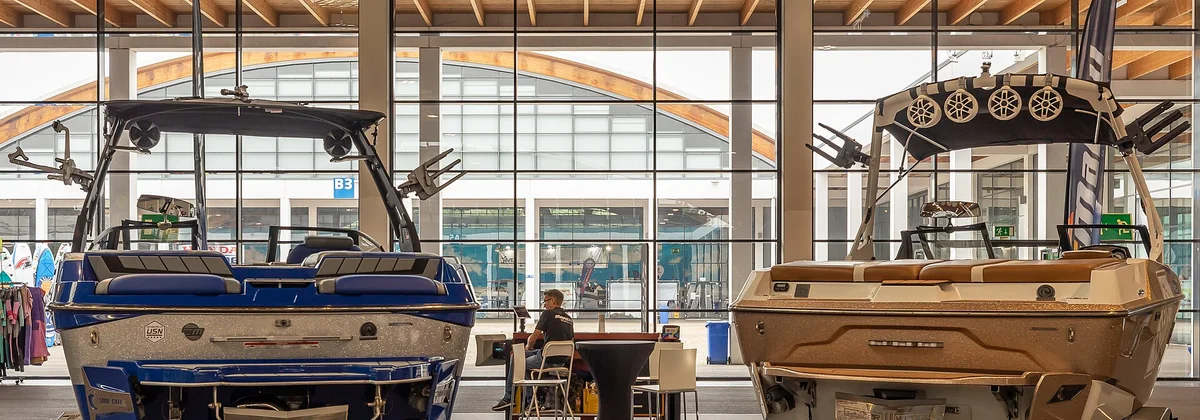
Quick answer: A ski boat and a wake boat are engineered toward opposite goals. The ski boat exists to leave almost no wake, using a direct drive with the engine amidships. The wake boat exists to build the biggest, cleanest wake it can, using a V-drive that puts the engine over the transom plus ballast tanks that deliberately sink the stern. One boat cannot be excellent at both, and the buyers who try to make it are the ones who sell within two seasons.
The Engineering Difference
| Ski boat, direct drive | Wake boat, V-drive | |
|---|---|---|
| Engine position | Amidships, under a central box | At the transom |
| Drivetrain | Straight shaft aft from the engine | Shaft doubles forward, exits aft |
| Design goal | Smallest, hardest, flattest wake | Largest, cleanest, most rideable wake |
| Ballast | None, or minimal | Integrated, often thousands of pounds |
| Interior space | Split by the engine box | Open, engine is out of the way |
| Typical tow speed | 30 to 36 mph for slalom | 10 to 14 mph for wakeboarding, 10 to 12 for surf |
| Hull shape aft | Fine, settles level | Broad, designed to displace |
| Buyer pool | Narrow, specialist | Larger, growing |
Insider tip: the tow speeds in that table are the fastest way to work out which boat somebody actually needs. Slalom skiing happens around 30 to 36 mph and wants flat water behind the boat; wake surfing happens around 10 to 12 mph and wants a wave. A boat optimised for one of those speeds is at the wrong end of its design range at the other.
Wake Surfing Changed the Category
Wakeboarding produced the V-drive and the tower. Surfing produced the ballast arms race. A surf wake is made by loading the boat heavily, listing it to one side, and using hull-mounted gates or tabs to shape a wave off one quarter that a rider can stay on with no rope at all.
That has three consequences buyers should know before they shop.
Weight. Modern surf boats carry very large integrated ballast systems. That weight is present all season, it affects the trailer requirement, and it is why these boats are heavy for their length.
Hull and system complexity. Surf gates, tabs, ballast pumps, tanks and plumbing are all systems that did not exist on a 1990s ski boat, and all of them are things that can leak or fail.
Wake size is regulated in some places. A growing number of lakes and jurisdictions restrict ballasted surfing, minimum distances from shore, or both. Check the rules on your specific water before buying the boat, not after.
Pros and cons of a dedicated tow boat
| Advantages | Disadvantages |
|---|---|
| Produces a wake nothing else can match | Among the most expensive small boats to run |
| V-drive layout gives exceptional interior space | Ballast, gates and plumbing are systems that fail |
| Strong, specialist resale within the enthusiast market | Narrow buyer pool outside it |
| Purpose-built seating, storage and racks | Poor at everything that is not towing |
| Modern hulls are surprisingly capable in chop | Heavy, which raises the trailer and tow requirements |
| Holds value well while the sport stays popular | Some lakes restrict ballasted surfing |
Sizes and Power
| Length | Type it usually is | Typical power | Capacity |
|---|---|---|---|
| 19 to 20 ft | Direct drive ski boat | 300 to 350 hp | 6 to 8 |
| 20 to 21 ft | Entry V-drive | 350 hp | 10 to 12 |
| 22 to 23 ft | Mainstream surf boat | 400 to 450 hp | 12 to 15 |
| 24 to 25 ft | Large surf boat | 450 to 600 hp | 15 to 18 |
| 26 ft and up | Flagship, often twin-purpose | 600 hp and above | 18 and up |
Two things in that table surprise people coming from a bowrider. The horsepower is far higher for the length, because these hulls are heavy and are asked to work rather than cruise. And capacity climbs steeply with length, because the V-drive layout frees the whole centre of the boat for seating.
Fuel burn follows directly. A 23 ft surf boat working a session with full ballast can move through 15 to 25 gallons in an afternoon, which is a different order of consumption from the same length of bowrider cruising.
What They Cost to Run
Tow boats are used differently from every other small boat, and the running costs follow the use rather than the length.
| Cost | Why it is higher than you expect |
|---|---|
| Fuel | High engine load for the whole session, not cruising |
| Ballast weight | Every gallon carried is fuel burned to move it |
| Upholstery | Very large seating area, and it lives in the sun |
| Tower, racks and audio | Expensive, exposed and a theft target |
| Insurance | Follows value, use and the tower equipment |
| Depreciation | Specialist boat, narrower buyer pool |
| Winter storage | Ballast systems must be drained properly or they freeze |
The insurance drivers are in the boat insurance cost guide and the storage fork in cost to dock a boat. Winterising a ballast system is more involved than winterising a bowrider, and the general schedule is in the winterization guide.
When Neither Is the Right Boat
The honest position: most families who want to pull a tube and occasionally ski should not buy a tow boat.
A sterndrive or outboard bowrider tows perfectly well, carries the same people, costs substantially less to buy and run, and is far easier to sell. A deck boat carries more people again and tows adequately. A tow boat earns its price only when the wake itself is the reason you are on the water, which is a real reason and a narrow one.
If the answer is a tow boat, remember it is heavy. The loaded rig frequently exceeds what buyers assume their vehicle can pull, and the arithmetic is in the boat trailer guide, with the servicing that a heavy trailer needs in the trailer maintenance guide.
Buying Used
The used tow boat market is deep and the boats have usually worked hard.
- The ballast system before the engine. Every pump, every hose, every tank, and the bilge under all of it. Leaks put water into the structure.
- Hours against age. A tow boat at 500 hours has done more work than a cruiser at 500 hours. Judge the hour meter by how the boat has been used.
- Tower mounting points. They carry enormous loads and the deck around them cracks.
- Rudder, shaft log and strut. Inboard-specific items that a sterndrive buyer will not think to check.
- Upholstery and the bases under it, which on a boat that is mostly seating is a very large bill.
The full sequence is in the used boat inspection checklist and how to buy a boat.
Tow boat or a bowrider that tows?
We can work out whether the wake is genuinely the reason you are buying, before you pay a specialist premium for it.
Frequently Asked Questions
They want opposite things from the same water. A ski boat is built to leave the flattest, smallest wake possible, using a direct drive with the engine amidships and a hull that settles level. A wake boat is built to create the largest, cleanest wake possible, using a V-drive with the engine at the transom plus ballast tanks that deliberately sink the stern.
Not well. Modern wake boats can empty their ballast and produce a smaller wake, and modern ski boats can be weighted, but each is a compromise of the other's design. Serious slalom skiers buy a direct drive; serious wakeboarders and surfers buy a V-drive with ballast. A family that does a bit of everything is usually better served by a sterndrive bowrider.
A V-drive places the engine at the very back of the boat with the shaft doubling forward and back out through the hull, which puts several hundred pounds of engine weight over the transom. That weight sinks the stern and helps build the wake. It also frees the middle of the boat for seating, which is why wake boats have far more usable interior space than direct drives.
Yes, and a lot of it. Surf wakes are produced by weighting the boat heavily and listing it to one side, so that the hull throws a rideable wave off one quarter. Purpose-built surf boats carry integrated ballast systems measured in thousands of pounds along with hull-mounted surf gates or tabs that shape the wave.
They are among the most expensive small boats to run. They are heavy, they carry ballast weight all season, they run at high engine load rather than cruising, and their fuel burn reflects all three. Add tower, racks and audio, which are expensive and theft-prone, and insurance and depreciation on a specialist boat with a narrow buyer pool.
The ballast system first, every pump, hose and tank, because leaks put water where the boat's structure is. Then engine hours against the boat's age, since tow boats work harder per hour than cruising boats. Then the tower mounting points, the transom, the rudder and shaft log, and the condition of the upholstery, which on these boats is a very large replacement bill.
Slalom skiing runs roughly 30 to 36 mph depending on the skier's line length and class, wakeboarding roughly 18 to 24 mph, and wake surfing roughly 10 to 12 mph. Those three numbers explain the whole category: a hull optimised for a flat wake at 34 mph is at the wrong end of its design range at 11 mph, and the reverse is equally true.
Request a yacht buyer consultation
Share your budget, target LOA, and use case. We reply within one business day with matched brokers or surveyors.