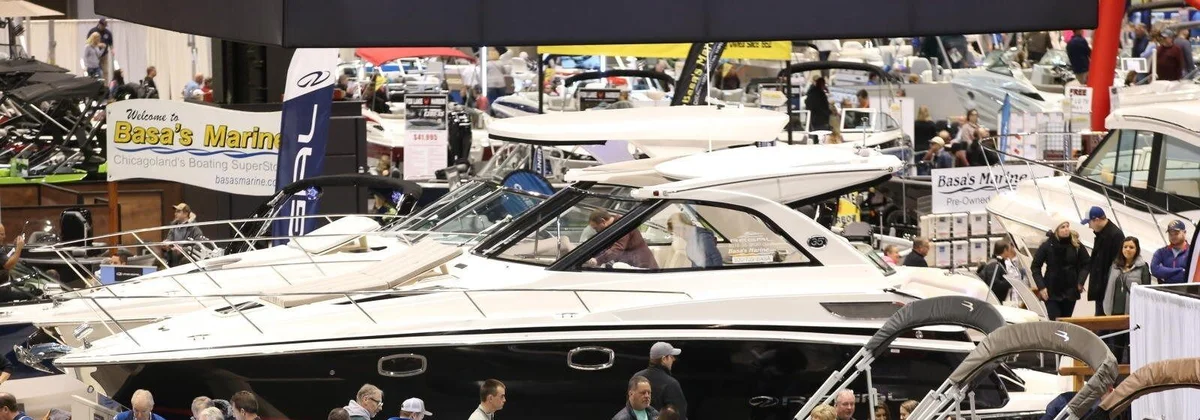
Quick answer: Chicago is an indoor January retail show, which means it is excellent for comparing dealers, packages and interiors and useless for judging how a hull behaves. Its real value to a buyer is the regional fact underneath it: Lake Michigan is not a lake in the way buyers from inland assume. It builds a short steep chop fast, and the boat that suits it is bigger and drier than the same budget would buy on a reservoir.
What an Indoor Show Can and Cannot Settle
| Question | Indoor show |
|---|---|
| Interior layout, headroom, storage | Yes, and this is what it is for |
| Build quality of joinery and hardware | Yes |
| Comparing three dealers’ packages | Yes, efficiently |
| Finance and insurance conversations | Yes, all in one hall |
| How the hull sits with load | No |
| Ride in a chop | No |
| Noise under way | No |
| Freeboard as it feels afloat | No, and cradles flatter every boat |
Insider tip: a boat in a cradle sits roughly at eye level, which makes the freeboard look generous and the topsides look tall. Afloat, the same boat sits far lower and the side decks feel narrower. If you are moving up a size class, do not let a cradle be the last time you see the boat before you buy it.
The Lake Michigan Problem
This is the fact that should shape a Chicago buyer’s shortlist, and it is the one an out-of-state brochure will never mention.
Lake Michigan is roughly 300 miles long. That fetch means wind has room to build waves, and because it is fresh water the chop is shorter and steeper than an ocean swell of the same height. Conditions can go from flat to genuinely unpleasant inside an hour, and the boat that copes is not the one that looked best in a hall.
| Feature | Why it matters on Lake Michigan |
|---|---|
| Deadrise at the transom | A flatter hull slams in a short steep chop |
| Freeboard | Determines how wet the boat is, not just how safe |
| Enclosed or protected helm | Extends the usable season by weeks at each end |
| Self-bailing cockpit | Water comes aboard on this lake, routinely |
| Reliable power and a kicker | Distance from help is real once you leave the harbour |
| Heater | May and September are cold on the water |
Practically, that pushes Chicago buyers up a size class relative to inland-lake buyers with the same money. A bowrider at 20 ft is a fine harbour and inshore boat and a poor choice for crossing to Michigan; the same buyer at 26 ft has a completely different summer. A deck boat carries more people but slaps more in exactly the conditions the lake produces.
The Slip Comes Before the Boat
In many markets you buy a boat and then find somewhere to keep it. On the Chicago lakefront that order can fail.
Harbour slips are finite, allocation is administered rather than purely commercial, and demand at popular harbours exceeds supply in a normal year. Buying a 32 ft boat with no confirmed home for it is a real and avoidable mistake.
| Storage option | Practical note |
|---|---|
| Lakefront harbour slip | Confirm availability and size class before buying |
| Outlying marina | More available, adds travel time to every outing |
| Dry stack | Limited by boat size and by lift capacity |
| Trailer and driveway | Frees you from the queue entirely, caps boat size |
| Winter storage, indoor or shrink-wrapped | A separate, mandatory cost in this climate |
The cost side is in cost to dock a boat and the trailer alternative in the boat trailer guide. In a five-month season the annual storage bill is spread across fewer usable days than in Florida, which changes the ownership arithmetic more than buyers expect.
Reading a Dealer Stand
Dealer density is the show’s strength, so use it as a comparison exercise rather than a shopping trip. Three stands selling similar boats will quote three different numbers, and almost none of the difference is in the hull.
| What varies between stands | Why it matters |
|---|---|
| Which options are included in the quoted price | The largest single source of apparent price difference |
| Commissioning and first-service policy | Often worth four figures and rarely compared |
| Trailer included or extra | On a trailerable boat, a substantial line |
| Electronics package | Easy to over-buy at a show |
| Warranty term and what voids it | Read it rather than being told about it |
| Where the service department actually is | You will visit it more than the showroom |
That last row deserves more weight than it gets. A dealer 90 minutes further away is a dealer you will resent every spring and every time something needs attention. Over a five-year ownership, service proximity is worth more than a few percent on the purchase price.
Ask every stand the same three questions: what is included at this number, what does commissioning cost, and where would the boat go for warranty work. Written answers from three dealers make the comparison obvious, and almost nobody does it.
What the Week Costs
| Line | Typical range | Note |
|---|---|---|
| Show admission, per day | $20 to $35 | Children often free or reduced |
| Parking, per day | $25 to $60 | Downtown venue rates |
| Hotel, per night, if travelling | $150 to $300 | January is low season |
| Survey, booked for spring | $20 to $30 per ft | Book before the spring rush |
| Short haul-out for that survey | $300 to $900 | Depends on yard and size |
| Winter storage, per season | $50 to $120 per ft | Regional, indoor costs more |
That last line is the one inland buyers underestimate. A five-month season with a mandatory winter lay-up is a different cost structure from year-round use, and it belongs in the budget before the purchase rather than in the first October afterwards.
The Five-Month Season Changes the Maths
An inland or northern boat is used for roughly 5 months and paid for across 12. That single fact reshapes the ownership budget compared with a warm-water market.
| Cost | Year-round market | Great Lakes |
|---|---|---|
| Usable months per year | 10 to 12 | About 5 |
| Storage | Slip only | Slip plus winter lay-up |
| Winterisation and commissioning | Minimal | An annual, unavoidable job |
| Effective cost per usable day | Lower | Roughly double for the same boat |
| Depreciation | Similar | Similar |
| Hours accumulated per season | Higher | Lower, which helps resale |
There is a genuine consolation in the last row: a Great Lakes boat accumulates hours slowly and lives out of salt water, so a well-kept 10 year old fresh-water boat frequently presents better than a 5 year old saltwater one. That is why fresh-water boats travel well in the used market. What to look for either way is in the used boat inspection checklist.
Pros and cons of buying at the Chicago show
| Advantages | Disadvantages |
|---|---|
| High regional dealer density in one hall | Almost entirely new-boat retail |
| Warm, dry, efficient for comparing interiors | Nothing about ride or handling is answerable |
| January timing leaves the whole season to prepare | You store the boat before you ever use it |
| Finance and insurance desks in the same building | Package pricing is easy to mistake for a discount |
| Good for first-time buyers and families | Thin above roughly 45 ft |
| Outgoing model year is genuinely negotiable | Cradles flatter every boat on the floor |
Which Buyer Should Go
| Buyer | Is Chicago the right week? |
|---|---|
| First boat, family use, Great Lakes | Yes |
| Moving up a size class for lake conditions | Yes, but see the boat afloat before signing |
| Buying used from a private seller | Go for research only |
| Brokerage yacht over 45 ft | No, use the Florida shows |
| Sailboat buyer | Limited, Annapolis in October is the show |
| Trailer boat, inland lakes | Yes, strong for this |
Earlier in the process, read how to buy a boat and buying a yacht at a boat show, and use the show calendar to see where Chicago sits against the in-water weeks. If you want to judge boats afloat rather than in a cradle, the Palm Beach guide covers the March in-water alternative.
Buying for Lake Michigan?
Tell us where you would keep it and how far you would go, and we will tell you what size and hull actually suit the lake.
Frequently Asked Questions
It usually runs in January over five or six days, indoors, at a convention venue rather than on the water. Confirm the dates with the organiser before booking. January placement is deliberate and useful: it puts the buying decision four to five months ahead of a Great Lakes season that effectively runs May to October.
Yes, if you are buying new or nearly new from a dealer, and less so if you are looking for brokerage inventory over 45 ft. The show's strength is dealer density: a large share of the region's dealers are in one hall with their finance desks, which makes it efficient for shortlisting and for comparing packages rather than hulls.
More boat than the same money buys on an inland lake. Lake Michigan builds a short, steep chop quickly and can turn from flat to unpleasant in under an hour, so freeboard, deadrise and an enclosed or protected helm matter more than they would on a reservoir. Most experienced Chicago owners consider 24 to 28 ft a sensible practical minimum for going any distance from the harbour.
Some brokerage and dealer trade-ins are usually present, but the show is fundamentally a new-boat retail event. If used is the plan, treat the show as research into what each model is like inside, then shop the used market afterwards with a much clearer idea of what you are looking at.
Mostly it is package pricing rather than a discount: included options, a free first service, electronics or a trailer bundled into the number. That is real value, and it is also usually available for a short period after the show. The genuinely negotiable item is often the outgoing model year sitting on the same stand.
Sort out finance and harbour slip questions first, because in Chicago a slip is not a given. Write a shortlist of models rather than brands, get pre-approved so a dealer's finance desk is a comparison rather than your only option, and plan to spend your time on fewer boats in more depth.
On the Chicago lakefront, effectively yes. Harbour slips are finite and allocation is administered rather than simply commercial, so buying a boat with no confirmed berth of the right size class is a genuine risk. Confirm the berth, or plan for an outlying marina, dry stack or a trailer, before you sign anything.
Request a yacht buyer consultation
Share your budget, target LOA, and use case. We reply within one business day with matched brokers or surveyors.