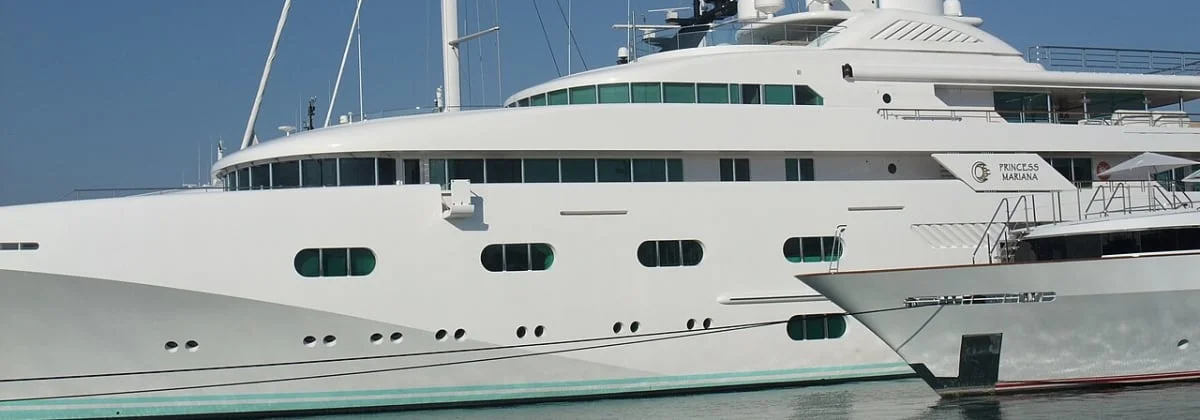
Quick answer: Mega yachts are typically 40-60m (130-200ft) luxury motor yachts with professional crew, multiple guest decks, full management, and annual running costs that commonly track 10-15% of vessel value. They sit above large production motor yachts and inside the broader superyacht world, but the practical buyer question is simple: can the yacht be staffed, berthed, insured, chartered, maintained, and resold without the ownership plan relying on optimistic assumptions?
What Is a Mega Yacht?
A mega yacht is best understood as a fully crewed luxury motor yacht in the 40-60m range, roughly 130-200ft. The label is not a legal class. It is a market shorthand used by brokers, owners, charter managers, shipyards, and insurers for yachts large enough to require professional operation but still compact enough to remain usable by private families, first-time superyacht owners, and charter-led buyers.
That distinction matters. A 28m yacht can be a superyacht by industry definition, because many markets use 24m as the entry point. But a 28m yacht may still feel like an enlarged private motor yacht: fewer crew, tighter guest separation, less complex engineering, simpler flag decisions, and more flexible berth options. A 50m mega yacht is different. It normally has captain, engineer, deck crew, interior crew, chef, safety management, planned maintenance schedules, class survey cycles, and a management company or experienced captain controlling the operating calendar.
For buyers comparing categories, a mega yacht should not be judged only by length. Beam, gross tonnage, crew accommodation, engineering access, tankage, range, class status, guest count, tender storage, beach club layout, and deck separation all change the ownership experience. Two yachts can both be 50m; one may be a heavy displacement yacht built for ocean range, while the other is a charter-friendly tri-deck optimized for Mediterranean weeks and marina presence.
| Category | Typical size | Practical meaning |
|---|---|---|
| Large motor yacht | 75-120 ft | Often owner-operated or captain plus small crew |
| Entry superyacht | 24-40m | Full crew likely, but still berth-flexible |
| Mega yacht | 40-60m | Full crew, management, charter potential, serious annual budget |
| Large custom superyacht | 60m+ | Custom operations, deeper crew bench, major shipyard lifecycle |
The term “mega yachts” is sometimes used loosely for any spectacular private yacht. For purchase planning, keep the narrower definition. A 40-60m yacht is the band where private enjoyment, charter economics, shipyard reputation, and operating discipline collide.
Mega Yacht vs Superyacht: The Useful Difference
Mega yacht and superyacht overlap, but they answer different questions. “Superyacht” describes the broad class. “Mega yacht” usually points to a more specific ownership profile: large enough to need a professional operating platform, small enough to be actively traded and chartered by private buyers.
Our superyacht buying guide covers the wider process: mandate, shortlist, broker selection, survey, legal structure, flag, financing, delivery, and management. This page is narrower. It focuses on the 40-60m segment where purchase price can look deceptively accessible compared with 70m+ custom yachts, while annual cost, crew complexity, and refit exposure can still surprise buyers.
| Question | Superyacht lens | Mega yacht lens |
|---|---|---|
| Size definition | Often 24m+ | Usually 40-60m |
| Buyer profile | Broad: first superyacht to ultra-custom | Private family, charter-minded owner, or step-up buyer |
| Main risk | Process complexity | Operating budget and refit timing |
| Market depth | Wide but uneven | Stronger liquidity in proven builders and layouts |
| Charter role | Optional by segment | Often part of the ownership model |
A buyer who says “I want a superyacht” may still be deciding between a 30m semi-custom yacht and an 80m new build. A buyer who says “I want a mega yacht” is usually already imagining full crew, guest suites, large toys, beach club, chef-led service, and the prestige of arriving in a major harbor without moving into the most extreme end of the market.
Who Should Consider a Mega Yacht?
Mega yachts suit buyers who want a private hospitality platform, not just transport. The best fit is usually an owner who plans enough use to justify fixed crew and berth costs, wants separation between family and crew, expects high service standards, and understands that charter income is not the same as yield guarantee.
Strong fit profiles include:
- Families using the yacht for six to twelve weeks per year across Mediterranean, Caribbean, or Bahamas seasons.
- Owners stepping up from 80-120ft motor yachts who need more crew, range, privacy, and toy storage.
- Charter-minded buyers who want a yacht with proven broker appeal, usable decks, strong cabin mix, and crew quarters that actually support service.
- Corporate or family office buyers who can run ownership through professional management and handle VAT, flag, insurance, payroll, and compliance without improvising.
- Long-range cruisers who want 4,000nm+ range, displacement hull comfort, and systems redundancy without moving into 70m+ custom territory.
Weak fit profiles include buyers who want occasional weekends, owners who dislike formal crew, buyers relying on charter revenue to make the purchase “pay for itself,” and anyone who has not budgeted for a heavy refit within the first ownership cycle. If your real use is two weeks per year, chartering may be smarter. Compare scenarios against superyacht charter costs before buying.
What Do Mega Yachts Cost to Buy?
Most used 40-60m mega yachts trade between roughly $12M and $80M, while new semi-custom builds start near $35M and premium custom projects pass $100M. Within those bands, price moves with builder tier, year, refit history, interior quality, gross tonnage, class status, engine hours, and charter reputation. Length matters, but it is not the whole market: a 43m Feadship with exceptional maintenance can command stronger buyer confidence than a newer, larger yacht from a weaker yard with thin documentation.
| Segment | Typical LOA | Used price range | New build range |
|---|---|---|---|
| Entry mega yacht | 40-45m | $12M-$30M | $35M-$55M |
| Core mega yacht | 45-55m | $20M-$60M | $50M-$90M |
| Upper mega yacht | 55-60m | $35M-$80M+ | $75M-$120M+ |
These are directional 2026 planning bands, not valuation guarantees. Asking prices can sit above market for months, and quiet off-market deals often reveal different reality than public listings. A buyer should ask three questions before reacting to any headline number:
- What is the refit clock? A yacht one season away from paint, teak, generators, bridge electronics, and class work is not cheaper just because the asking price is lower.
- What is the builder and documentation quality? Yards such as Benetti, Feadship, and Lurssen carry different resale confidence than obscure one-off builds.
- What is included? Tenders, toys, spares, AV systems, loose furniture, charter inventory, and crew handover support can materially affect the true acquisition cost.
The how to buy a superyacht guide walks through offer mechanics, deposit, memorandum of agreement, survey, sea trial, acceptance, and closing. In the mega yacht band, the offer is only the beginning. Your real negotiation leverage often appears after survey when class notes, maintenance backlog, and capex timing are quantified.
Annual Running Costs: The 10-15% Rule
The classic rule of thumb says a large yacht costs about 10% of its value per year to run. For mega yachts, a more realistic planning range is often 10-15% before major refit years. Some owners run leaner; some yachts run far higher. The difference usually comes from crew size, cruising itinerary, charter program, berth selection, fuel use, paint cycle, and how much deferred maintenance was inherited at purchase.
| Cost line | 45m private yacht | 55m charter-capable yacht |
|---|---|---|
| Crew salaries and benefits | $900,000-$1.6M | $1.4M-$2.4M |
| Management, accounting, compliance | $150,000-$350,000 | $250,000-$500,000 |
| Insurance | $180,000-$450,000 | $350,000-$800,000 |
| Berth and winter storage | $150,000-$500,000 | $300,000-$900,000 |
| Maintenance and class work | $900,000-$2M | $1.5M-$3.5M |
| Fuel, provisioning, owner trips | $300,000-$1M | $600,000-$1.8M |
For a $30M mega yacht, a $3M-$4.5M annual operating budget is not unusual. For a $60M yacht, $6M-$9M becomes a serious planning range, especially if the boat is chartered heavily, repositioned across oceans, or kept in prime Mediterranean berths.
Read the deeper superyacht running costs model before making an offer. The biggest mistake is not underestimating fuel. It is underestimating fixed cost. Crew, insurance, management, berth, inspections, parts, paint, and systems upkeep continue whether the owner spends twenty nights aboard or two.
Crew: The Operating Core of Mega Yacht Ownership
Crew quality determines whether a mega yacht feels effortless or exhausting. In the 40-60m range, manning depends on flag, charter status, itinerary, guest count, and systems complexity, but a typical vessel will carry a captain, chief officer or mate, chief engineer, deckhands, chief stewardess, interior crew, chef, and sometimes rotational engineers or seasonal deck crew.
| Yacht size | Typical crew count | Notes |
|---|---|---|
| 40-45m | 7-9 | Captain, engineer, chef, interior and deck team |
| 45-55m | 9-12 | Better guest service, more charter resilience |
| 55-60m | 12-16 | Rotations, specialist engineering, stronger hotel operation |
Do not judge crew needs from glossy listing photos. Ask how many crew berths exist, whether cabins are legal and practical, where laundry is handled, how stores are loaded, whether the galley can support charter service, and how engineer access works when guests are aboard. A yacht can look generous on deck but be operationally tight below.
Crew retention also has resale value. A well-run yacht with a stable captain, documented maintenance culture, and clean service history gives buyers confidence. A yacht that churns crew every season often develops hidden problems: inconsistent logbooks, reactive maintenance, poor guest service, and weak charter feedback.
Builders: Which Yards Matter in the 40-60m Band?
Builder reputation matters because mega yacht ownership is a lifecycle, not a one-time purchase. Crew know some yards better. Surveyors trust some engineering packages more. Insurers and lenders recognize certain names. Refit yards can source parts and drawings more easily when the original builder has a serious support network.
Benetti is one of the most visible names in the 40-60m mega yacht market, with strong semi-custom and custom experience. Buyers like Benetti for Italian styling, volume, charter familiarity, and a deep fleet. The Benetti guide is a useful starting point if you are comparing Mediterranean charter layouts.
Feadship carries exceptional prestige in the custom Dutch market. A well-kept Feadship in the 40-60m range can attract buyers who value engineering, provenance, and long-term refit support. See the Feadship guide if resale confidence and pedigree are major priorities.
Lurssen is better known for larger custom superyachts, but the brand carries immense recognition across the luxury yacht market. If a buyer is comparing German build quality, Northern European engineering, and top-tier custom credentials, the Lurssen profile belongs on the research list.
Other important names include Heesen, Amels, Sanlorenzo, Custom Line, Baglietto, Westport, Trinity, Oceanfast, and Palmer Johnson. The right yard depends on use case. A private family yacht for quiet cruising is not the same spec as a commercially active charter yacht built around outdoor decks, cabin flexibility, and broker-friendly guest flow.
Charter Income: Helpful Offset, Not a Guarantee
Charter can offset a meaningful share of annual running costs in a strong season, but it rarely turns a mega yacht into a predictable investment asset. A well-presented 40-60m yacht typically markets between about €150,000 and €500,000 per week plus expenses in the Mediterranean, yet a successful program depends on cabin layout, crew reputation, broker relationships, itinerary, calendar discipline, flag, VAT handling, insurance, condition, toys, marketing photography, and repeat guest feedback.
| Factor | Why it matters |
|---|---|
| Cabin mix | Five or six guest cabins increase charter appeal |
| Deck layout | Multiple outdoor zones photograph and sell well |
| Crew reputation | Repeat clients follow great captains and chefs |
| Toy inventory | Chase boat, slide, Seabobs, inflatables, diving support |
| Refit condition | Charter guests punish tired interiors in reviews |
| Itinerary | Western Med and Caribbean demand is deeper than niche routes |
The better question is not “Will it pay for itself?” It is “How much charter use can the owner tolerate without damaging private enjoyment and accelerating wear?” A yacht doing many charter weeks may generate meaningful gross revenue, but crew overtime, provisioning, broker commission, maintenance, laundry, consumables, repositioning, and refit wear reduce the net benefit.
For some owners, charter is worth it because the yacht remains active, crew stay sharp, and the annual budget is partially offset. For others, privacy and calendar control matter more. Model both cases before purchase, especially if the acquisition thesis depends on charter.
Shortlisting a 40-60m mega yacht?
Share your target LOA, budget, charter plan, and preferred cruising region. We sanity-check the shortlist before you spend survey money.
What to Inspect Before Buying a Used Mega Yacht
A used mega yacht survey should be more like commercial due diligence than a simple boat inspection. You need hull, machinery, class, flag, safety, hotel systems, AV/IT, tenders, toys, crew areas, interior condition, paint, teak, and documentation reviewed by specialists.
Start with the visible items, but do not stop there. Paint condition on a 50m yacht can represent seven figures of exposure. Teak deck replacement can be a major project. Generators, chillers, stabilizers, sewage systems, watermakers, bridge electronics, and fire systems all carry lifecycle cost. A yacht may present beautifully during a broker showing and still be entering an expensive maintenance window.
Prioritize these checks:
- Class and flag status, confirm current certificates, upcoming surveys, exemptions, and any outstanding conditions.
- Paint and fairing, inspect gloss, cracking, repairs, corrosion, and whether a full paint cycle is imminent.
- Teak and exterior decks, measure remaining life, seams, fasteners, soft spots, and drainage.
- Main engines and generators, review hours, oil analysis, rebuild history, vibration, cooling, and exhaust.
- Stabilizers and thrusters, service history, leaks, control systems, bearing condition, and spares.
- Hotel systems, air conditioning, refrigeration, laundry, watermakers, sewage treatment, galley, and storage.
- Crew spaces, berth count, ventilation, laundry flow, mess area, privacy, and safe working routes.
- Charter records; if marketed for charter, review booking history, guest feedback, maintenance after charters, and broker notes.
Treat survey findings as a negotiation map. Some defects are normal and can be priced. Others reveal a yacht that has been cosmetically maintained while critical systems aged beneath the surface.
Financing, Ownership Structure and Flag
Almost every 40-60m purchase involves corporate ownership, a deliberate flag decision, and a management agreement, more structure than smaller yacht deals, and that is normal rather than a warning sign. Buyers may also use leasing structures, VAT planning, and crew payroll systems. The right setup depends on citizenship, tax residence, cruising area, charter intention, finance, and whether the yacht will enter commercial registry.
Finance is available for some buyers and some yachts, but lenders care about builder, age, value, jurisdiction, survey quality, and borrower profile. A recognizable 50m from a strong yard with clean class records is easier to finance than a niche one-off build with uncertain resale market. Expect conservative loan-to-value, detailed insurance requirements, and tighter covenants than on smaller leisure boats.
Flag choice affects manning, safety rules, charter compliance, tax treatment, inspections, and where the yacht can operate commercially. Cayman Islands, Marshall Islands, Malta, Isle of Man, and other registries appear frequently in this market. Do not choose flag based on broker shorthand. Ask maritime counsel and management to model your actual use case.
Mega Yacht Ownership Timeline
The cleanest purchases begin before the first showing. The owner defines use case, budget, crew style, charter appetite, preferred region, and refit tolerance. Then the broker can filter listings with discipline instead of chasing every glamorous new arrival.
| Phase | What happens | Buyer risk |
|---|---|---|
| Mandate | Define size, budget, use, charter, region | Vague brief wastes months |
| Shortlist | Compare builders, layouts, records | Photos hide operating problems |
| Offer | Submit price, terms, deposit, survey scope | Weak terms reduce leverage |
| Survey | Sea trial, haul-out, systems review | Under-scoped survey misses capex |
| Acceptance | Renegotiate, accept, or reject | Emotion overrides findings |
| Closing | Flag, insurance, funds, delivery | Poor handover disrupts first season |
| First year | Crew, berth, maintenance plan | Deferred work becomes urgent |
For most buyers, the first year is the learning year. The yacht may need crew changes, AV fixes, tender updates, soft goods, itinerary changes, or a more realistic budget. Buying the right platform reduces that friction. Buying the wrong yacht turns every trip into project management.
What Serious Mega Yacht Buyers Ask
Fuel is rarely the deciding question at this size. Crew availability, refit slot access, insurance appetite, paint lead times and the quality of a charter calendar all matter more to whether a yacht is genuinely attractive.
Three points come up repeatedly. First, 40-45m yachts can be marketed as easier ownership, but they still need disciplined crew and management if the owner expects superyacht service. Second, charter history is useful only when paired with maintenance evidence; a busy charter yacht can be profitable on paper and tired in the engine room. Third, buyers are paying more attention to builder support and drawings because refit yards move faster when documentation is clean.
The conservative reading is the right one here: buy the yacht you can run comfortably without perfect charter income, choose a builder and layout with resale depth, and keep a first-year reserve separate from the purchase price. The “cheap” mega yacht is often the one that has already had paint, teak, class work, generator refresh, and major hotel systems addressed by the seller.
Red flags and survey checklist
Walk away or reprice aggressively if: (1) class society status is suspended or due survey overdue, (2) charter income claims lack audited statements, (3) main engine hours do not match logbooks and AIS track history, (4) seller refuses haul-out before deposit release, or (5) major hotel systems (AC, watermakers, stabilisers) have no service records for 24+ months.
Your survey checklist should include: tank coatings and sounding, generator load tests at guest-house load, tender garage hydraulics, fire suppression tags, crew accommodation compliance, and a full cosmetic scope for teak and paint, cosmetic deferral on 40m+ yachts often signals six-figure yard bills within 18 months.
Above 60 metres the field narrows to a handful of yards: Lürssen, Feadship and Benetti account for much of the delivered fleet.
Frequently Asked Questions
A mega yacht is usually a 40-60m luxury motor yacht with full crew, guest suites, professional management, and operating economics closer to a superyacht than to an ordinary motor yacht.
Used 40-60m mega yachts often trade from about $12M to $80M depending on builder, age, condition, refit history, and charter record. New premium builds can exceed $100M.
Plan around 10-15% of vessel value per year before major refit years. A $30M yacht may need $3M-$4.5M annually for crew, maintenance, management, berth, insurance, fuel, and owner trips.
Not always. Superyacht is the broader category, often starting at 24m. Mega yacht is a market term usually used for the 40-60m band inside the superyacht market.
Charter can offset operating costs, but it should not be treated as guaranteed profit. Seasonality, crew reputation, layout, flag, compliance, and refit condition drive performance.
Benetti, Feadship, Lurssen, Heesen, Amels, Sanlorenzo, Custom Line, Westport, Baglietto, and Trinity are common names in the 40-60m market. Yard reputation affects survey confidence and resale.
Request a yacht buyer consultation
Share your budget, target LOA, and use case. We reply within one business day with matched brokers or surveyors.