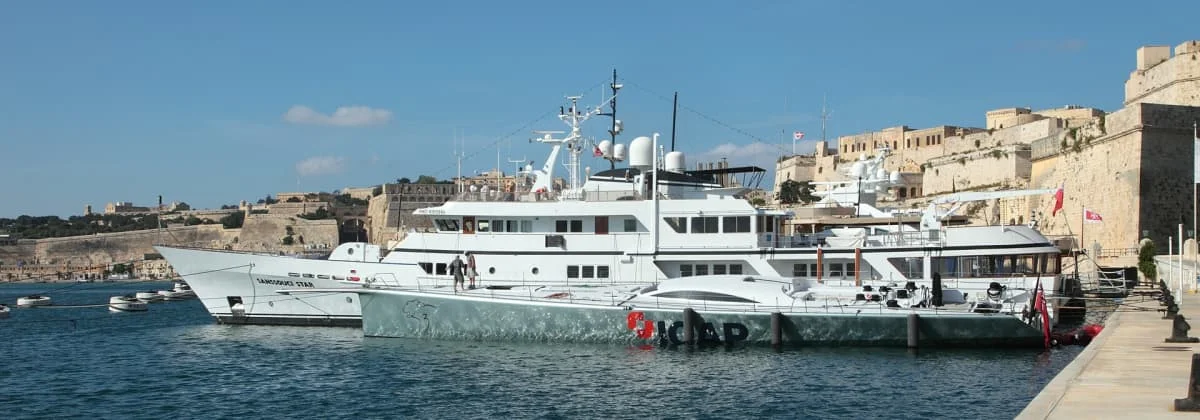
Quick answer: Malta (Transport Malta) is the leading EU open register for many superyachts, chosen for EU flag status, Med cruising infrastructure, and VAT structures counsel implements correctly (not flag magic). Indicative registry fees for 24-40m yachts often run $8K-$25K+ plus survey, legal, and possible import/VAT costs; timelines 6-16 weeks. Compare Cayman, Marshall Islands, and three-flag guide.
Disclaimer: Not legal or tax advice. Malta registration and EU VAT require qualified counsel in relevant jurisdictions.
Why Does Malta Dominate EU Superyacht Registration?
Malta is the largest EU yacht register and the default answer when a yacht needs an EU flag rather than an offshore one. Transport Malta combines EU status, a workable commercial code and a VAT lease route, with initial registration for 24-40m yachts running roughly $8K-$25K.
Malta attracts owners who need:
- EU flag for operational and banking preferences in Europe.
- Transport Malta administration with long superyacht experience.
- Med ecosystem, yards, managers, insurers in Mediterranean market.
- Documented VAT paths when import is executed properly; see yacht VAT EU guide.
Transport Malta Registration Basics
| Element | Buyer note |
|---|---|
| Private yacht | Pleasure use, still regulated |
| Commercial yacht | Charter, code + manning |
| VAT documentation | Separate from certificate of registry |
| Tonnage cert | Fee and compliance driver |
Use current Transport Malta fee schedule, below is planning only.
Malta yacht registration in one paragraph: Transport Malta operates the largest EU yacht register and is the standard choice where a vessel needs an EU flag rather than an offshore one. Initial registration runs roughly $4K-$8K under 24m, $6K-$12K at 24-30m, $8K-$18K at 30-40m and $12K-$25K above 40m or on the commercial track, with annual renewals of $3K-$10K. Provisional registration is commonly issued in 2-4 weeks and permanent registration in 6-10 weeks, extending to 12-16 weeks where a VAT file is assembled alongside. Malta’s practical advantage is not price but EU status: at 18%, Maltese VAT on a €2,000,000 yacht is €360,000 against €400,000 in France, €440,000 in Italy, €480,000 in Greece and €500,000 in Croatia. Figures are indicative 2026 planning bands and must be confirmed with counsel before the MOA.
What Does Malta Yacht Registration Cost?
Malta registry fees scale with tonnage and track, running about $4K-$8K initial under 24m and $12K-$25K above 40m or commercial, with renewals of $3K-$10K. First-year cost is typically two to three times the registry line once survey, incorporation and counsel are added.
| Band (typical) | Initial (indicative) | Renewal (indicative) |
|---|---|---|
| Under 24m | $3K-$10K | $1.5K-$5K |
| 24-30m private | $8K-$18K | $4K-$8K |
| 30-40m private | $12K-$25K | $6K-$12K |
| 40m+ commercial | $18K-$35K+ | $8K-$18K+ |
How Does the Malta VAT Route Actually Work?
Malta matters to buyers mainly because it is an EU flag that can be paired with a VAT treatment, not because its fees are low. A €2M yacht importing into Malta faces 18% VAT against 20-25% in France, Italy, Greece or Croatia, which is why the structure is designed before the MOA. Does not automatically:
- Prove EU VAT-paid status in all ports.
- Eliminate customs checks without paperwork.
- Replace owner tax obligations in home country.
May support when structured correctly:
- Documented import and VAT payment through qualified advisors.
- EU operational narrative banks and charter brokers expect.
- Med-centric cruising with compliant paperwork.
Deep dive: yacht VAT EU guide.
Who Can Register a Yacht in Malta?
Malta registration requires an EU or approved owning entity, proof of title, tonnage measurement, insurance in force and a radio licence. Transport Malta assesses the owner and the paperwork rather than the vessel alone, and a single missing document holds the certificate for weeks. Typical requirements:
- Malta or qualifying owning company: counsel-designed.
- Title and builder/deletion documentation.
- Survey and yacht code compliance where applicable.
- Insurance bind hull and P&I.
- VAT/import file if claiming EU-paid status.
How Long Does Malta Registration Take?
Malta issues provisional registration quickly and permanent registration on a longer clock. Clean files commonly run 6-10 weeks end to end, and 12-16 weeks where a VAT file is being built alongside. Provisional cover in 2-4 weeks is what usually allows delivery to proceed.
- Structure and tax planning sign-off.
- Entity incorporation and bank if needed.
- Survey and tonnage.
- Transport Malta application via agent.
- Certificate of Registry + radio licence.
- VAT/customs file completion if applicable.
Closing alignment: yacht closing process.
Private vs Commercial Malta Registration
Hidden charter use on private registration creates port-state and tax exposure.
Malta, Cayman or Marshall Islands: Which Flag Fits?
The choice splits on EU status rather than on cost. Malta is an EU flag and the only one of the three that supports an EU VAT position directly; Cayman and Marshall Islands are non-EU registers preferred by superyacht lenders above 40m. Fees across all three overlap at $8K-$25K.
| Factor | Malta | Cayman / Marshall |
|---|---|---|
| EU flag | Yes | No |
| VAT path discussion | Central | Not applicable same way |
| Registry fees | Often higher | Often lower headline |
| Med operations | Native ecosystem | Non-EU flag ops |
Compare: three-flag guide.
Structure Malta flag with counsel early
Share LOA, EU cruising plan, and charter intent, we connect brokers and advisors who close Malta programmes regularly.
Re-flagging to Malta
All-in re-flag + VAT project can exceed $50K-$200K+ depending on vessel value and status, model before MOA.
Documentation Checklist
| Document | Note |
|---|---|
| Title / bill of sale | Chain clean |
| Deletion cert | Prior flag |
| Tonnage & survey | Closed findings |
| Insurance | Bind active |
| Corporate docs | Resolutions |
| VAT/import evidence | If claimed |
| Mortgage consent | If financed |
What Mistakes Do Buyers Make With Malta Registration?
The recurring Malta failures are structural rather than administrative: the VAT position is assumed rather than documented, or commercial intent surfaces after private registration. Rebuilding either after the fact costs more than the $4K-$25K registry fee that prompted the choice.
- Assuming flag = VAT paid.
- Private reg + charter without commercial path.
- Late tax counsel after deposit paid.
- Incomplete import file at first EU port call.
- Choosing Malta without Med use case: cost may exceed benefit.
Where Malta Registrations Go Wrong
Two mistakes recur. The first is entering EU waters on a Malta flag with no VAT file behind it: an EU flag is not evidence of customs status, and the delay plus emergency counsel costs a multiple of what the file would have cost to assemble in advance. The second is choosing Malta for its standing without a Mediterranean cruising plan that needs an EU flag at all, those owners tend to re-flag within a couple of years and pay twice. The version that works starts tax and registry in parallel at MOA stage.
Worked Example
| Cost line | Indicative |
|---|---|
| Transport Malta initial | $12K |
| Survey and tonnage | $8K |
| Legal entity Malta | $5K |
| VAT/import (case-specific) | $0-$200K+ |
| Agent fees | $3K-$8K |
Should Malta Be Your Flag?
Malta fits when the yacht will spend real time in EU waters, the owner needs a documented VAT position, and charter is either planned or possible. It fits poorly when a US domestic mortgage drives the deal or when the vessel will never enter EU waters and pays for EU status it never uses.
- Will the yacht cruise EU waters more than 90 days per year?
- Does your structure require EU VAT-paid evidence for banks or buyers?
- Is commercial charter planned within twenty-four months?
- Does your insurer and lender prefer EU flag at your LOA?
- Is Malta entity substance already satisfied or budgeted?
Three or more yes answers, Malta belongs on shortlist with tax counsel. Zero or one, compare Marshall or Cayman before defaulting to Malta marketing.
Malta Registration Timeline with VAT File
| Phase | Duration | Notes |
|---|---|---|
| Tax structure memo | 2-4 weeks | Before entity |
| Entity + bank | 2-6 weeks | Parallel survey |
| Survey + tonnage | 2-4 weeks | Book early |
| Transport Malta application | 2-4 weeks | After survey |
| VAT/customs file | 4-12 weeks | Variable |
Malta Registration Document Pack (detailed)
Malta registration without parallel VAT advisor is the most expensive shortcut on the registry, certificate in hand with unpaid import narrative does not help at first EU port inspection. Budget counsel time in the same closing spreadsheet as Transport Malta agent fees. Transport Malta certificate is one document in a multi-document EU compliance folder, treat them as one project with one project manager on the owner side. Never schedule Med delivery party until counsel signs off on VAT file status, not registry certificate alone, port delays cost more than one extra legal hour.
Costs and timeline buyers should model
Malta’s registry fees are only one line. Counsel, survey, company administration, and any VAT or lease-scheme work usually dominate the budget. A straightforward private registration can move in weeks when documents are clean; commercial or VAT-linked files often take longer because survey class, manning, and tax evidence must align.
Put the flag decision before the Med season you care about. Owners who start the Malta file in May for a July charter season regularly lose the first charter window to incomplete class paperwork or late VAT evidence.
Common Malta registration mistakes
- Copying another yacht’s VAT lease or Temporary Admission story without matching residency and use
- Registering commercially without budgeting ISM/ISPS-style management where required
- Ignoring marina and charter licensing rules in the first cruising country
- Paying deposits before counsel confirms the owning entity can hold a Malta flag
- Treating an EU flag as proof that VAT is settled
Pros and cons of Malta yacht registration
| Upside | Trade-off |
|---|---|
| EU flag option with deep yacht counsel and management market | VAT and charter compliance still need their own workstream |
| Strong fit for Med-based private and commercial programmes | More moving parts than a simple Red Ensign pleasure filing |
| Useful when commercial coding and EU operations must coexist | Timelines stretch when class, manning, and tax evidence lag |
| Clear private vs commercial paths when designed early | Copy-paste structures from other yachts often fail diligence |
Who should shortlist Malta, and who should not
Shortlist Malta when the yacht will spend serious time in the EU, when commercial optionality matters, or when counsel has already mapped a Malta-compatible VAT path. Avoid Malta as a “default EU stamp” if Temporary Admission on another flag already fits, if the owner has no EU use case, or if the team cannot support commercial compliance.
Owners buying in Florida for later Med use should decide the flag before delivery routing is booked. Changing the plan after the yacht is already eastbound usually costs a season.
Practical checks before you pick Malta
Malta sits at the intersection of EU flag status, commercial yacht codes, and frequent VAT structuring conversations. That mix is useful, and it is also where buyers get burned when they copy another owner’s structure without matching use, residency, or charter plans.
Before you file:
- Separate flag choice from VAT strategy. An EU flag does not automatically solve VAT. Temporary Admission, VAT-paid status, and lease schemes each have different evidence packs.
- Confirm whether the yacht will be private, commercial, or dual-use across seasons. Malta commercial compliance is workable, but only if manning, survey, and management are budgeted.
- Ask your insurer and lender for written acceptance of Malta registration on this LOA and ownership entity. Do not assume a prior policy on another flag transfers cleanly.
Owners who cruise the Med for more than a tourist season should map marina checks, charter permissions, and crew certification before the first summer. Pair this page with the yacht VAT Europe guide and the private vs commercial registration comparison.
Owner scenarios: who flags Malta
Malta’s decisive advantage is that it is an EU flag with a mature commercial code, which settles most European charter decisions before fees are compared. The three situations below are where that advantage translates into real money. Owners cruising entirely outside the EU should weigh the premium carefully.
- The EU charter operator, Malta’s decisive case: an EU flag with a developed commercial code, opening EU charter without the workarounds non-EU flags require.
- The owner pairing the flag with Malta’s VAT machinery, where registration, leasing structures, and VAT-paid status administration live in one jurisdiction with one professional network.
- The financed buyer, since Maltese mortgage registration is well-tested in EU banking and lenders treat it as home ground.
Purely private owners cruising outside the EU get less from Malta’s premium; the Cayman comparison below prices the difference honestly.
Frequently Asked Questions
Transport Malta registration fees depend on gross tonnage and vessel category. Indicative initial registration for many 24-40m yachts often runs approximately $8,000-$25,000 in registry and related fees before survey and legal costs, potentially higher than some non-EU open registers. Annual renewal is tonnage-dependent. Confirm current Transport Malta tariffs before closing.
Malta is the primary EU open-register choice for many superyacht owners seeking EU flag status, established administration, and pathways discussed for EU VAT-paid documentation when import is handled correctly. Malta suits Med-centric cruising and owners whose counsel structures EU compliance through Malta, not automatic tax savings without professional advice.
No, flag alone does not prove VAT-paid status. EU VAT compliance depends on import procedure, documentation, and use. Malta is often used in structures where legitimate VAT payment or qualifying status is documented, verify with qualified EU maritime tax counsel, not registration marketing.
Straightforward registrations with complete documentation often take 6-10 weeks. VAT and import coordination, re-flag, or survey findings can extend to 12-16 weeks. Start entity, survey, and tax planning before delivery.
Depends on tax residency, EU cruising, charter plans, and bank requirements. Malta is the EU flag path; Cayman is a leading non-EU open register. Compare in the three-flag guide and confirm with counsel, neither is universally superior.
Yes, Malta has established commercial yacht registration and code compliance paths for charter programmes operating in EU and international waters. Commercial registration triggers additional manning, safety, and tax obligations, structure before delivery.
Request a yacht buyer consultation
Share your budget, target LOA, and use case. We reply within one business day with matched brokers or surveyors.